Ancient Engineering · Baalbek, Beqaa Valley, Lebanon

Baalbek & the Trilithon

Home of the largest cut stones on Earth — three 800-tonne blocks in a wall, and a 1,650-tonne monster still in the quarry.

Mainstream: 1st century BC – 3rd century AD (Roman; podium and Trilithon mid-1st century AD)Alternative: Pre-Roman — proposals range from Phoenician times back to c. 10,000 BC for the megalithic podium34.01°, 36.20°

At a glance

Baalbek & the Trilithon
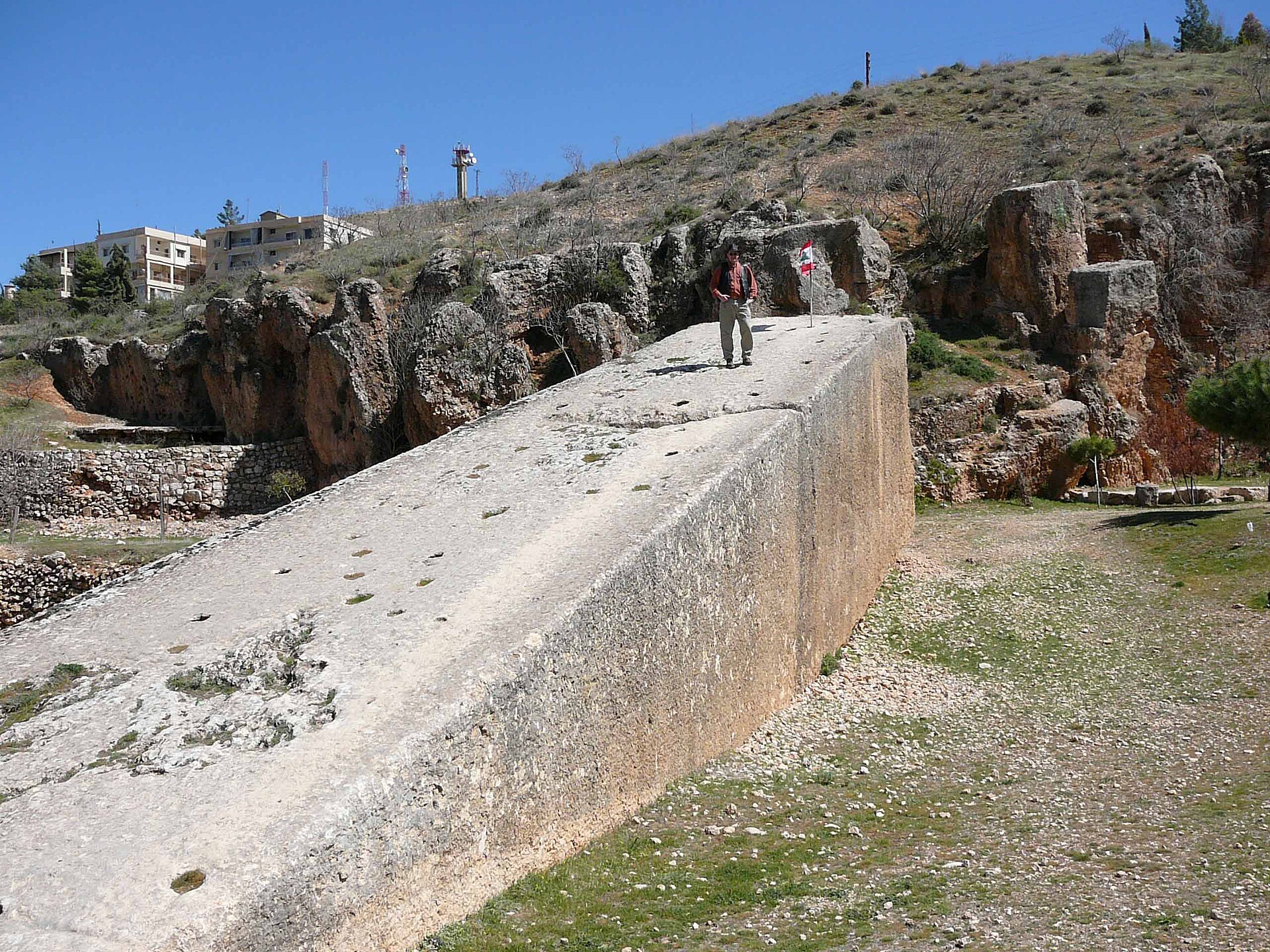
Photo: Ralph Ellis · CC BY-SA 4.0

Baalbek, Roman Heliopolis, sits in Lebanon's fertile Beqaa Valley and contains some of the most colossal sacred architecture ever attempted. The Temple of Jupiter Heliopolitanus rose on a podium incorporating the famous Trilithon — three limestone blocks each roughly 19 metres long and weighing around 800 tonnes, set in a wall course some six metres above the base. In the quarry less than a kilometre away lie even larger abandoned monoliths: the Stone of the Pregnant Woman (about 1,000 tonnes), the Stone of the South (about 1,242 tonnes) and the 'Forgotten Stone' identified in 2014 at roughly 1,650 tonnes — the largest known dressed stone block from antiquity. No other ancient culture, including the Egyptians, routinely handled stones of this scale.

See it on the globe →
The mainstream view

What archaeology says

Classical archaeologists attribute the entire sanctuary, podium included, to Roman engineering. Construction of the Jupiter temple began under Augustus and continued in phases for over two centuries, with the great courtyard and propylaea added through the reigns of Nero, Trajan and beyond. Architectural studies by Daniel Lohmann of the German Archaeological Institute traced a coherent Roman construction sequence: the Trilithon course belongs to a Julio-Claudian enlargement of the podium, bonded into the Roman design, sitting atop a foundation course of smaller (though still enormous) blocks, and left visibly unfinished when the megalithic outer casing project was abandoned mid-build. The blocks carry Roman-style tooling and drafting identical to that on the quarry stones.

The logistics, while extreme, are considered within Roman capability. The quarry lies about 800–900 metres away and slightly uphill of the temple, so the blocks could be moved on rollers or sledges down a gentle gradient without lifting. Jean-Pierre Adam's 1977 engineering study calculated that a few hundred men using capstans, rollers and prepared trackways could shift an 800-tonne block — slow, expensive, but feasible. The abandoned quarry stones are read as evidence of ambition outrunning practicality: the Romans cut blocks even they could not economically move, and simply left them.

Excavation of Tell Baalbek beneath the courtyard shows settlement reaching back to the Pre-Pottery Neolithic around 8000 BC, but nothing suggesting monumental pre-Roman megalithic construction — the earlier layers are villages and a modest Bronze and Iron Age sanctuary.

Key evidence cited
  • Daniel Lohmann's architectural analysis showing the Trilithon course bonded into the Julio-Claudian podium design
  • Identical Roman tooling and drafting margins on the Trilithon and the abandoned quarry monoliths
  • The quarry sits slightly uphill only 800–900 metres away, allowing transport without lifting
  • Jean-Pierre Adam's engineering study showing capstans and rollers could move 800-tonne blocks
  • Tell Baalbek excavations show only villages and a modest sanctuary before the Roman era
The alternative view

What the skeptics propose

Alternative researchers argue the megalithic podium is far older than the temple standing on it. Graham Hancock, visiting in 2014, proposed that the Trilithon and its supporting courses were built by a lost civilisation of the last Ice Age — potentially contemporary with Gobekli Tepe, 12,000 years ago — and that the Romans, finding a hugely ancient sacred platform, built their grandest temple on top of it. He points out that the Trilithon blocks dwarf anything the Romans are documented moving elsewhere (the heaviest recorded Roman lift, the Lateran obelisk, is around 455 tonnes), that no Roman text celebrates what would have been the engineering triumph of the age, and asks why practical Roman builders would place 800-tonne blocks six metres up a wall when smaller stones would serve.

Earlier writers went further. Zecharia Sitchin claimed Baalbek was a landing platform of the Anunnaki, and the late Alan Alford argued the podium's scale pointed to pre-Flood high technology. Local Lebanese tradition, recorded for centuries, ascribes the stones to giants or to Cain — folklore that alternative authors read as a memory of pre-Roman origins.

Mainstream archaeologists respond that the podium is demonstrably integrated with the Roman construction sequence — the Trilithon rests on courses that bond into dated Roman work, and the quarry blocks bear the same Roman tool marks — and that the absence of a surviving text is unremarkable given how little Roman technical literature survives at all. Hancock himself concedes the case is circumstantial; sceptics of his position note that half-finished blocks still attached to bedrock in the quarry look exactly like an abandoned Roman worksite, not a 12,000-year-old one.

Key evidence cited
  • The Trilithon blocks far exceed the heaviest documented Roman lift (the c. 455-tonne Lateran obelisk)
  • No surviving Roman text records moving the largest stones ever handled in antiquity
  • Hancock's argument that the megalithic courses look like a distinct, earlier construction phase
  • Placement of 800-tonne blocks six metres above ground level seems needlessly difficult
  • Long-standing local traditions attributing the stones to giants or pre-Flood builders

Genuinely open questions

  1. Why did the Romans choose blocks of such extreme size for the podium when smaller courses would have served structurally?
  2. How exactly would the Trilithon blocks have been finally positioned and fitted so tightly at height?
  3. Why was the megalithic casing project abandoned, leaving the largest stones ever cut sitting in the quarry?

Worth knowing

The 'Forgotten Stone', identified by German archaeologists in 2014 beneath the Stone of the Pregnant Woman, weighs an estimated 1,650 tonnes — as much as four fully loaded jumbo jets — and is still partly attached to the quarry bedrock.