What archaeology says
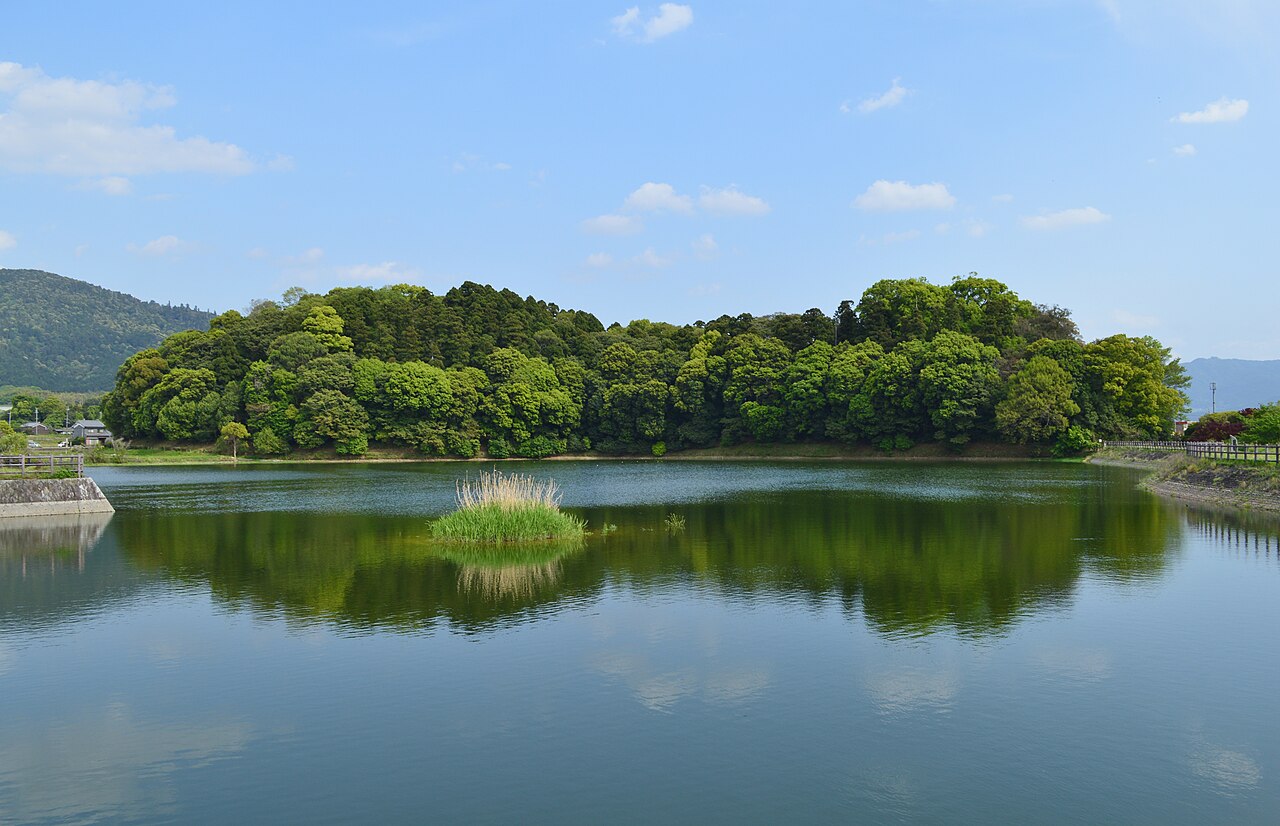
The controversy crystallised in 1910, when historian Naito Konan argued for the Kinai (Yamato) location while Shiratori Kurakichi championed northern Kyushu — a debate so durable it is often called the oldest controversy in Japanese archaeology. Today most, though not all, academic archaeologists favour the Kinai theory, and its centrepiece is the Hashihaka Kofun at Sakurai in Nara Prefecture: a 280-metre keyhole-shaped tomb, the first of the giant kofun, which radiocarbon work published by the National Museum of Japanese History in 2009 dated to roughly AD 240-260 — strikingly close to Himiko's recorded death around 248.
Supporting the Kinai case is the nearby Makimuku site, a large planned settlement of the early 3rd century with pottery drawn from across Japan, suggesting exactly the kind of supra-regional centre the Wei Zhi describes. The wide distribution of triangular-rimmed bronze mirrors with Wei-era inscriptions, radiating from the Kinai, is read by many as the trace of Himiko's hundred mirrors being redistributed to allied chiefs.
The Imperial Household Agency, however, designates Hashihaka as the tomb of a legendary princess, Yamato Totohi Momoso, and restricts excavation of it as an imperial mausoleum — so the one dig that might settle Japan's greatest historical argument is forbidden. Mainstream scholars on both sides agree on what Yamatai was: a real, historically documented paramount chiefdom marking Japan's transition from scattered Yayoi communities to a unified state; the dispute is purely over where.
- The Wei Zhi (c. AD 297) is a near-contemporary documentary source recording Himiko's embassies to Wei in 238-247, with titles and gifts specified.
- Radiocarbon dating published in 2009 places the Hashihaka Kofun's construction around AD 240-260, matching Himiko's death date of c. 248.
- The Makimuku site near Hashihaka shows a planned 3rd-century centre with pottery from many regions of Japan — evidence of a supra-regional polity in the Kinai.
- Triangular-rimmed bronze mirrors bearing Wei reign dates cluster in distributions radiating from the Kinai region.
- The name Yamatai is most naturally read as an early transcription of Yamato, the historic heartland of the Japanese state.
- Both major camps rest on the same accepted documentary and archaeological record; the disagreement is interpretive, not evidential.