Ancient Engineering · Yanqing District, Beijing, China

Guyaju Cave Dwellings

China's largest cave-dwelling complex — 350 rooms chiselled into a granite gorge — and not one line of history says who made it or why.

Mainstream: c. AD 618–960 (most scholars favour the late Tang or Five Dynasties period)Alternative: c. 202 BC – AD 220 (Han-dynasty garrison theory) — or the work of a people who left no record at all40.47°, 115.77°

At a glance

Guyaju Cave Dwellings
Photo: pfctdayelise · CC BY-SA 2.5

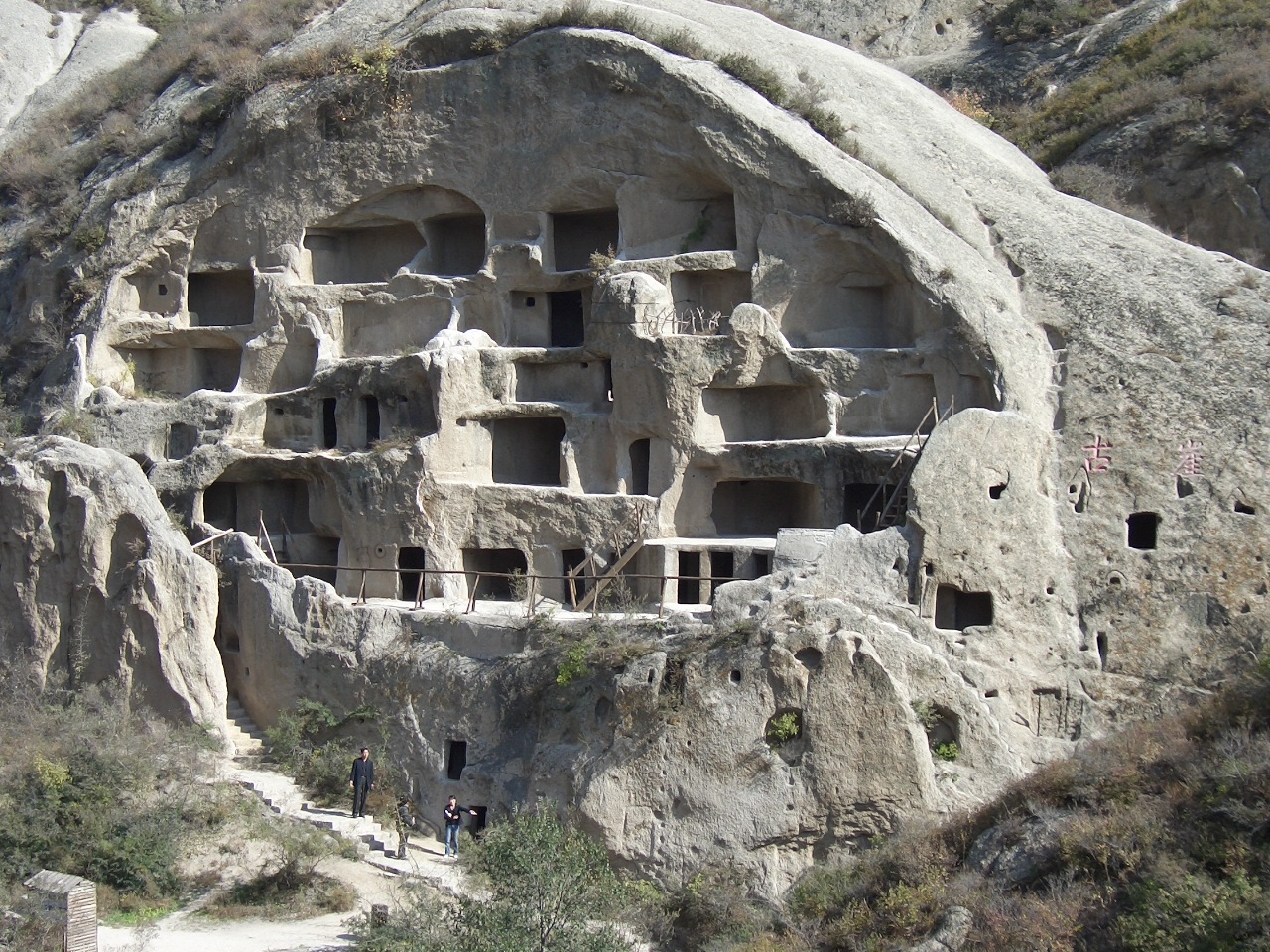
Hidden in a secluded gorge in the Jundu Mountains, about 90 kilometres northwest of central Beijing, the Guyaju ('ancient cliff dwellings') complex comprises well over a hundred rock-cut dwellings containing more than 350 individual rooms, honeycombed across two cliff faces over roughly 1.5 square kilometres. Rooms are rectangular and carefully finished, with carved doorways, windows, lampstands, flues, storage niches and — most strikingly — kang sleeping platforms with integrated stove flues, all cut from the living granite. One elevated multi-roomed suite with stone columns is nicknamed the 'Chieftain's Palace'. It is the largest cave-dwelling site known in China, and it is a genuine historical blank. No dynastic history, local gazetteer or inscription mentions it. The site was only formally identified in 1984, during a cultural relics survey by the Yanqing County administration, and opened to visitors in 1991. In 2013 it was listed as a Major Historical and Cultural Site Protected at the National Level. Estimates suggest the complex required chiselling out several thousand cubic metres of hard granite — a task demanding organisation, iron tools and years of labour. Yet excavation has recovered no datable organic material, no frescoes, no pottery assemblage of consequence and no texts. Everything about who dug Guyaju, when, and why they abandoned it must be argued from the architecture alone.

See it on the globe →
The mainstream view

What archaeology says

The position most often cited by Chinese archaeologists and heritage authorities is that Guyaju was cut in the late Tang dynasty or the Five Dynasties period (roughly the ninth to tenth centuries AD) by the Kumo Xi, a nomadic people related to the Khitan — the 'Xiyi' or Western Xi branch of whom are recorded fleeing into the Jundu Mountains around Yanqing after military defeats in the early tenth century. The theory fits the geography (a defensible, hidden gorge on the steppe frontier), the period's chronic insecurity, and the one thin documentary thread available: Liao-era records placing displaced Xi groups in exactly this region. The kang bed-stoves suit a population wintering in place, and the rooms' domestic fittings indicate genuine long-term habitation rather than temporary refuge.

A rival scholarly camp argues for an official Tang project — a fortified granary or garrison station — noting that cutting hundreds of orderly rooms in granite implies iron tools in quantity, disciplined labour and central financing beyond a refugee band's means. Others push the origin back to the Han dynasty, reading the site as a military outpost linked to beacon-tower defence lines against the Xiongnu; proponents point to the site's sightlines and to Han garrison practice in frontier commanderies.

Crucially, mainstream researchers are candid that none of these theories is proven. The Yanqing survey teams found no organics for radiocarbon dating and no diagnostic artefacts, so the date bracket of 'roughly 1,000 to 2,000 years old' rests on tool marks, architectural typology and regional history. Guyaju is that rare thing in Chinese archaeology: a major site the sources simply never noticed.

Key evidence cited
  • Liao-era records placing displaced Xi (Kumo Xi) groups in the Yanqing mountains in the early tenth century
  • Kang bed-stoves with flues, lampstands and storage niches indicating organised long-term habitation
  • Tool marks consistent with iron chisels, pointing to the Iron Age or later
  • The defensible hidden-gorge setting matching frontier insecurity of the Tang–Five Dynasties era
  • Architectural order and uniformity suggesting planned, centrally organised excavation
The alternative view

What the skeptics propose

Because the documentary record is empty, Guyaju attracts speculation well beyond the academic theories — and here the alternative and mainstream debates blur into one another, since even the 'orthodox' Kumo Xi attribution is an inference. Popular writers and heritage bloggers emphasise how strange the silence is: imperial China documented frontier works obsessively, so a project of this scale escaping every record suggests either a deliberately hidden community — outlaws, refugees or a persecuted sect — or a date early enough that records were lost. Some draw comparisons with other enigmatic rock-cut complexes in China, such as the Longyou Caves, as evidence that large-scale unrecorded excavation has happened more than once.

The steelman of the sceptical case runs on logistics. Granite is far harder than the sandstones and loess in which Chinese cave dwellings are normally cut. Producing 350 finished rooms with squared corners, fitted flues and load-bearing columns would demand enormous quantities of iron chisels and constant resharpening — hence, sceptics of the refugee theory argue, either a state actor (favouring the Han garrison or Tang granary readings) or a longer, earlier occupation than the tenth-century window allows. The absence of smoke-blackening in some 'kitchen' features, and of the rubbish middens a real village generates, has also been used to argue the site was never fully occupied — perhaps abandoned soon after completion.

The honest rebuttal to the more romantic claims is that nothing at Guyaju requires anything exotic: iron tools, granite and patience are a sufficient explanation, and undated does not mean ancient. But unlike most sites in this catalogue, here the mystery is not manufactured — professional archaeology genuinely cannot yet say who dug Guyaju.

Key evidence cited
  • Total absence of the site from dynastic histories and local gazetteers despite its scale
  • The enormous iron-tool and labour cost of cutting 350 rooms in granite, argued to exceed a refugee band's means
  • Sightlines and frontier position cited for a Han-dynasty garrison or beacon-station origin
  • Claimed scarcity of occupation debris and soot, suggesting brief use or abandonment after completion
  • No organic material or diagnostic artefacts recovered, leaving the true date unconstrained

Genuinely open questions

  1. Who actually cut Guyaju — Kumo Xi refugees, a Tang or Han state project, or someone else entirely?
  2. Why does a complex of this scale appear in no historical record whatsoever?
  3. Why was the site abandoned, and where did its population go?

Worth knowing

Many Guyaju rooms contain kang bed-stoves — the heated sleeping platforms still used across northern China — except that here the 'furniture' is carved from solid granite, plumbing included, making them possibly the oldest built-in beds in the Beijing region.