Ancient Engineering · Moche, Trujillo, Peru

Huaca del Sol & Huaca de la Luna

The largest adobe building of the ancient Americas — until the Spanish rerouted a river to mine it for gold.

Mainstream: c. AD 100-800 (Moche culture)Alternative: Date broadly accepted; contested are the huacas' function, the sacrifices, and what the lost two-thirds held-8.13°, -78.99°

At a glance

Huaca del Sol & Huaca de la Luna
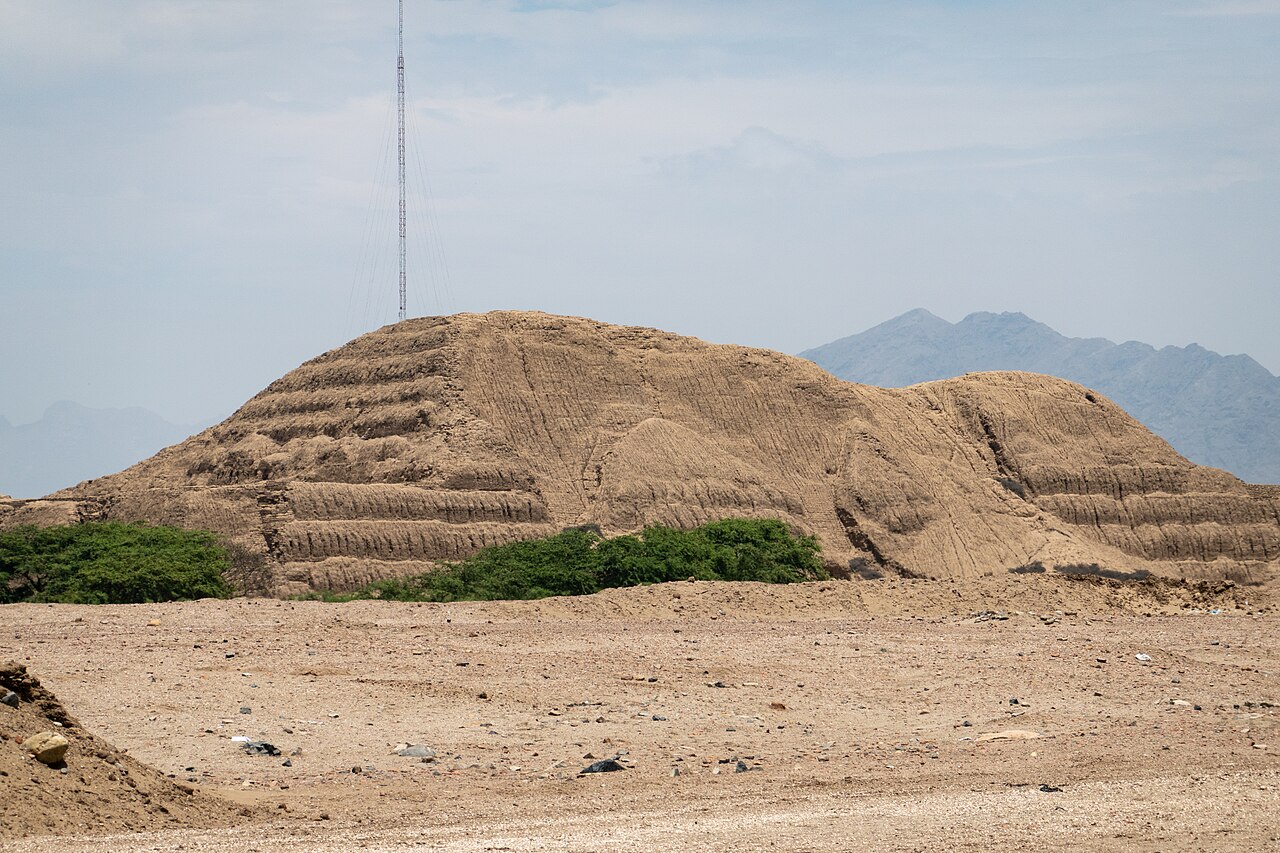
Photo: PsamatheM · CC BY-SA 4.0

On the plain between Cerro Blanco and the Moche River near Trujillo stand the twin huacas of the Moche capital: Huaca del Sol, a cross-shaped adobe platform mound originally about 340 by 160 metres at its base and some 50 metres tall, built from well over 130 million mould-made bricks; and Huaca de la Luna, a smaller temple complex against the mountain whose interior walls preserve vivid polychrome murals. Between them lay a dense urban zone. Together they formed the capital of the Moche civilisation, which flourished on Peru's north coast from roughly AD 100 to 800 — centuries before the Incas.

See it on the globe →
The mainstream view

What archaeology says

Excavation — above all the Huaca de la Luna project directed from 1991 by Santiago Uceda and Ricardo Morales of the National University of Trujillo — has transformed understanding of the Moche capital. Huaca del Sol was built in at least eight stages, largely complete by about AD 450, and the hundreds of distinct maker's marks pressed into its bricks are read as tallies from over a hundred communities contributing labour tax, a system prefiguring the Inca mit'a. It is generally interpreted as the administrative and elite-residential pole of the city, with Huaca de la Luna as its ceremonial counterpart.

Huaca de la Luna's murals depict the fanged deity nicknamed Ai Apaec, the Decapitator, and excavations by Steve Bourget in the 1990s uncovered the remains of some seventy sacrificed men — many bearing healed combat injuries — deposited in episodes linked to El Niño rains. Combined with iconography of ritual combat and prisoner sacrifice on Moche pottery, this gave archaeology one of its clearest cases of ideology, weather and violence entwined.

The mound's ruin is largely colonial. In the early seventeenth century Spanish entrepreneurs diverted the Moche River against the base of Huaca del Sol to wash it away and expose tombs — hydraulic mining for grave gold — destroying perhaps two-thirds of the structure. What survives, about 41 metres high, is a fraction of one of the greatest buildings of the pre-Columbian world, and it has never been systematically excavated.

Key evidence cited
  • Over 100 distinct maker's marks on adobes indicating organised community labour contributions
  • Eight construction stages at Huaca del Sol, substantially complete by c. AD 450
  • Uceda and Morales's excavations revealing superimposed painted temples at Huaca de la Luna
  • Skeletons of about 70 sacrificed warriors with healed combat injuries (Bourget, 1990s)
  • Continuity of adobe platform architecture on the Peruvian coast from Caral onward
  • Colonial records of the Moche River diversion explaining the mound's destruction
The alternative view

What the skeptics propose

The huacas of Moche attract less exotic speculation than Giza, but genuine controversies run deep. The oldest is diffusionist: from nineteenth-century writers to Thor Heyerdahl, some have asked whether stepped pyramid-building on Peru's coast and in Egypt or Mesopotamia could share a remote common source. Mainstream archaeology answers that adobe platform mounds evolved locally over millennia — Peru's earliest monumental mounds at Caral predate the Moche by 2,500 years — and most alternative writers now concede the point, shifting their interest to why pyramid forms recur worldwide.

Livelier disputes concern interpretation. Bourget's reading of the Huaca de la Luna sacrifices as El Niño crisis rituals has been debated by colleagues such as John Verano, who emphasises ritualised combat among warriors; others question how literally the Decapitator iconography maps onto practice. The interpretation of Huaca del Sol as palace-and-administration rests on limited excavation — the building is essentially unexplored — so claims about its function remain, as critics note, largely inference from its shape and from Huaca de la Luna's contrast.

Finally there is the matter of what was lost. Colonial documents record the 1602-era river diversion and the gold it yielded, and some researchers argue the destroyed two-thirds of Huaca del Sol contained royal tombs comparable to Sipán's — meaning the richest chapter of Moche archaeology may have been washed into the Pacific, or may in part still await excavation in the surviving mass.

Key evidence cited
  • Huaca del Sol has never been systematically excavated, leaving its function unproven
  • Two-thirds of the structure destroyed, potentially including elite tombs like Sipán's
  • Scholarly disagreement (Bourget vs Verano) over the meaning of the sacrifices
  • Recurrence of stepped-pyramid forms worldwide, the classic diffusionist puzzle
  • Colonial gold recoveries hinting at rich burials once inside the mound

Genuinely open questions

  1. What lies unexcavated inside the surviving third of Huaca del Sol?
  2. Were the Huaca de la Luna sacrifices driven by El Niño crises, warfare, or calendrical ritual?
  3. How many people lived in the urban zone between the huacas at its height?
  4. What caused the decline of the Moche capital around AD 600-800 — climate, upheaval, or both?

Worth knowing

Colonial-era Spaniards literally rerouted a river to hydraulically mine Huaca del Sol for treasure — one of history's most destructive acts of looting.