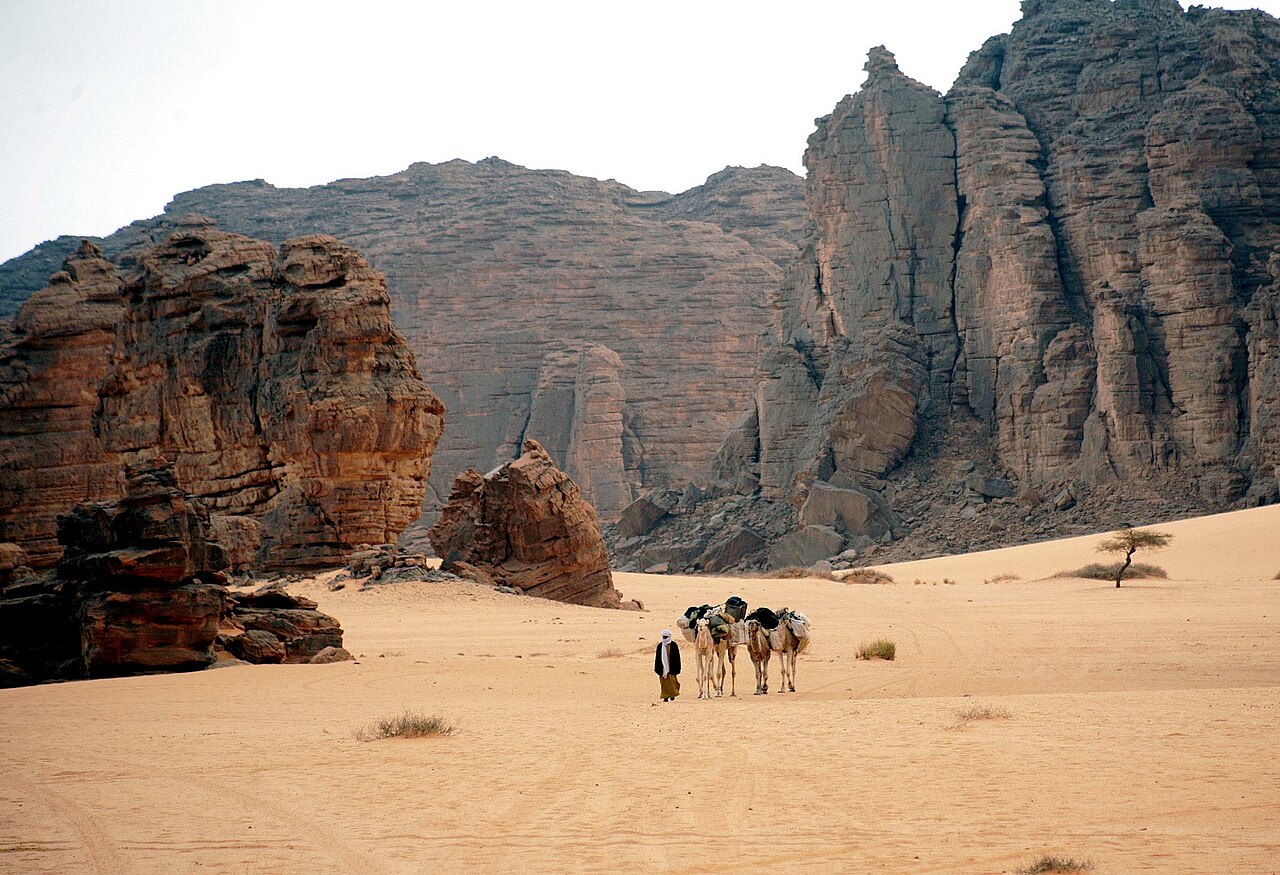
Belief & Society · Tassili n'Ajjer plateau, near Djanet, south-eastern Algeria

Tassili n'Ajjer

The Saharan plateau where a six-metre 'Great Martian God' launched a thousand ancient-astronaut books

Mainstream: c. 10,000 BC to 1st millennium AD; Round Head figures c. 7000-5000 BCAlternative: Round Head period, read as a record of non-human visitors during the Green Sahara25.50°, 9.00°

At a glance

Tassili n'Ajjer
Photo: Magharebia · CC BY 2.0

Tassili n'Ajjer is a vast sandstone plateau in the Algerian Sahara holding one of the richest bodies of rock art on Earth, with an estimated 15,000 or more paintings and engravings. Brought to world attention by French ethnographer Henri Lhote, whose 1958 book The Search for the Tassili Frescoes described months of copying the paintings, the site records a Sahara that was once green, with rivers, cattle herds, giraffes and swimmers. Its most famous images belong to the so-called Round Head period: huge, featureless figures with bulbous heads, one of which Lhote jokingly nicknamed the Great Martian God. That nickname took on a life of its own when Erich von Däniken reproduced the figures in Chariots of the Gods? as possible portraits of spacesuited visitors. UNESCO inscribed the plateau as a World Heritage Site in 1982.

See it on the globe →
The mainstream view

What archaeology says

Mainstream archaeology reads Tassili n'Ajjer as a long visual archive of the African Humid Period, when the Sahara was a savannah dotted with lakes between roughly 12,000 and 5,000 years ago. Researchers divide the art into broad phases: an early hunter phase featuring wild fauna, the Round Head paintings of monumental human figures, a long pastoral phase dominated by cattle, and later horse and camel periods that track the region's desiccation. The sequence matches independent climate records from lake sediments and pollen cores, which is why the art is treated as evidence for the Green Sahara rather than as a mystery in need of exotic explanation.

The Round Head figures, for all their strangeness, sit comfortably within human ritual art. Specialists such as Jean-Loïc Le Quellec, a leading French authority on Saharan rock art, note that the bulbous heads, body paint, masks and horned attributes closely resemble masking and body-decoration traditions documented ethnographically in the Sahel and West Africa. Lhote himself was explicit that his Martian label was a joke, and he spent years arguing against the extraterrestrial reading that grew from it. Some of Lhote's team's copies were later shown to be embellished or, in a few cases, outright fabrications by copyists, a scandal that mainstream scholars themselves exposed.

Dating remains genuinely difficult because paint on sandstone rarely preserves datable carbon, so the chronology leans on style, superimposition, weathering and associated archaeology. Most specialists place the Round Heads between about 9,500 and 7,000 years ago, though some argue for older or younger ranges. That honest uncertainty concerns centuries and millennia, not the identity of the painters, whom archaeology consistently identifies as African hunter-gatherers and early pastoralists.

Key evidence cited
  • The art's subject matter (hippos, crocodiles, cattle herds, swimmers) matches independent palaeoclimate evidence for a Green Sahara between c. 12,000 and 5,000 years ago
  • Round Head imagery parallels documented African masking and body-paint traditions, as argued in detail by Jean-Loïc Le Quellec
  • Henri Lhote publicly rejected the extraterrestrial reading and explained the Martian nickname as a joke among his team
  • Several sensational 'copies' from Lhote's expeditions were exposed as embellished or faked by copyists, undercutting images the alien literature relied on
  • Archaeological deposits on the plateau contain ordinary tools, pottery and grinding equipment of Holocene hunter-gatherers and pastoralists
  • Stylistic sequences and superimpositions show gradual, human artistic evolution over millennia rather than a single anomalous episode
The alternative view

What the skeptics propose

The alternative reading begins with Erich von Däniken, who in Chariots of the Gods? (1968) presented the Great Martian God of Jabbaren and other Round Head figures as depictions of beings in pressure suits and helmets. In his account, the rounded, featureless heads are visors, the body outlines are suits, and the figures' enormous scale reflects the awe of humans recording visitors from the sky. Later ancient-astronaut writers and television series have kept the Tassili figures in steady rotation, pairing them with hollow-eyed figures from Utah and haloed figures from Australia as evidence of a worldwide pattern of contact imagery.

A related alternative current focuses not on aliens but on altered states. Ethnobotanists and psychedelic researchers, most prominently Terence McKenna in Food of the Gods (1992), pointed to a Tassili painting of a masked figure sprouting what they read as mushrooms from its body, arguing the Round Head art records an ancient psilocybin cult and even that such mushroom use shaped human cognition. Mainstream specialists reply that the mushroom identification is far from secure on the faded originals, but the image remains iconic in psychedelic literature.

It is worth noting that the Tuareg people of the region, in whose homeland the plateau lies, have their own long relationship with the sites, treating parts of the landscape as inhabited by spirits and ancestors. Neither the spacesuit reading nor the laboratory-style archaeological reading captures that living dimension, and Saharan specialists increasingly argue that local knowledge deserves a seat at the interpretive table alongside both camps.

Key evidence cited
  • The Jabbaren Great Martian God stands roughly six metres tall with a featureless rounded head, a scale and anonymity von Däniken argued suits a suited visitor
  • Multiple Round Head figures appear to float, lack facial features, and wear apparent one-piece outlines read by proponents as suits
  • The famous 'mushroom shaman' figure is cited by Terence McKenna and others as evidence of an ancient psychedelic cult encoded in the art
  • Proponents note the mainstream chronology for the Round Heads is admitted to be uncertain by centuries or millennia
  • The worldwide recurrence of bulbous-headed, haloed or goggle-eyed figures is presented as a cross-cultural pattern too consistent for coincidence

Genuinely open questions

  1. When exactly were the Round Head paintings made, and over how long a span?
  2. What did the Round Head figures mean to their painters — gods, masked dancers, spirits, or something else entirely?
  3. Does the 'mushroom figure' really depict fungi, and was psychoactive plant use part of Round Head ritual life?
  4. How much of the published Tassili corpus was distorted by mid-century copyists, and can modern imaging recover the originals?

Worth knowing

Henri Lhote's own team coined the name 'Great Martian God' as a joke about the figure's helmet-like head — a throwaway quip that von Däniken later treated almost as a field identification.