What archaeology says
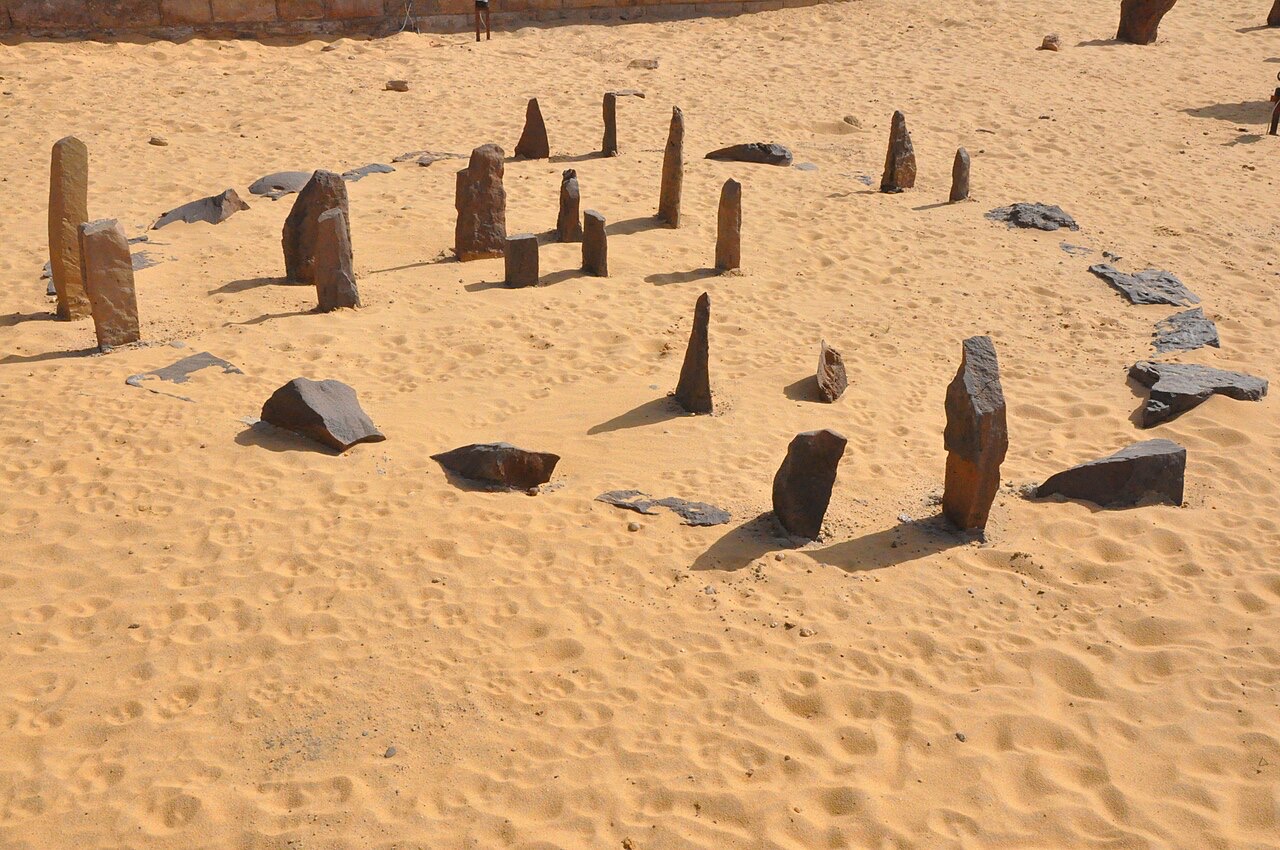
Fred Wendorf, Romuald Schild and archaeoastronomer J. McKim Malville interpret Nabta Playa as a ceremonial centre used by Neolithic pastoralists between roughly 7500 and 3400 BC. The small calendar circle contains two sight-line pairs: one aligned close to north-south, the other pointing towards sunrise at the summer solstice — the moment that heralded the life-giving monsoon rains. Malville's team also identified longer megalithic alignments radiating from a central cluster, plausibly directed at the bright stars Arcturus, Sirius and stars of Orion as they rose in the sixth and fifth millennia BC.
The excavators see the site as evidence of surprising social complexity among early Saharan herders: cattle burials under stone tumuli, deep wells, hut arrangements and sculpted bedrock beneath one mound all point to a regional gathering place with ritual significance. Malville has called it the earliest known astronomically aligned monument in the world, but he grounds that claim firmly in radiocarbon-dated Neolithic occupation layers.
When the monsoon belt shifted south around 3400 BC the region dried out and the herders dispersed — many scholars suspect towards the Nile Valley, where their cattle cults and sky-watching traditions may have fed into pre-dynastic Egyptian religion. The circle itself was relocated to the Nubian Museum in Aswan for protection.
- Radiocarbon dates from hearths, settlements and the megalith-bearing sediments cluster between c. 7500 and 3400 BC, with the calendar circle placed around the fifth millennium BC
- The circle's sight-lines fit a north-south axis and summer solstice sunrise — exactly the event that mattered to monsoon-dependent herders
- Cattle burials, deep walk-in wells and arranged village plans show a complex pastoral society capable of communal construction
- Malville's surveys match the longer megalith lines to rising positions of Sirius, Arcturus and Orion's stars at epochs consistent with the radiocarbon dates
- The drying of the Sahara around 3400 BC coincides with rising social complexity in the pre-dynastic Nile Valley, supporting a migration link