Ancient Engineering · Begrawiya, Sudan

Nubian Pyramids of Meroë

Sudan has roughly twice as many pyramids as Egypt — and most people have never heard of them.

Mainstream: c. 300 BC – AD 350 (Meroitic period; Nubian pyramid-building from c. 700 BC)Alternative: Dates undisputed — debate centres on how much Kushite civilisation owed to Egypt versus indigenous African roots16.94°, 33.75°

At a glance

Nubian Pyramids of Meroë
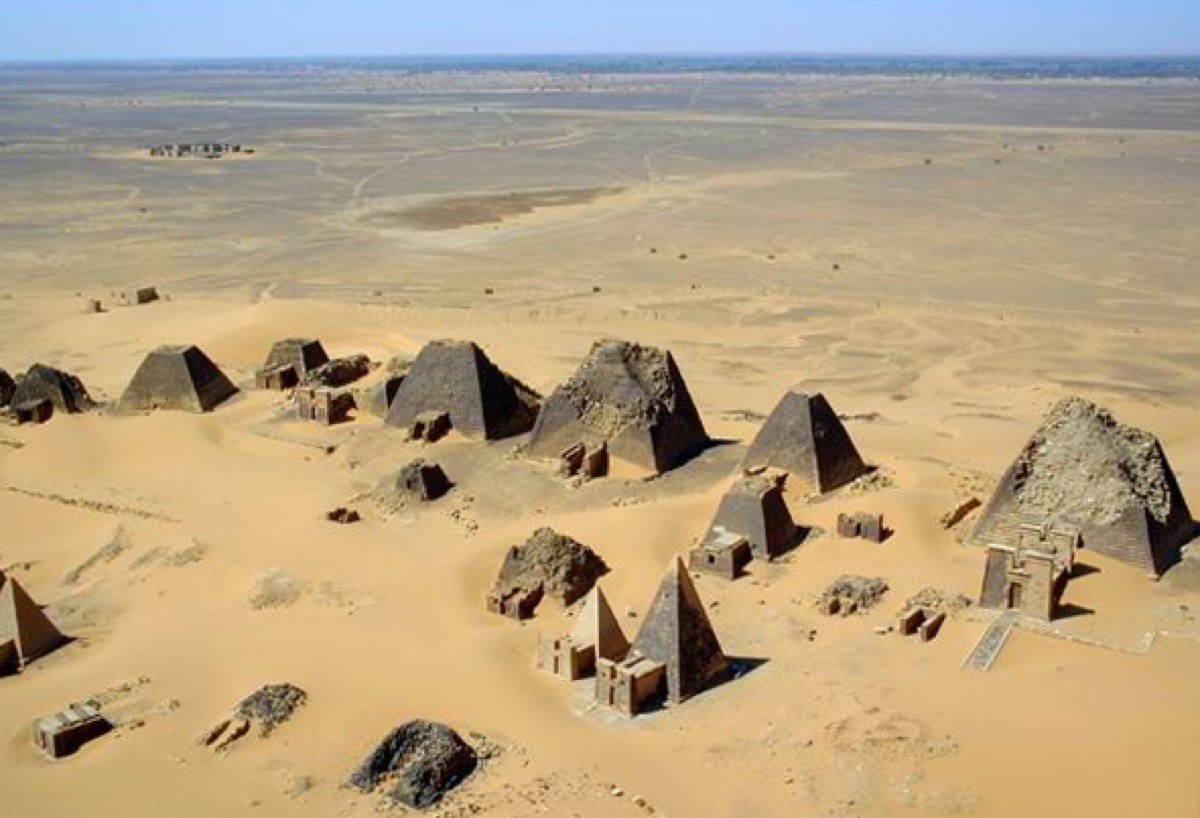
Photo: Photographer: B N Chagny · CC BY-SA 1.0

At Meroë, on the east bank of the Nile about 200 km northeast of Khartoum, more than 200 steep-sided sandstone pyramids mark the royal cemeteries of the Kingdom of Kush. Smaller and sharper-angled than Egyptian pyramids — typically 6 to 30 metres tall with slopes around 70 degrees — they were built over some six centuries for Kushite kings, queens and nobles, each fronted by an offering chapel. Together with earlier royal cemeteries at El-Kurru and Nuri, they give Sudan more pyramids than Egypt, and the site has been a UNESCO World Heritage Site since 2011.

See it on the globe →
The mainstream view

What archaeology says

Archaeologists and historians place the Meroë pyramids firmly within the Kingdom of Kush, whose rulers — after conquering and ruling Egypt itself as the 25th 'Black Pharaoh' Dynasty in the 8th–7th centuries BC — adopted and adapted pyramid burial. The sequence is well documented: royal burials moved from El-Kurru and Nuri (where the pyramid of Taharqa still stands) south to Meroë around 300 BC, and building continued until the kingdom's decline around AD 350, roughly when the Ethiopian kingdom of Aksum raided the city. Dating rests on inscriptions naming known rulers (including powerful ruling queens, the Kandakes), imported datable goods from Ptolemaic Egypt and Rome, radiocarbon evidence and stratigraphy.

The pyramids' burial chambers lie beneath, not inside, the monuments, reached by stairways — a key architectural difference from Old Kingdom Egypt. Meroë itself was a major iron-working centre, dubbed by some archaeologists 'the Birmingham of ancient Africa', with slag heaps and furnaces attesting industrial-scale production. The Meroitic language, written in its own alphabetic script from around 300 BC, can be read phonetically but remains largely untranslated — one of the last undeciphered scripts of the ancient world.

Scholars emphasise Kush was not a copy of Egypt but a distinct African civilisation that selectively borrowed and transformed Egyptian forms, worshipping its own gods (like the lion-god Apedemak) alongside Egyptian ones.

Key evidence cited
  • Inscriptions naming known Kushite kings and queens in chapels and chambers
  • A continuous, excavated royal cemetery sequence from El-Kurru and Nuri to Meroë
  • Datable Ptolemaic and Roman imports in tombs
  • Kushite rule of Egypt as the 25th Dynasty, documented in Egyptian and Assyrian records
  • Iron-smelting slag heaps and furnaces dating Meroë's industrial economy
The alternative view

What the skeptics propose

Meroë attracts less 'lost civilisation' theorising than Giza, and the alternative debates here are mostly about cultural priority and neglect. Some Afrocentric writers, following the tradition of Senegalese scholar Cheikh Anta Diop, argue that mainstream scholarship long minimised Nubia's role — treating Kush as derivative when, they contend, the Nile Valley's civilising current flowed from south to north, with Nubia (and sites like Qustul, where excavator Bruce Williams suggested pre-dynastic royal iconography might precede Egypt's) as a wellspring of pharaonic culture. Mainstream Egyptology accepts deep interconnection and acknowledges historical racial bias in early scholarship (George Reisner notoriously misattributed Kushite achievements), but holds that Egyptian kingship iconography developed first in Egypt, and that Nubian pyramids clearly postdate Egyptian ones by nearly two millennia.

A smaller fringe strand folds Meroë into global 'ancient mysteries' narratives — pointing to the steep angles, the undeciphered Meroitic script, and alleged alignments as hints of hidden knowledge. These claims name few specific researchers and have little traction even in alternative circles.

Where critics of the mainstream have a widely conceded point is neglect and damage: the site was devastated in 1834 by Italian treasure hunter Giuseppe Ferlini, who smashed the tops off dozens of pyramids and did find a queen's gold cache (Amanishakheto's jewellery, now in Berlin and Munich), and Sudanese archaeology remains underfunded and threatened — most recently by the civil war that began in 2023.

Key evidence cited
  • Diop's and successors' arguments for a south-to-north flow of Nile Valley civilisation
  • Bruce Williams's Qustul incense burner as possible pre-Egyptian royal iconography
  • The still-untranslated Meroitic script leaving Kushite history partly unread
  • Documented early-20th-century scholarly bias (e.g. Reisner) against African attribution
  • Claimed astronomical alignments of pyramid fields (largely untested)

Genuinely open questions

  1. What does the Meroitic language actually say — and to which language family does it belong?
  2. How did the Qustul and pre-dynastic Nubian evidence relate to the rise of Egyptian kingship?
  3. Why did Kushite royals revive pyramid burial nearly 800 years after Egypt abandoned it?

Worth knowing

In 1834 treasure hunter Giuseppe Ferlini blew the tops off dozens of Meroë pyramids and struck gold on one of his first tries — Queen Amanishakheto's jewellery hoard — ensuring the mutilation of a royal cemetery for a single lucky find.