Ancient Technology · Found in tombs of the Cauca valley region, Colombia; best examples in the Museo del Oro, Bogota

Quimbaya 'Aeroplanes'

Thumb-sized gold figures from Colombia that look, to some eyes, like fighter jets

Mainstream: c. AD 500-1000 (Quimbaya-Tolima goldwork traditions)Alternative: Same age, but claimed to depict working aircraft4.60°, -74.07°

At a glance

Quimbaya 'Aeroplanes'
Photo: Walters Art Museum · Public domain

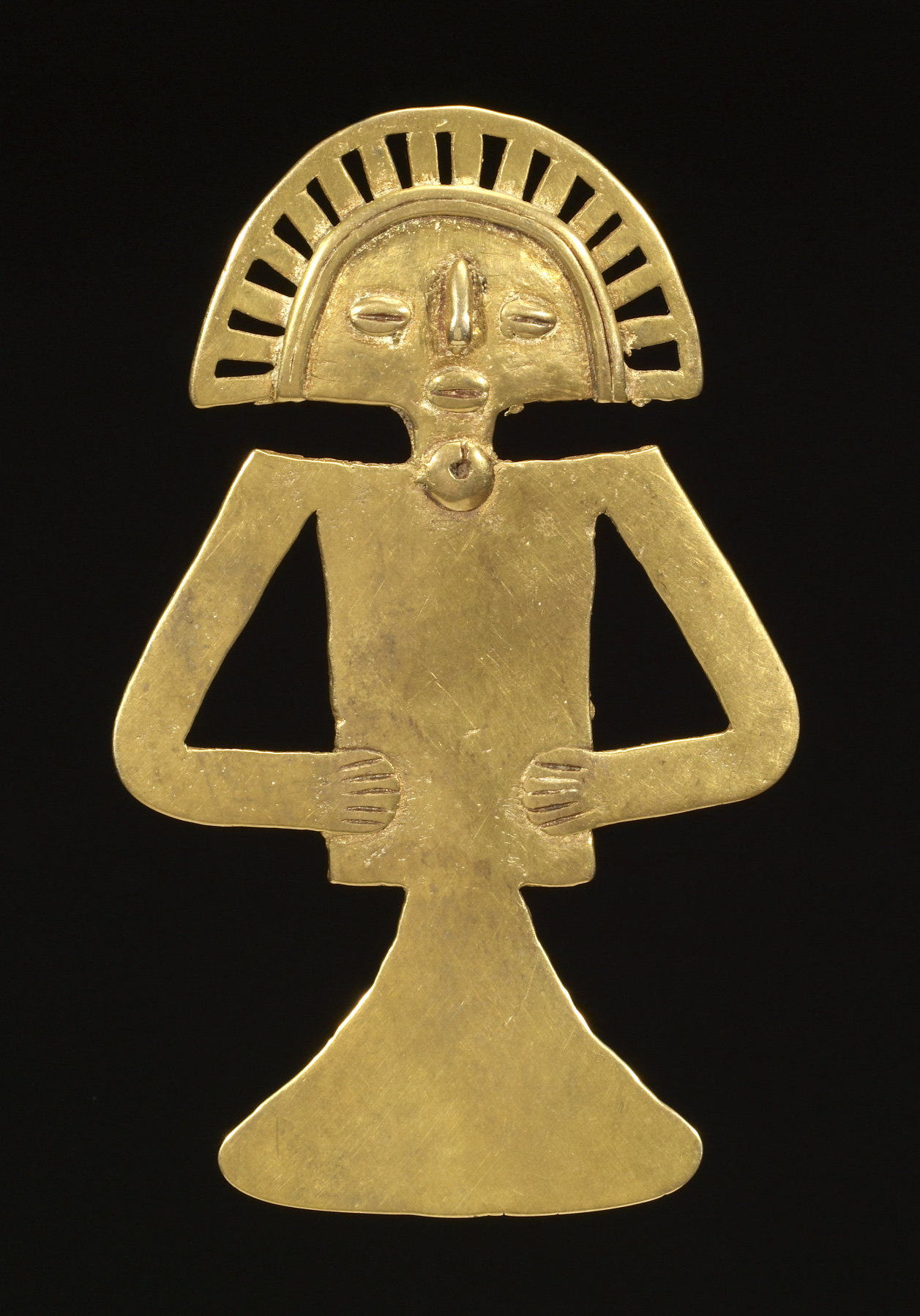
Among the thousands of gold votive pieces recovered from pre-Columbian tombs in Colombia's Cauca valley are a few dozen small pendants, five to seven centimetres long, with swept 'wings' set at the rear of the body, upright 'tail fins' and 'stabilisers'. Attributed broadly to the Quimbaya and neighbouring Tolima goldworking traditions of roughly AD 500-1000, most were cast by the lost-wax method in tumbaga, a gold-copper alloy. Museum labels call them zoomorphic pendants — stylised birds, fish and insects. The ancient-astronaut literature calls them model aeroplanes, and in 1994 two German aeromodellers famously built scaled-up versions that flew.

See it on the globe →
The mainstream view

What archaeology says

Archaeologists and the Museo del Oro in Bogota, whose researchers such as goldwork specialist Maria Alicia Uribe Villegas have catalogued the corpus in depth, interpret the pendants within a rich and well-understood tradition of animal representation. The 'aeroplanes' sit on a continuum with hundreds of unambiguous birds, flying fish, moths, bats, frogs and lizards from the same workshops: eyes, beaks, teeth and spiral nose-ornaments appear on many of the 'aircraft', and features read as cockpits and fins match crests, tails and fins of real Colombian fauna, including the flying fish Exocoetus and catfish with barbels.

The pendants were personal ornaments and grave offerings in a shamanic culture where flight — the transformation of the shaman into a bird — was a central religious idea, which is why winged imagery saturates the goldwork. Stylisation, symmetry and exaggeration are hallmarks of the craft, not engineering drawings.

Mainstream commentators add that the 1994 flying-model experiments prove nothing about intent: with enough motor power and modern trim, many compact shapes can be made to fly, and the models' builders had to choose thrust, materials and centre of gravity themselves — none of which is encoded in the pendants.

Key evidence cited
  • The pendants belong to a continuous series with unmistakable birds, fish, insects and bats from the same workshops and tombs
  • Many 'aeroplanes' carry eyes, teeth, beaks and nose-ornament spirals — biological and cultural features, not mechanical ones
  • Flying fish and armoured catfish native to the region share the 'wings-aft, upright tail' configuration cited as unbiological
  • Shamanic bird-flight symbolism pervades Quimbaya and Tolima goldwork, explaining the emphasis on winged forms
  • Lost-wax casting in tumbaga is thoroughly documented craft technology, with no trace of aeronautical materials or tooling
  • No airstrips, fuels, large mechanical parts or depictions of humans flying machines occur anywhere in the archaeology of Colombia
The alternative view

What the skeptics propose

The aircraft interpretation goes back to the 1960s-70s ancient-astronaut wave: the zoologist and Fortean writer Ivan T. Sanderson published an analysis arguing one Tolima pendant was mechanistically 'unbiological' — wings low and aft, tail fin vertical, features no known animal combines — and aeronautical engineer Arthur Poyslee at the Aeronautical Institute of New York was cited in support. Erich von Daeniken adopted the pendants, and they became a staple of the genre.

The claim's most famous moment came in 1994, when German aeromodellers Peter Belting and Conrad Luebbers built radio-controlled models scaled up about sixteen to one, with propeller and later jet-style propulsion, keeping the pendant's aerodynamic surfaces. The models flew stably and performed take-offs and landings, a result showcased by the Ancient Astronaut Society and endlessly replayed on the Ancient Aliens television series as evidence that the goldsmiths were copying something that actually flew.

Current status: the flight experiments are real and repeatable, but even sympathetic commentators concede they demonstrate only that the shapes can be made airworthy, not that pre-Columbian Colombia had aviation. No landing strips, workshops, large-scale wreckage or textual traditions of flight have been found, and the claim survives mainly in television and online media rather than in any research programme.

Key evidence cited
  • Ivan T. Sanderson argued in the late 1960s that the Tolima pendant's wing and tail placement matches aircraft, not any animal
  • The 1994 Belting-Luebbers scale models flew stably with only propulsion and landing gear added, preserving the ancient geometry
  • Delta wings and vertical stabilisers are engineering solutions, advocates argue, that art rarely stumbles on by accident
  • A handful of the pendants lack clear eyes or mouths, weakening the zoomorphic reading for those specific pieces
  • Supporters note the models flew even in glide tests, suggesting genuinely sound aerodynamic proportions
  • The pendants featured in Ancient Alien Society congress demonstrations, keeping the claim under continuing public examination

Genuinely open questions

  1. Which creatures, if any, do the most 'mechanical' half-dozen pendants actually depict — the museum corpus still lacks firm species matches for some
  2. How much did Belting and Luebbers' choices of scale, trim and power contribute to flight compared with the original geometry?
  3. Why did the wings-aft configuration recur across Quimbaya and Tolima workshops separated by considerable distances?
  4. Could residue or wear studies reveal how these particular pendants were worn or used in ritual?

Worth knowing

The best-known 'aeroplane' pendants are not technically Quimbaya at all — several derive from the neighbouring Tolima style, but the catchier name stuck in the popular literature.