Ancient Engineering · Cappadocia, Turkey

Derinkuyu Underground City

An 18-storey city carved 85 metres straight down, big enough to hide 20,000 people — and no one knows exactly when digging began.

Mainstream: Possibly begun c. 8th–7th century BC (Phrygian); vastly expanded c. AD 600–1100Alternative: c. 12,000+ years ago — a refuge dug during the Younger Dryas cataclysm38.37°, 34.73°

At a glance

Derinkuyu Underground City
Photo: Wikimedia Commons

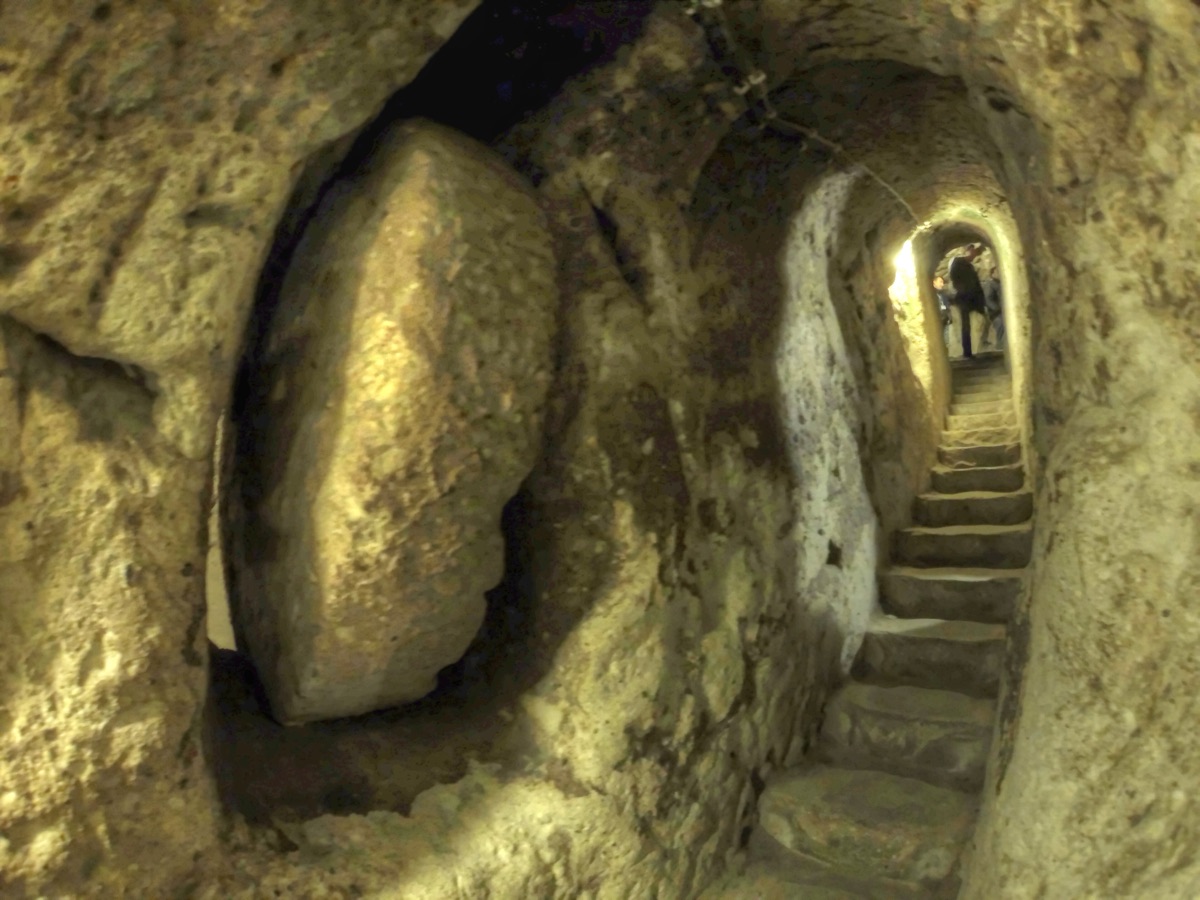
Derinkuyu is the deepest of Cappadocia's several hundred known underground settlements, a multi-level warren cut into soft volcanic tuff reaching roughly 85 metres below the town of the same name. Its 18 or so levels include living quarters, kitchens with soot-blackened ceilings, stables, wineries, wells, a school and a chapel, all ventilated by thousands of shafts and sealable from inside by massive rolling stone doors weighing up to half a tonne. Estimates suggest it could shelter up to 20,000 people plus livestock. Forgotten for generations, it was rediscovered in 1963 when a local resident knocked through a wall of his house during renovations and found a passage.

See it on the globe →
The mainstream view

What archaeology says

Because Derinkuyu is carved from living rock, it cannot be directly dated — a point everyone concedes. Mainstream historians therefore date it by texts, artefacts and architectural context. The oldest written hint is Xenophon's Anabasis (c. 370 BC), which describes Anatolian villagers living in excavated underground houses with their livestock. Many scholars attribute the earliest phases to the Phrygians, accomplished Iron Age rock-cutters active in the region from around the 8th century BC; others suggest Hittite-era beginnings or later Persian-period work.

What is not seriously disputed is that the complex reached its vast present form under Byzantine Christians, roughly the 7th to 12th centuries AD, when Cappadocia's population repeatedly hid from Arab raids during the Arab–Byzantine wars, and later from Turkic incursions. The chapels, Greek inscriptions and overwhelmingly Byzantine-to-medieval artefacts found inside reflect this era. Cappadocian Greeks still used the tunnels as refuges as late as the 20th century, before the 1923 population exchange emptied the region of its Greek-speaking community — after which Derinkuyu was forgotten until 1963.

Mainstream archaeologists note that the absence of any Palaeolithic or Epipalaeolithic material anywhere in the complex, or in the region's underground cities generally, argues strongly against a deep-prehistoric origin: thousands of years of occupation always leaves datable rubbish, and Derinkuyu's rubbish is Iron Age and later.

Key evidence cited
  • All datable artefacts and inscriptions inside are Iron Age or later, overwhelmingly Byzantine and medieval
  • Xenophon (c. 370 BC) describes underground dwellings in Anatolia, matching an Iron Age origin
  • Chapels, crosses and Greek graffiti tie the major expansion to Byzantine Christians hiding from Arab raids
  • Documented use as a refuge continued into the 20th century by Cappadocian Greeks
  • No Palaeolithic or Neolithic material has ever been found in any Cappadocian underground city
The alternative view

What the skeptics propose

Graham Hancock featured Derinkuyu in 'Ancient Apocalypse', arguing that such an extreme, costly refuge makes little sense as protection against ordinary human raiders — attackers could simply besiege the exits — but makes 'perfect sense', in his view, as shelter from something falling from the sky: the airbursts, firestorms and sudden deep cold he attributes to the Younger Dryas comet impacts around 10,800 BC. He and others note that since carved tuff cannot be dated, the conventional chronology is an assumption stacked on the latest occupants' debris, and the original excavation could be arbitrarily older.

Supporters of this view point to the sheer engineering sophistication — self-sealing stone doors operable only from inside, ventilation reaching the deepest levels, internal wells not exposed to surface poisoning — as evidence of planning for prolonged, total concealment rather than brief raids. Some writers, including Andrew Collins, have connected Cappadocia's underground world to the Zoroastrian myth of Yima, commanded by the god Ahura Mazda to build an underground refuge to survive a devastating world winter — read literally as a memory of the Younger Dryas.

Sceptics reply that historically documented raids were precisely the kind of short, violent events these refuges handle well, that the doors and wells are standard siege logic, and that the myth of Yima is undatable literature. They also note Hancock offers no artefacts from the alleged 12,000-year-old phase. Both sides agree, however, that no one can currently prove when the first chamber was cut — the honest answer to Derinkuyu's origin is 'unknown'.

Key evidence cited
  • Rock-cut architecture cannot be radiocarbon dated, so the original excavation date is genuinely unknowable from the stone itself
  • The scale and depth (18 levels, capacity ~20,000) seem disproportionate to defence against ordinary raiders (Hancock)
  • Inside-only rolling stone doors, deep wells and long-duration life support suggest planning for extended concealment
  • The Zoroastrian myth of Yima's underground 'vara' built against a world-destroying winter is read as a memory of the Younger Dryas

Genuinely open questions

  1. When was the first level actually cut, and by whom — Phrygians, Hittites, or someone earlier?
  2. How many underground cities remain undiscovered in Cappadocia, and are more of them interconnected?
  3. How did excavators manage ventilation, spoil removal and structural planning at such depth with simple tools?

Worth knowing

Derinkuyu lay completely forgotten until 1963, when a homeowner renovating his basement knocked down a wall and found a mysterious room — then a tunnel — then an 18-storey city.