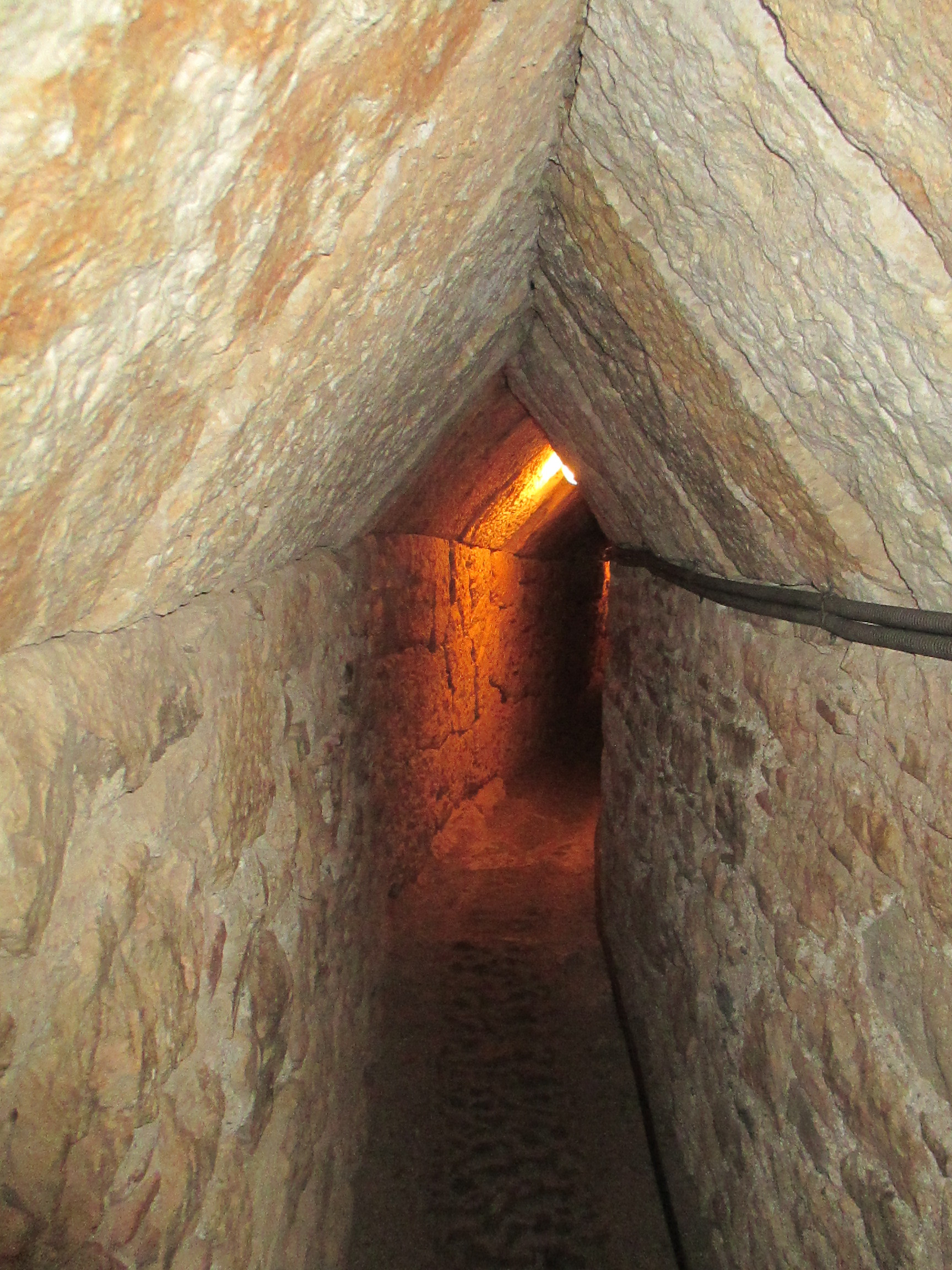
What archaeology says
Kienast's geodetic survey, published as the definitive monograph in 1995, effectively reverse-engineered Eupalinos' method from the tunnel itself. Eupalinos first established a straight 'mountain line' over the summit — probably staked out with ranging poles and levelled with simple instruments like the chorobates — fixing the two portals on the same line and the same contour. Each crew then dug inward along its bearing. Painted red survey marks and a reference line named for the letter 'kappa' survive on the walls, recording his running measurements in Samian feet.
The subtleties are what impress engineers. Knowing that two nominally straight headings might still slide past each other, Eupalinos deliberately bent both tunnels into a dog-leg near the expected meeting zone, converting a possible parallel miss into a guaranteed crossing — a piece of error-management reasoning centuries ahead of its formal mathematics. Vertically, he held both headings to the same level so precisely that the floors met with a discrepancy of only a few decimetres; horizontally the junction is nearly perfect. When the north crew hit bad ground and had to detour, he adjusted the geometry and lengthened the other heading's target zone to compensate. Mathematician Tom Apostol's widely read 2004 analysis walks through how every step is achievable with rope, stakes, right angles and patience; a later, more instrument-heavy explanation using the dioptra, described by Hero of Alexandria around AD 60, is generally considered anachronistic for the sixth century BC.
Excavation and inscriptions leave the attribution secure: Herodotus names Eupalinos and Samos in Histories 3.60, the pottery and construction details fit Polycrates' era, and the tunnel served the city for roughly a thousand years before falling out of use in Byzantine times.
- Herodotus (Histories 3.60) naming Eupalinos of Megara and ranking the tunnel among the Greeks' greatest works
- Kienast's full geodetic survey documenting the mountain line, dog-leg strategy and closing error of under a metre
- Painted survey marks and the 'kappa' measuring system preserved on the tunnel walls
- German Archaeological Institute excavations (1971–73) dating construction to Polycrates' reign
- Roughly a thousand years of use confirmed by pipe replacements and Byzantine-era abandonment deposits