Origins of Civilisation · Konya Plain, Turkey

Çatalhöyük

A 9,000-year-old 'city' with no streets, where people walked on the roofs and buried their dead under the beds.

Mainstream: c. 7100–5950 BCAlternative: Date broadly accepted — the dispute centres on the 'Mother Goddess' religion, alleged matriarchy, and some of James Mellaart's finds37.67°, 32.83°

At a glance

Çatalhöyük
Photo: Murat Özsoy 1958 · CC BY-SA 4.0

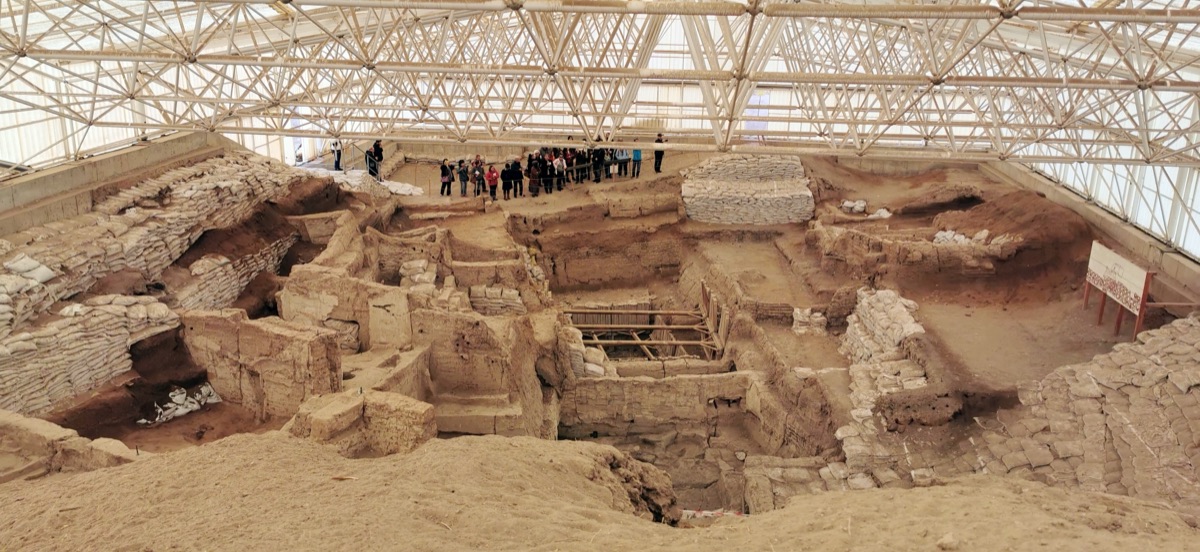
Çatalhöyük is a Neolithic and Chalcolithic proto-city on Turkey's Konya Plain, occupied for over a thousand years from around 7100 BC and housing perhaps 3,500–8,000 people at its peak — an astonishing population for the time. Its mudbrick houses were packed wall-to-wall with no streets or doors at ground level; residents entered through roof hatches by ladder. Interiors were repainted with murals, fitted with plastered bull skulls, and floored over the graves of family members. Excavated first by James Mellaart (1961–1965) and then for 25 years by Ian Hodder's international project (1993–2018), it is a UNESCO World Heritage Site and one of the most intensively studied prehistoric settlements on Earth.

See it on the globe →
The mainstream view

What archaeology says

Mainstream archaeology sees Çatalhöyük as an egalitarian farming community — one of the world's first large permanent settlements. Radiocarbon dating, refined by Bayesian modelling under the Hodder project, brackets the East Mound between roughly 7100 and 5950 BC. Residents grew wheat, barley and lentils, herded sheep and goats, and continued hunting aurochs. Analysis of skeletons, house sizes and grave goods shows remarkably little social or gender inequality: men and women ate similar diets, did similar work, and received similar burials. Houses, not temples or palaces, were the unit of society; Hodder found no central authority, no elite quarter and no public buildings, describing the settlement as 'radically egalitarian'.

The famous imagery — leopard reliefs, vultures over headless bodies, the corpulent 'Seated Woman' flanked by felines — is interpreted by the Hodder project not as proof of a Mother Goddess cult (Mellaart's view) but as part of a symbolic world concerned with ancestors, wild animals, and the drama of death and memory. Figurine studies showed most figurines are animals, and many 'goddess' figures may represent mature, high-status women or ancestors rather than deities. Skulls were sometimes removed, plastered and recirculated among the living — an ancestor practice shared across the Near Eastern Neolithic.

A 2014 study of the celebrated 'map mural' — long claimed as the world's oldest map, showing the town beneath an erupting volcano — found that Hasan Dağ did erupt around 6900 BC, within the mural's era, though sceptical researchers note the 'map' may equally be a geometric pattern and a leopard skin.

Key evidence cited
  • Extensive radiocarbon series with Bayesian modelling dates occupation to c. 7100–5950 BC
  • Bioarchaeology shows near-equal diets, workloads and burials for men and women — but no evidence of matriarchy
  • Most figurines are animals; 'goddess' figures are rare and often found in rubbish deposits, not shrines
  • No temples, palaces, elite residences or central storage — an egalitarian, house-based society
  • 25 years of meticulous excavation with full digital recording, among the best-documented digs ever
The alternative view

What the skeptics propose

Çatalhöyük's alternative story is less about lost civilisations than about a contested religion and a scandal. James Mellaart interpreted the site as the centre of a Mother Goddess cult and an essentially matriarchal society — a reading enthusiastically adopted by Marija Gimbutas, who wove Çatalhöyük into her vision of a peaceful, goddess-worshipping 'Old Europe' later overthrown by patriarchal Indo-European invaders. The site remains a pilgrimage destination for Goddess-movement groups today, who argue that Hodder's project systematically downplayed evidence of female-centred religion. Mainstream researchers counter that decades of figurine, burial and dietary analysis simply do not support a matriarchy or a dominant goddess — though they do confirm striking gender equality.

The darker thread concerns Mellaart himself. Banned from Turkey after the 'Dorak affair' (a supposed Bronze Age treasure he published that was never produced and allegedly never existed), he was posthumously exposed in 2018 when researcher Eberhard Zangger found in his apartment draft 'sketches' of murals Mellaart had claimed were ancient — strong evidence he fabricated material late in life. This has cast a retrospective shadow over some of his more sensational unpublished Çatalhöyük claims, though his core excavation records and the site's spectacular reality are not in doubt.

A few fringe writers also fold Çatalhöyük into catastrophist narratives — citing the volcano mural as a memory of cataclysm — but there is no evidence of warfare at the site, and even most alternative authors treat Çatalhöyük's dating as sound.

Key evidence cited
  • The 'Seated Woman of Çatalhöyük' and wall reliefs are read by Goddess-movement writers as a Mother Goddess
  • The apparent gender equality is cited as fitting a female-honouring social order later erased
  • The 'map mural' matched by a real Hasan Dağ eruption c. 6900 BC is claimed as the world's first town plan and disaster record
  • Supporters argue Mellaart's original shrine interpretations were dismissed too sweepingly after his posthumous disgrace

Genuinely open questions

  1. Why did thousands of people choose to live packed together, entering homes through the roof, when land was abundant?
  2. What did the leopard, bull and vulture imagery actually mean to residents?
  3. Is the 'map mural' a town plan beneath an erupting volcano or a geometric design under a leopard skin?

Worth knowing

Residents periodically dug up the skulls of their ancestors, coated them in plaster, painted them, and kept them in their homes — one burial held a woman cradling a plastered skull that was already generations old.