Catastrophe & Climate · Santorini (Thera), Greece

Akrotiri & the Thera Eruption

The Bronze Age Pompeii — a whole town flash-frozen in ash, whose eruption date has split archaeology for forty years and may lie behind the legend of Atlantis.

Mainstream: Eruption c. 1600 BC (mid-16th to early-17th century BC); town destroyed at the height of the Late Bronze AgeAlternative: Traditional archaeological chronology c. 1500 BC — and, for Atlantis theorists, an event later mythologised across a millennium36.35°, 25.40°

At a glance

Akrotiri & the Thera Eruption
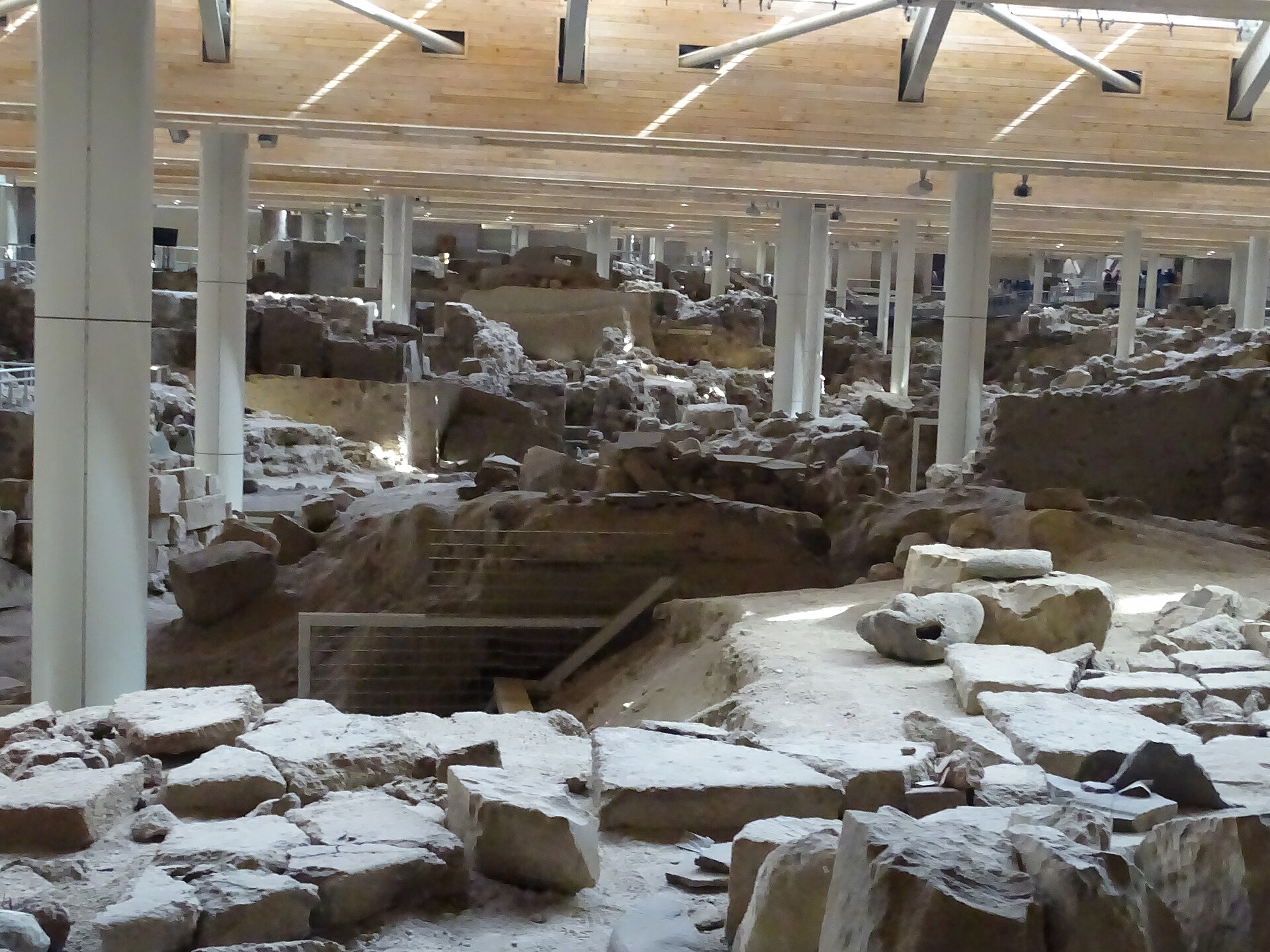
Photo: Ad Meskens · CC BY-SA 4.0

Akrotiri is a Cycladic Bronze Age town on the southern tip of Santorini, buried under metres of pumice and ash when the Thera volcano erupted in one of the largest eruptions of the last ten thousand years. Multi-storey houses stand preserved to their upper floors, their walls covered in some of the most exquisite frescoes of the ancient Aegean — boxing boys, blue monkeys, a fleet of ships, saffron-gatherers. Unlike Pompeii, almost no bodies and little portable wealth have been found, suggesting the townspeople read the warning tremors and fled before the final blast. The eruption that sealed the site is a keystone datum for the entire eastern Mediterranean chronology, which is precisely why the argument over its exact date has been so fierce.

See it on the globe →
The mainstream view

What archaeology says

The town was destroyed by the Minoan (Thera) eruption, a colossal VEI-7 event that ejected some 30 to 60 cubic kilometres of material, collapsed the centre of the island into a caldera and sent tsunamis across the Aegean. Excavation began under Spyridon Marinatos in 1967 and continues today; the ashfall preserved organic imprints, timber, furniture voids and painted plaster to a degree unmatched in Bronze Age Europe. The absence of human remains and the removal of valuables point to an evacuation triggered by precursor earthquakes, making Akrotiri a story of survival rather than mass death.

On dating, two camps long disagreed by more than a century. The archaeological or 'low' chronology, built on synchronisms with Egyptian and Near Eastern material, placed the eruption around 1500 BC. Radiocarbon and other scientific methods have pushed for a 'high' chronology in the 17th to 16th centuries BC. The single most debated find is a charred olive branch recovered from Therasia, radiocarbon-dated with its growth rings to argue for an eruption around 1600 BC. By the 2010s and 2020s, refined annual radiocarbon records led by Sturt Manning and colleagues, together with tree-ring and ice-core work, narrowed the window to roughly 1611 to 1560 BC, closing much of the old gap. Most scientists now favour a date in the earlier-to-mid 16th century BC, though a hard consensus with the archaeologists is still emerging.

Key evidence cited
  • A complete Bronze Age town preserved in ash, with frescoes, furniture voids and multi-storey walls intact
  • Absence of bodies and portable valuables indicating a pre-eruption evacuation after warning quakes
  • Refined annual radiocarbon records (Manning and colleagues) narrowing the eruption to c. 1611-1560 BC
  • The charred Therasia olive shrub radiocarbon-dated to support a mid-16th-century-BC event
  • Caldera collapse, thick regional tephra layers and tsunami deposits confirming a VEI-7 eruption
The alternative view

What the skeptics propose

Two contested strands run through Thera. The first is chronological but comes from within the field: a body of Egyptologists and Aegean archaeologists maintains that the artefactual synchronisms cannot be stretched to fit a 17th-century eruption without dislocating well-anchored Egyptian dates, and that the radiocarbon signal may be distorted by volcanic carbon dioxide venting from the island, which can make plants growing near the vent appear older than they are. A 2022 study argued for a Second Intermediate Period placement, and Paolo Cherubini and co-authors have questioned whether the celebrated olive branch can even be ring-counted reliably, since olive wood lacks clear annual rings. The debate is narrowing but not settled.

The second strand is the Atlantis connection. From Marinatos onward, scholars have proposed that Plato's account of a great island power destroyed in a day and a night by earthquake and flood preserves a folk memory of the Minoan world shattered by Thera. Advocates point to the ring-shaped caldera, the sudden fall of a sophisticated maritime culture, and the tsunami damage on Crete. Critics counter that Plato sets Atlantis 9,000 years before his own time, beyond the Pillars of Heracles, and at a vastly larger scale — so any link requires treating his figures as garbled by a thousand years of retelling. Whether Thera is the historical kernel of Atlantis or merely the most cinematic candidate remains an open and much-loved question.

Key evidence cited
  • Egyptian and Near Eastern artefact synchronisms that many archaeologists read as favouring c. 1500 BC
  • Volcanic CO2 venting near Thera that could bias radiocarbon dates older than the true age
  • Cherubini and colleagues' argument that olive wood cannot be reliably ring-counted for annual dating
  • Plato's Atlantis narrative of an island power destroyed suddenly by earthquake and flood
  • The ring-shaped caldera and abrupt Minoan decline offered as the historical kernel of the legend

Genuinely open questions

  1. Can the radiocarbon 'high' chronology and the archaeological synchronisms be fully reconciled, or does one dataset contain a systematic error?
  2. Where did the population of Akrotiri go, and does any settlement preserve the refugees or their memory of the disaster?
  3. Is the Atlantis story a genuine, distorted recollection of Thera, or a coincidental match read backwards into Plato?

Worth knowing

The frescoes at Akrotiri include what may be the earliest known depiction of a landscape for its own sake in Western art — and a fleet fresco so detailed that scholars use it to reconstruct Bronze Age ship design.