What archaeology says
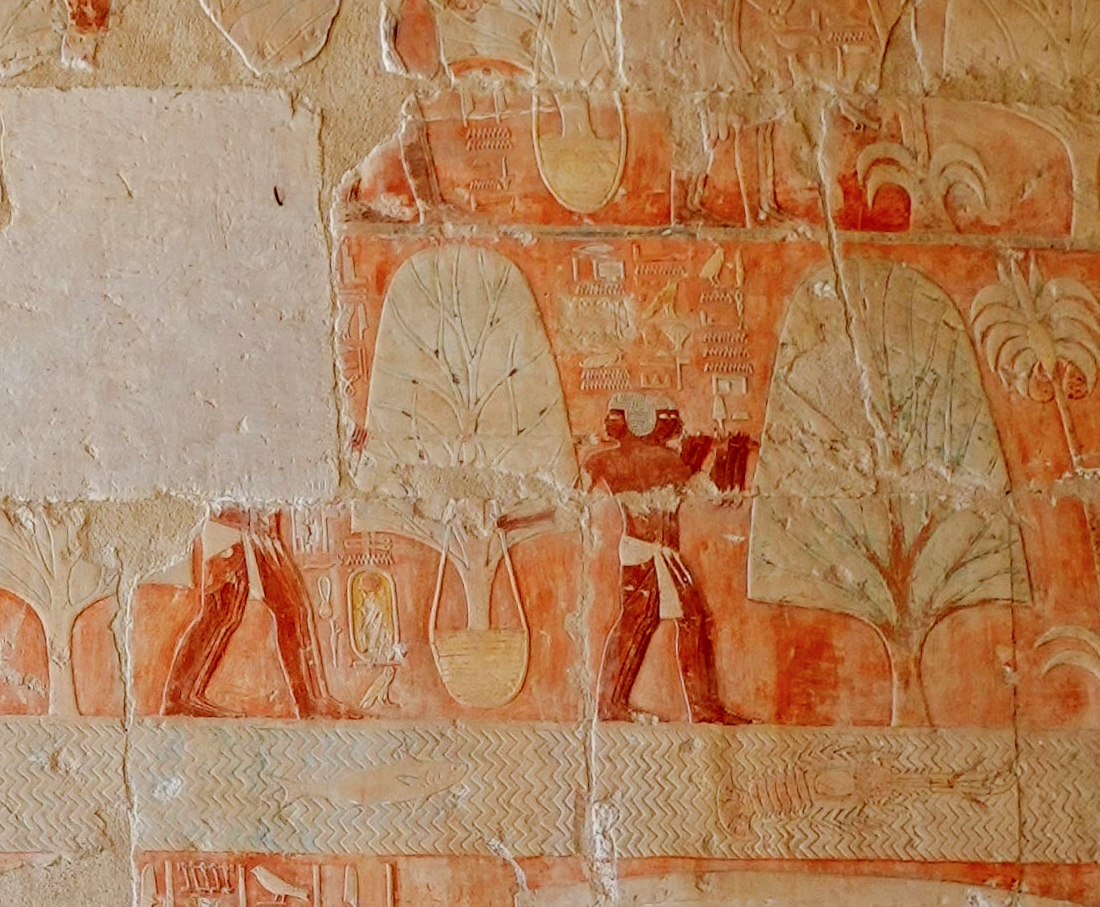
Egyptologists have no doubt Punt existed, because the Egyptians documented their dealings with it in detail. The richest source is the mortuary temple of Queen Hatshepsut at Deir el-Bahri (c. 1470 BC), whose reliefs depict a full seaborne expedition to Punt: Egyptian ships loaded with myrrh trees in baskets, heaps of incense, gold, ebony and leopard skins, the Puntite ruler Parahu and his notably large-bodied wife Ati, and villages of domed reed houses raised on stilts among palms. Earlier and later texts, from the Old Kingdom Palermo Stone to New Kingdom tomb scenes, confirm Punt as a recurring, real trade destination reached down the Red Sea.
The long-standing scholarly consensus places Punt on the African coast of the southern Red Sea and the Horn of Africa — roughly modern Eritrea, eastern Sudan, Ethiopia and Somalia — on the basis of the tropical products, the domed houses, and animals such as giraffes and rhinoceroses shown in the reliefs. That view has been sharpened by science. From 2010, a team including Nathaniel Dominy, Gillian Moritz and Salima Ikram analysed oxygen and strontium isotopes in mummified baboons the Egyptians imported (baboons appear repeatedly in the Punt reliefs), finding the closest match in the Eritrea-Ethiopia-Somalia region rather than Arabia. A 2020 follow-up refined the result toward Eritrea and eastern Ethiopia, and a 2023 ancient-DNA study led by Gisela Kopp tied a mummified hamadryas baboon genetically to populations around coastal Eritrea, proposing that Punt and the later classical port of Adulis were essentially the same place seen at different times.
- Hatshepsut's Deir el-Bahri reliefs showing a seaborne expedition, myrrh trees, the ruler Parahu and Queen Ati
- Old-to-New-Kingdom texts (Palermo Stone onward) recording Punt as a recurring real trade destination
- Tropical products and fauna — myrrh, ebony, giraffes, baboons — indicating an African tropical source
- 2010 and 2020 baboon isotope studies (Dominy, Moritz, Ikram) pointing to Eritrea/Ethiopia/Somalia
- 2023 ancient-DNA study (Kopp) genetically tying an imported baboon to coastal Eritrea, near later Adulis