Myth & Memory · L'Anse aux Meadows, Newfoundland, Canada

Vinland & L'Anse aux Meadows

Medieval sagas said Vikings reached America five centuries before Columbus. Everyone assumed it was a tall tale — until a solar storm dated the proof to a single year.

Mainstream: Norse occupation dated precisely to AD 1021 (with activity around c. 1000–1025)Alternative: The Vinland sagas were long treated as legend or wishful nationalism until the site was found in 196051.60°, -55.53°

At a glance

Vinland & L'Anse aux Meadows
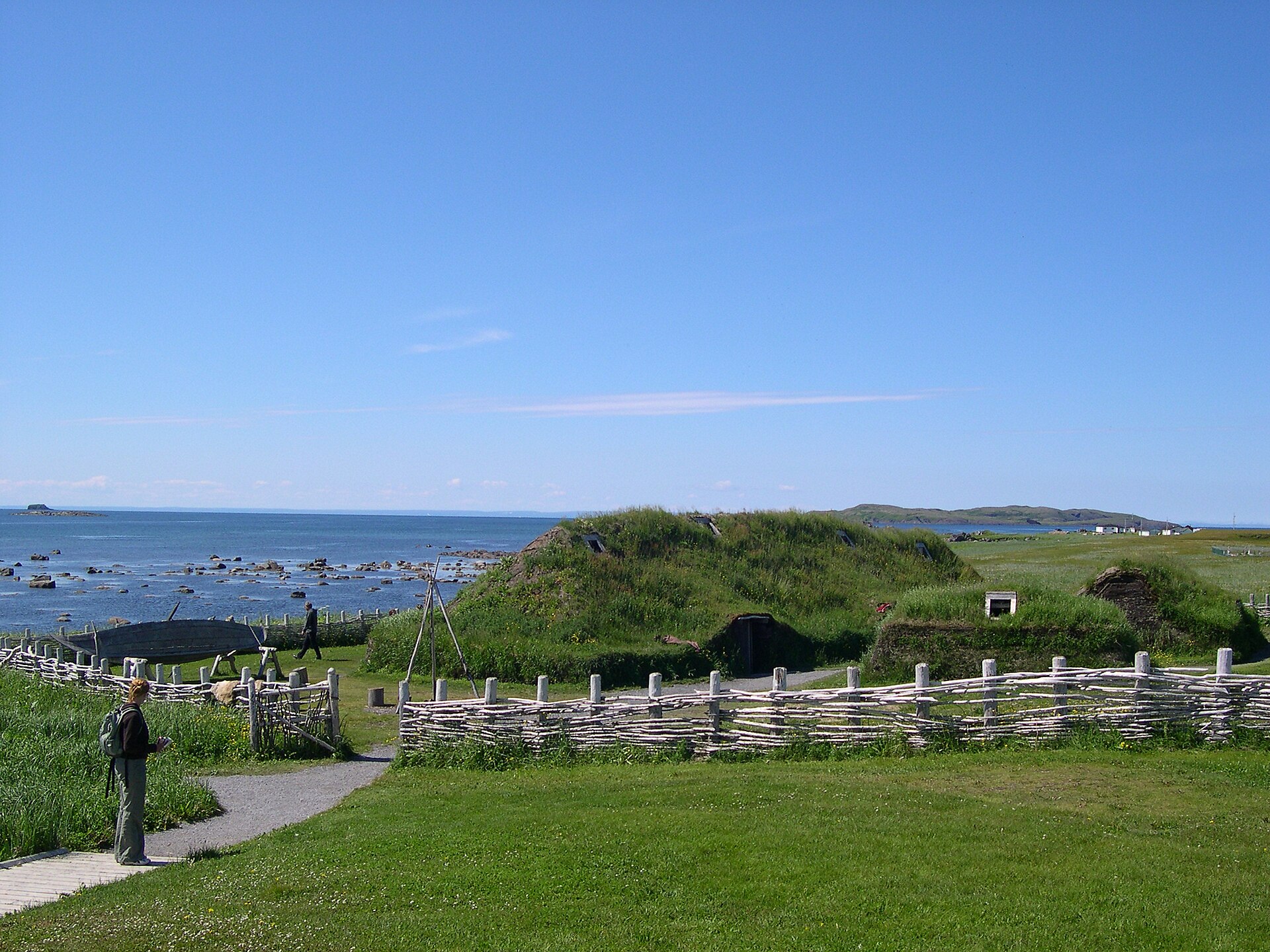
Photo: Dylan Kereluk · CC BY 2.0

L'Anse aux Meadows is a cluster of low grassy mounds on the windswept northern tip of Newfoundland. Excavation revealed the remains of eight Norse turf buildings, a smithy, and iron nails and boat rivets — the only confirmed Viking-Age European settlement anywhere in the Americas outside Greenland. Its discovery turned the medieval Icelandic 'Vinland sagas', the Saga of the Greenlanders and the Saga of Erik the Red, from suspected legend into a broadly reliable account of Norse voyages to a land they called Vinland. It is a textbook example of an oral-then-written tradition vindicated by the ground, and of how honest science also records its failures.

See it on the globe →
The mainstream view

What archaeology says

The Vinland sagas describe Leif Erikson and others sailing west from Greenland around AD 1000 to lands they named Helluland, Markland and Vinland. For centuries these were read as heroic literature, quite possibly embellished or invented, and rival claims about Norse traces in North America were tangled up with fraud (such as the Kensington Runestone) and ethnic pride. That changed in 1960 when the Norwegian explorer Helge Ingstad and the archaeologist Anne Stine Ingstad, following a local Newfoundlander's tip about 'old Indian camps', identified the mounds at L'Anse aux Meadows as Norse. Their excavations through the 1960s uncovered turf halls of unmistakably Icelandic-Greenlandic type, iron-working debris, and a bronze cloak-pin — proof of a European presence centuries before Columbus.

The dating was tightened dramatically in 2021, when Margot Kuitems and Michael Dee of the University of Groningen published a result in Nature. They exploited a known cosmic-ray event: a massive solar storm in AD 993 left a sharp spike of carbon-14 in every tree growing that year. Finding that spike in three pieces of Norse-cut wood and counting the rings outward, they showed all three trees had been felled in exactly AD 1021 — the earliest precisely dated evidence of Europeans in the Americas, and a rare case of calendar-year precision in archaeology. The settlement is now read as a base camp and gateway for exploring and gathering resources further south, rather than a permanent colony.

Key evidence cited
  • Eight Norse turf buildings, a smithy and iron boat-rivets excavated by the Ingstads from 1960
  • The 2021 Nature study dating three Norse-cut timbers to exactly AD 1021 via the AD 993 solar-storm carbon-14 spike
  • Butternuts and butternut wood from trees native only further south, proving voyages beyond the site
  • A bronze ring-pin and spindle-whorl of characteristic Norse Greenlandic-Icelandic type
  • Close correspondence between the excavated site and the Vinland sagas' account of a western base camp
The alternative view

What the skeptics propose

The 'alternative' twist at L'Anse aux Meadows is that the sagas, treated for generations as dubious legend, turned out to be substantially trustworthy. Details once dismissed as saga colour — wild grapes, self-sown wheat, timber worth carrying home, encounters with Indigenous peoples the Norse called Skraelingar — fit a real world south and west of the settlement, and the site itself proved the voyages were fact.

But the story also demonstrates the discipline's integrity, because not every hopeful claim survives. In 2015 and 2016 the space-archaeologist Sarah Parcak used satellite imagery to identify a promising anomaly at Point Rosee, on Newfoundland's south-west coast, and it was widely trumpeted as a possible second Norse site. Careful excavation showed the 'turf wall' was a natural formation and the 'roasted bog iron' a natural mineral accumulation; in 2017 the team reported, plainly, that there was no evidence of Norse presence or of any human activity there before historic times. That published negative result is a model of good practice — a reminder that satellite hints must be tested with a trowel, and that a single confirmed site does not mean every intriguing shape in the ground is Viking.

Vinland almost certainly extended well beyond L'Anse aux Meadows: butternuts found at the site come from trees that grow no closer than the Gulf of St Lawrence, implying the Norse ranged much further south. Where those southern camps were, and whether any survive, remains the live and honestly unfinished part of the story.

Key evidence cited
  • The Vinland sagas, long dismissed as legend or nationalist wishful thinking, were vindicated by the dig
  • Saga details such as grapes, timber and encounters with Skraelingar match the real geography to the south
  • Point Rosee (2015–2016) shows the honest negative: a promising satellite anomaly disproved by excavation
  • The 1021 date proves European contact with the Americas nearly five centuries before Columbus
  • Butternut evidence implies further, still-undiscovered Norse camps south of Newfoundland

Genuinely open questions

  1. Where exactly was 'Vinland' the grape-bearing land, and are there other Norse camps still to be found around the Gulf of St Lawrence?
  2. How long and how often did the Norse use L'Anse aux Meadows before abandoning the western venture?
  3. What was the full nature of Norse contact with the Indigenous peoples the sagas call Skraelingar?

Worth knowing

The precise date of AD 1021 was readable only because a giant solar storm in AD 993 branded every living tree on Earth with a carbon-14 spike — so a burst of radiation from the Sun a thousand years ago is what let scientists pin the Vikings' arrival to a single calendar year.