Catastrophe & Climate · Saaremaa Island, Estonia

Kaali Meteorite Craters

A Bronze Age island community watched the sky fall — and may have walled off and worshipped the wound it left behind.

Mainstream: c. 1530–1450 BC (impact, per Losiak et al. 2016 charcoal dating)Alternative: c. 5600–4000 BC (older peat and spherule dating) — or as late as c. 800–400 BC (Veski et al.)58.37°, 22.67°

At a glance

Kaali Meteorite Craters
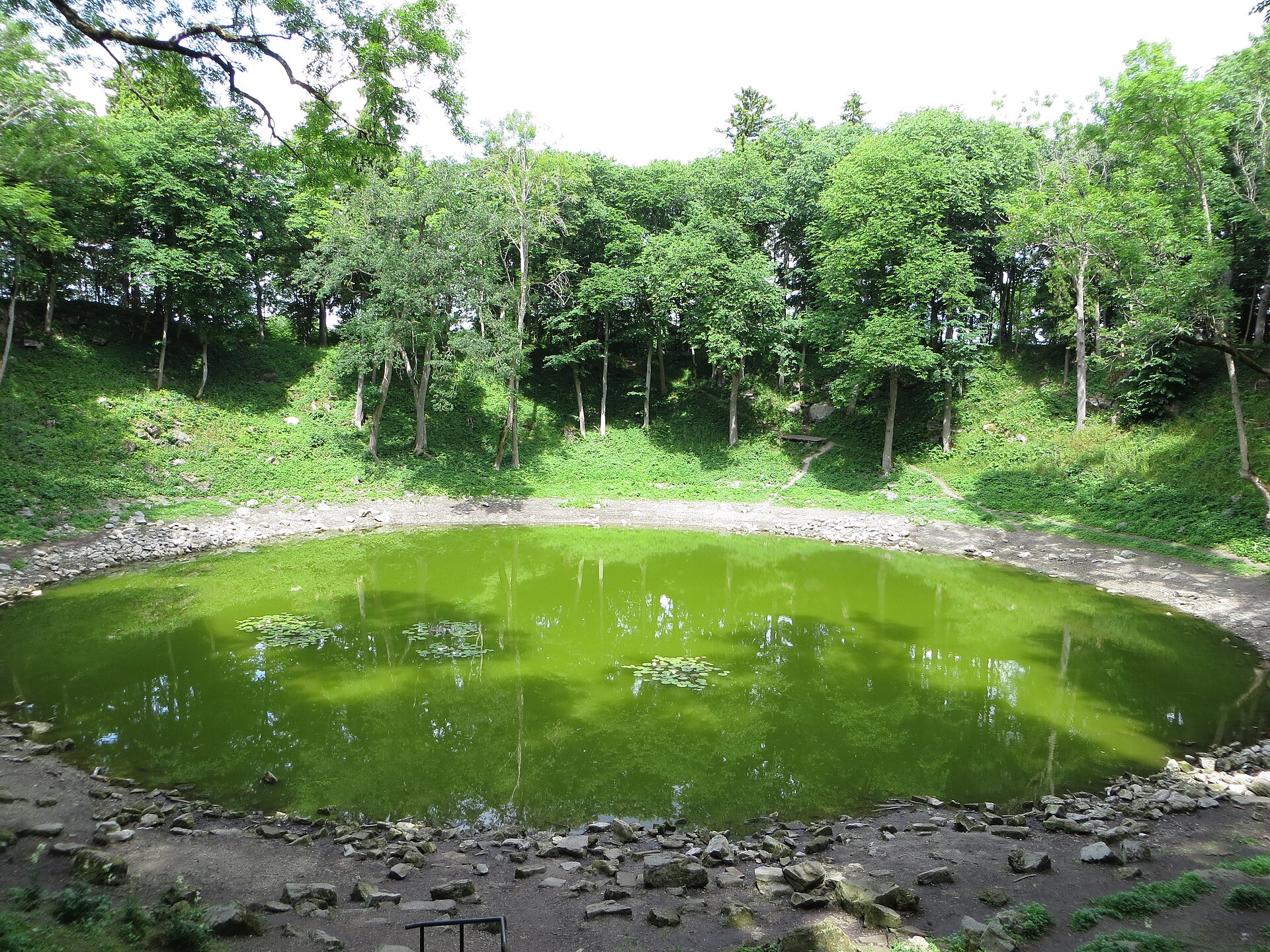
Photo: Bernt Rostad · CC BY 2.0

On the Estonian island of Saaremaa, a cluster of nine craters records the moment an iron meteoroid tore apart in the atmosphere and slammed into a landscape that was almost certainly inhabited. The main crater, 110 metres across and 22 metres deep, now cradles the eerily circular lake Kaali, while eight smaller satellite craters lie scattered within a kilometre. The incoming body is estimated to have released energy in the low kilotonne range — comparable to a small nuclear weapon — flattening and burning forest for kilometres. Kaali is one of the very few impact sites on Earth where a strong case can be made that humans witnessed the event, remembered it, and built a cult around the scar. An Iron Age stone rampart around the lake, heaps of sacrificed animal bones and a hidden silver hoard all suggest the crater remained a charged, sacred place for centuries.

See it on the globe →
The mainstream view

What archaeology says

The current best estimate for the impact comes from a 2016 study led by Anna Losiak, who radiocarbon-dated charcoal recovered from within the proximal ejecta blanket — material charred by the impact itself and buried instantly, so immune to the reservoir effects that plague lake and bog dating. Her team's result of 3237 ± 10 radiocarbon years places the event shortly after 1530–1450 BC, squarely in the Nordic Bronze Age, when Saaremaa supported farming communities who could not have missed a kilotonne-scale explosion on their small island.

Archaeology supports a long human relationship with the crater. Excavations in the 1970s revealed a fortified settlement beside the lake and a substantial dry-stone wall, 2 to 2.8 metres thick at the base, that appears to have enclosed the crater during the pre-Roman Iron Age (c. 500 BC – AD 50). Inside lay unusually rich deposits of domestic animal bone — horse, ox, sheep, pig and dog — interpreted as offerings, along with a silver hoard. Mainstream researchers read this as a pagan cult site: whether or not living memory of the fall survived, the perfectly round lake in its raised rim was clearly treated as a place apart.

Estonian scholars such as Siim Veski and colleagues have also probed the impact's environmental fingerprint, finding impact-derived iron microspherules in the nearby Piila bog. Their reading of the peat originally suggested a much later event, around 800–400 BC, accompanied by signs of local ecological disturbance — a result now generally superseded by the ejecta charcoal dates, but a reminder of how hard small craters are to date.

Key evidence cited
  • Charcoal within the impact ejecta blanket radiocarbon-dated to shortly after 1530–1450 BC (Losiak et al. 2016)
  • Nine-crater field with recovered iron meteorite fragments confirming a single fragmenting impactor
  • Iron Age fortified settlement and a 2.3–2.8 metre thick stone wall enclosing the crater lake
  • Abundant sacrificed domestic animal bones and a silver hoard indicating long cult use
  • Impact microspherules traced in Saaremaa bogs, tying regional sediment layers to the event
The alternative view

What the skeptics propose

The dating controversy is real and unusually wide: published ages for Kaali span nearly six thousand years. Early Estonian work, including Aaloe's excavations and Anto Raukas's 1995 study of silicate microspherules in surrounding mires, pointed to an impact around 7,500–7,600 years ago — roughly 5600 BC, in the Mesolithic. If that older date were right, the witnesses would have been hunter-gatherers rather than Bronze Age farmers, and the event would predate almost all surviving northern European mythology. Critics of the young date also note that radiocarbon ages from the crater sediments themselves disagree with one another by more than two millennia, so no single result should be treated as final.

The more evocative alternative case concerns memory. Former Estonian president and writer Lennart Meri argued in his 1976 book Hobevalge (Silverwhite) that the Kaali fall blazed through Baltic and even Mediterranean tradition: he proposed that Saaremaa was the legendary Thule described by the Greek explorer Pytheas, connecting the name to Finnic words for fire, and read Estonian and Finnish folklore — including motifs in the Kalevala of a fire from heaven and a sun that fell to earth — as encoded eyewitness accounts. Local tradition called Kaali the place where 'the sun went to rest'. Some researchers have even linked the fall to the Greek myth of Phaethon, who crashed the sun's chariot at the edge of the world near the amber routes.

Sceptics reply that myth-matching is unfalsifiable — fire-from-the-sky stories are near universal — and Meri wrote as a literary essayist, not a geologist. But the combination at Kaali is hard to dismiss outright: a physically witnessed impact, a walled and venerated crater lake, and a regional folklore saturated with falling-sun imagery makes it perhaps Europe's strongest candidate for a catastrophe preserved in oral tradition.

Key evidence cited
  • Raukas's 1995 microspherule study dating the fall to c. 7,500–7,600 years ago
  • Radiocarbon results from crater and bog sediments spanning c. 6400 to 400 BC — a genuine unresolved spread
  • Veski's Piila bog data suggesting ecological disturbance around 800–400 BC
  • Lennart Meri's Silverwhite thesis linking Kaali to the Thule legend and Baltic fire-myths
  • Estonian and Finnish folklore of a fallen sun, including the local name for Kaali as the sun's resting place

Genuinely open questions

  1. Why do dating methods at Kaali disagree by thousands of years, and can the older spherule dates be fully explained away?
  2. Was the stone rampart around the lake defensive, ceremonial, or both — and did its builders know what had made the crater?
  3. Do any surviving Baltic myths genuinely descend from eyewitness accounts of the impact, or is the resemblance coincidental?

Worth knowing

The Kaali impact released energy comparable to a small atomic bomb over an inhabited island — and more than a thousand years later, Iron Age islanders were still sacrificing animals beside the crater lake it created.