What archaeology says
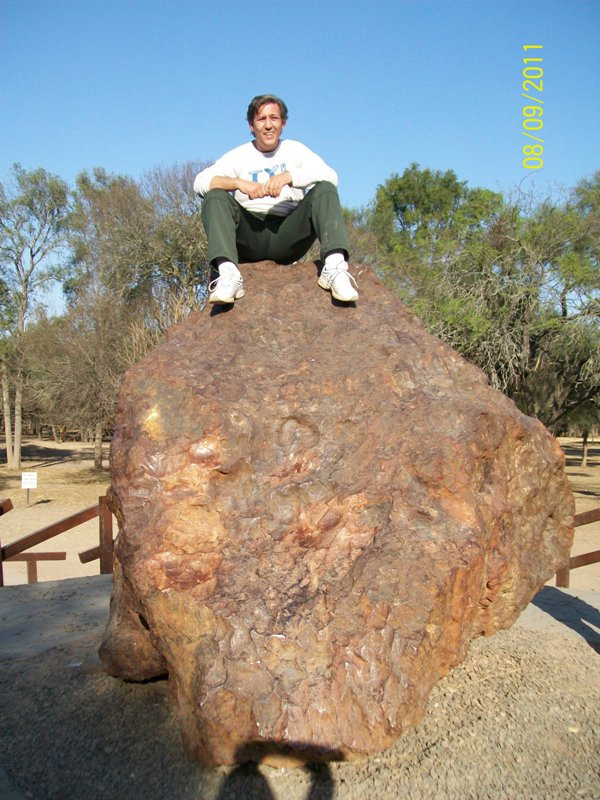
Scientifically, Campo del Cielo is among the best-studied crater fields in the world, thanks largely to the American planetary scientist William Cassidy, whose expeditions from the 1960s mapped the strewn field, excavated buried masses and worked out the physics of the fall: a single iron meteoroid, perhaps 4 metres across, entering at a very shallow angle from the south-west and fragmenting progressively, so that the largest pieces travelled furthest along the ellipse. Radiocarbon dates on charred wood from within the craters cluster around 3,950 ± 90 and 5,800 ± 200 years before present, bracketing the fall at roughly four to five thousand years ago — unambiguously within the span of human occupation of the Chaco.
The documented history is equally rich. Spanish colonial authorities heard indigenous reports of a great iron in the bush, and in 1576 an expedition under Captain Hernan Mexia de Miraval reached a huge mass that became known as the Meson de Fierro, the 'great table of iron'. Rediscovered in 1774 and blasted at by Rubin de Celis's 1783 expedition — who concluded, wrongly, that it was not worth exploiting — the Meson de Fierro was then lost, and its location remains one of meteoritics' enduring mysteries, though a 2019 study identified a probable fragment of it in Vienna's Natural History Museum. Another mass, Otumpa, was hauled out in 1803; a piece reached the British Museum, where it helped convince early nineteenth-century scientists that iron really did fall from the sky.
For mainstream researchers the Moqoit connection is a striking case of scientific and ethnographic dating converging: the radiocarbon ages are consistent with the fall having been witnessed by ancestors of the region's indigenous peoples, whose place-name preserved the event's celestial origin centuries before European science accepted that meteorites existed.
- Radiocarbon dates of c. 3,950 and 5,800 years BP on charred wood from inside the craters
- At least 26 mapped craters and penetration funnels aligned along a single shallow-entry trajectory (Cassidy's fieldwork)
- Over 100 tonnes of chemically matching IAB iron recovered, including El Chaco (28.8 t) and Gancedo (30.8 t)
- Colonial records from 1576 onward documenting indigenous knowledge of the irons before European contact
- 2019 identification of a probable Meson de Fierro fragment in Vienna, confirming the historical accounts