Belief & Society · Caney Fork valley, near Cullowhee, Jackson County, North Carolina, USA

Judaculla Rock

A soapstone boulder crowded with 1,500 undeciphered marks — and the handprint of the Cherokee giant who leapt from his mountain

Mainstream: Soapstone quarrying c. 2000-1000 BC; most glyphs c. AD 500-1700 (Woodland to Mississippian, possibly later)Alternative: In Cherokee tradition, the mark of the giant Tsul'kalu; fringe writers link it to lost scripts and giants35.30°, -83.11°

At a glance

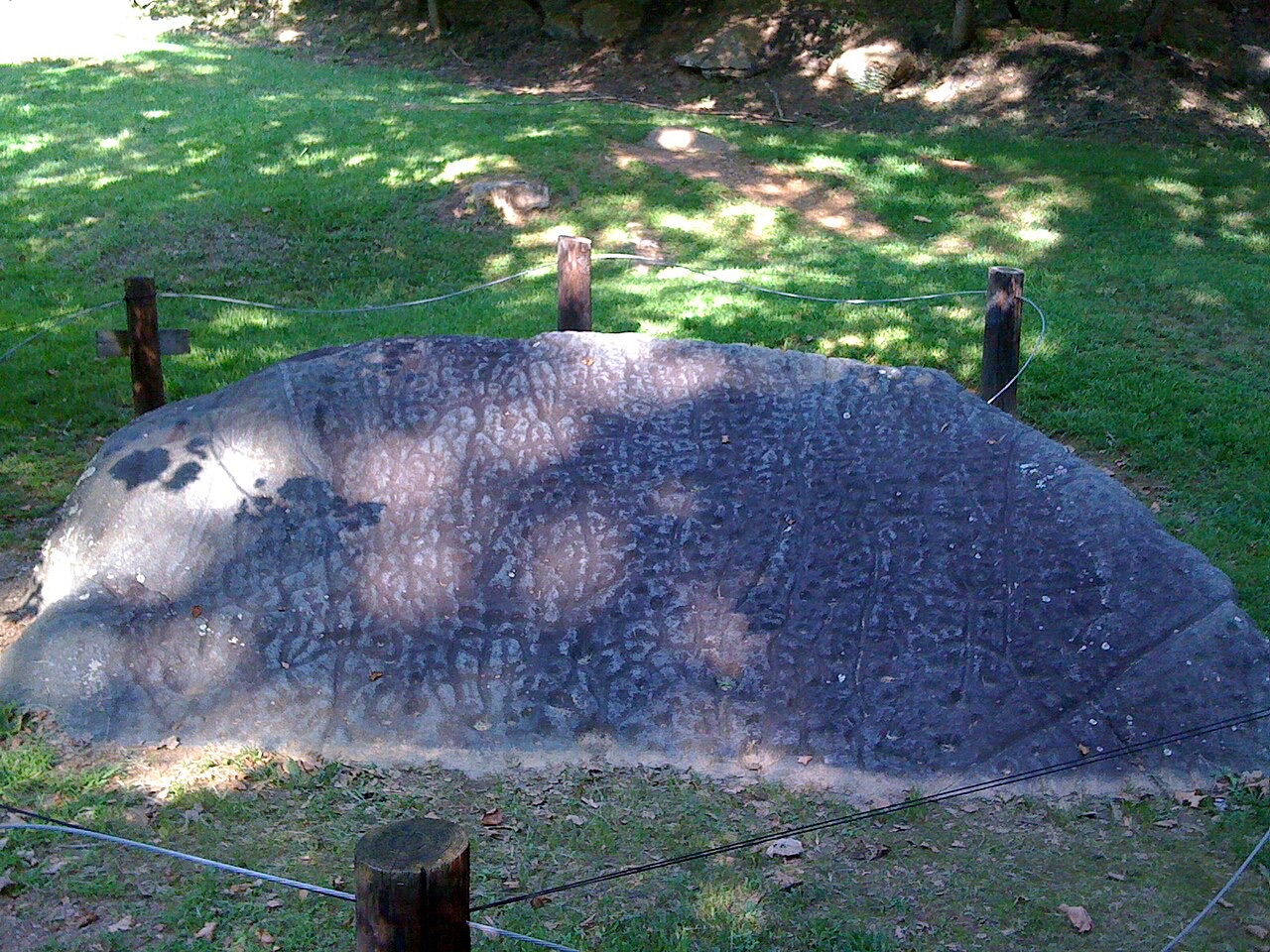
Judaculla Rock
Photo: Spjctim · Public domain

In a quiet valley below the Balsam Mountains of western North Carolina lies Judaculla Rock, a curved outcrop of soapstone bearing roughly 1,548 carved motifs — more than any other known boulder east of the Mississippi. Cupules, rings, crosses, branching lines and stylised figures crowd its surface so densely that no one has convincingly read them. To the Cherokee (Aniyunwiya), the rock belongs to Tsul'kalu — anglicised as Judaculla — the slant-eyed giant and Master of Game who dwelt on the Tanasee Bald above; tradition holds he scratched the rock, in some tellings landing on it in a great leap from his mountain home, leaving what look like the marks of a seven-fingered hand. The boulder also carries scars of a different kind: extraction grooves from Late Archaic people who quarried its soapstone for bowls perhaps three thousand years before the glyphs.

See it on the globe →
The mainstream view

What archaeology says

Archaeologists read Judaculla Rock as a palimpsest with at least two deeply separated chapters. The first is industrial: soapstone (steatite) is soft, heat-resistant and was prized across the Late Archaic Southeast for carving cooking bowls, and the boulder preserves clear bowl-extraction scars and quarrying debris dated by excavation of the surrounding deposits to roughly 2000-1000 BC. The second chapter is symbolic: the cupules, nested rings, cross-in-circle motifs and stylised figures were pecked over and around the quarry scars, and researchers such as Scott Ashcraft, working with Western Carolina University and Cherokee partners, place most of this activity between the Woodland and Mississippian periods — roughly AD 500 to 1700 — with some marks possibly as late as the early historic era. Cross-in-circle designs, for instance, belong to a well-known Mississippian symbolic repertoire.

What the glyphs say is genuinely unknown, and mainstream scholars are candid about it. Proposals include a boundary or treaty marker, a map of the surrounding valleys and hunting grounds, tallies, clan or ceremony records, and accumulated marks from generations of ritual visits — perhaps connected to the documented Cherokee use of the nearby Judaculla old fields as a sacred place. No proposal has produced a decipherment, and most specialists doubt the marks constitute writing in the linguistic sense at all.

Crucially, mainstream practice now treats Cherokee tradition as evidence rather than folklore garnish. The Eastern Band of Cherokee Indians regards the rock as a living sacred site, participates in its stewardship with Jackson County, and Mooney's 1900 recording of the Tsul'kalu narratives is used to understand the boulder's role as a threshold to the Master of Game's domain — a place where hunters once fasted and sought permission before the hunt.

Key evidence cited
  • Approximately 1,548 recorded motifs make it the densest carved boulder east of the Mississippi, documented by modern survey and 3D scanning
  • Bowl-extraction scars and excavated quarry debris date soapstone working at the boulder to the Late Archaic, c. 2000-1000 BC
  • Motifs such as cross-in-circle designs belong to known Woodland-Mississippian symbolic repertoires of the Southeast
  • James Mooney's 1900 Myths of the Cherokee records the Tsul'kalu tradition in detail, tying the rock to a documented sacred landscape
  • The Eastern Band of Cherokee Indians' continuing relationship with the site supports interpretation as a long-used ceremonial place
  • No verified Old World script elements have been identified despite repeated epigraphic claims
The alternative view

What the skeptics propose

The oldest alternative account is the Cherokee one, and it should not be flattened into either camp. As recorded by James Mooney and as told today, Tsul'kalu is the great lord of game animals, a giant with slanting eyes who married a Cherokee woman and dwells inside the Balsam range; the rock carries his marks — in popular tellings the scrape or handprint left when he leapt from Tanasee Bald, in older narratives a boundary of his domain where hunters made observances. On this view the marks are not a puzzle awaiting decipherment but the visible trace of a still-present being and a still-binding relationship between people and game. Cherokee tradition thus contradicts fringe claims of a lost non-Native civilisation as firmly as it resists purely archaeological framings of the rock as an artefact.

Non-Native alternative writers have nonetheless been busy since the nineteenth century. The glyphs have been claimed as Paleo-Hebrew or other Old World scripts by pre-Columbian-contact enthusiasts, as records of a vanished race of giants (with Tsul'kalu cited, against Cherokee understanding, as a literal memory of them), as a star map, and as an account of ancient battles; ancient-astronaut media have folded the undeciphered marks and the giant tradition into narratives of non-human contact. None of these claims has produced verifiable evidence, and epigraphers find no genuine Old World script on the stone.

The rock itself keeps the argument honest: it is soft soapstone, weathering measurably within living memory, and comparisons of early twentieth-century photographs with the present surface show marks fading. Whatever Judaculla Rock records — law, land, cosmology, or the footfall of a giant — it is a text that erodes, which is why Cherokee and county stewards now guard it behind a low fence and ask visitors to keep their hands, and their theories, gently off the stone.

Key evidence cited
  • The glyphs remain genuinely undeciphered, with no accepted reading after more than a century of study
  • Cherokee tradition attributes the marks to the giant Tsul'kalu, and a prominent marking is popularly seen as a seven-fingered handprint
  • Fringe epigraphers have claimed resemblances to Old World scripts, keeping pre-Columbian contact theories alive in popular literature
  • Giant lore surrounding Tsul'kalu is cited by lost-race and giants proponents as a memory of literal beings
  • The density and apparent organisation of the marks strike many observers as more message-like than decorative

Genuinely open questions

  1. Do the glyphs encode anything systematic — territory, ceremony, tallies, a map — or are they accumulated devotional marks?
  2. How much time separates the quarrying scars from the main glyph-carving phases, and can the glyphs be dated directly?
  3. What was the relationship between the rock, the Judaculla old fields, and hunting ritual in Cherokee lifeways?
  4. Can the soft, weathering soapstone be conserved before further detail is lost?

Worth knowing

Judaculla Rock is a rare case where the quarry became the canvas: Late Archaic people carved cooking bowls out of the boulder a thousand or more years before later hands covered the same surface with over 1,500 mysterious marks.