Ancient Engineering · Asuka region, Nara Prefecture, Japan

Masuda-no-Iwafune & the Asuka Stones

An 800-tonne granite 'rock ship' stranded on a hilltop — the largest and strangest of Asuka's unexplained carved stones.

Mainstream: Probably 7th century AD (late Asuka period)Alternative: Unknown — alternative writers argue the granite working belongs to an older, lost megalithic tradition later mythologised34.47°, 135.82°

At a glance

Masuda-no-Iwafune & the Asuka Stones
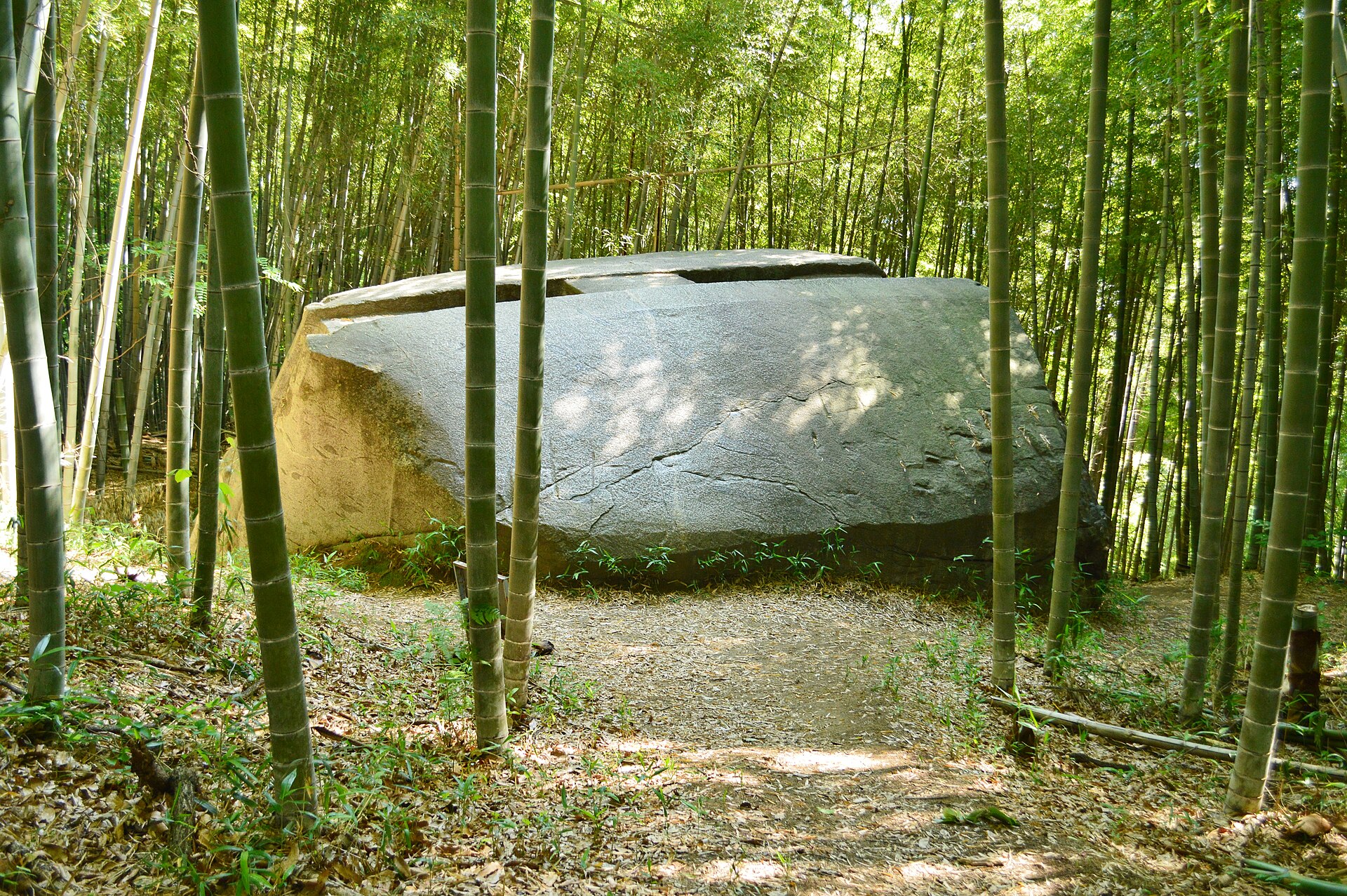
Photo: Saigen Jiro · CC0

On a wooded hilltop near Okadera Station in the historic Asuka region stands Masuda-no-Iwafune, the 'Rock Ship of Masuda' — a single mass of granite about 11 metres long, 8 metres wide and 4.7 metres high, weighing roughly 800 tonnes. Its upper surface has been flattened into a platform crossed by a shallow trough, into which two square shafts, each about a metre across, descend into the stone; one flank carries a curious carved lattice or checkerboard pattern. It is the largest of the enigmatic carved granites scattered across Asuka — a family that includes the turtle-shaped Kameishi, the channelled Sakafune-ishi and the paired Oni-no-Manaita and Oni-no-Setchin — none of which is explained by any surviving text. Who carved the rock ship, and why, remains one of Japanese archaeology's most cheerful admissions of ignorance.

See it on the globe →
The mainstream view

What archaeology says

Historians place the stone in the Asuka period (AD 538–710), when the surrounding valley was the seat of Japan's imperial court and the stage for its first Buddhist temples, continental-style palaces and engineered waterworks. The leading scholarly interpretation reads Masuda-no-Iwafune as an abandoned tomb project: the two square shafts closely resemble the initial cuttings for the twin-chambered, rock-cut granite tombs of the era — the nearby Oni-no-Manaita and Oni-no-Setchin are the dismembered floor and lid of exactly such a tomb, and the finely hollowed Kengoshizuka tumulus shows the finished form. On this reading the carvers began sinking a pair of burial chambers from above, struck a flaw or lost their patron, and walked away. The lattice pattern on the flank fits a standard masonry technique: a grid pecked out to guide the systematic flattening of a face.

Rival mainstream proposals keep the debate alive. Some researchers have suggested an astronomical or calendrical function — a sighting platform associated with the court's adoption of continental calendar science in the seventh century — while an Edo-period tradition connects the stone to the construction of the long-vanished Masuda Lake below the hill. What no academic doubts is capability: Asuka's builders, aided by immigrant masons from the Korean kingdom of Baekje, demonstrably cut, moved and dressed hard granite for tomb chambers, temple foundation stones and fountains, using iron tools, abrasives, levers and large organised workforces. The mystery of the rock ship is its purpose, not the possibility of its manufacture.

Key evidence cited
  • The two square shafts match the initial cuttings of twin-chambered Asuka-period rock-cut tombs
  • Nearby Oni-no-Manaita and Oni-no-Setchin prove local mastery of monumental granite tomb carving
  • The lattice pattern matches a standard pecked grid used to flatten stone faces by hand
  • Asuka court records document immigrant Baekje masons and large organised construction workforces
  • The stone was carved in place on its hilltop — no transport of 800 tonnes was ever required
The alternative view

What the skeptics propose

The stone's own name points skyward. Iwafune — 'rock ship' — echoes the heavenly stone vessels of Japanese myth, such as the Ame-no-torifune craft on which deities descended, and local legend holds that gods sailed this very rock down from the heavens. Ancient-astronaut and lost-civilisation writers take the mythology as garbled memory: on their reading, the Asuka carved stones are the surviving hardware of a forgotten epoch, inherited and reinterpreted by the seventh-century court rather than created by it. Brien Foerster, who has featured the site through his Hidden Inca Tours platform, and writers at Ancient Origins highlight the improbability of hauling or shaping 800 tonnes of granite on a hilltop with the documented toolkit of early Japan.

The technical case rests on the stone itself: faces flattened over metres to a smoothness proponents describe as saw-like, crisp square shafts sunk deep into some of the hardest stone in the region, and the precisely pecked lattice grid, which some interpret not as a mason's levelling guide but as the tell-tale scarring of a mechanical dressing process. Comparisons are drawn with Peru's carved bedrock outcrops and with Ishi-no-Hōden, 100 kilometres to the west, to argue for a shared megalithic style unlike anything in the later Buddhist stone tradition. Mainstream archaeologists respond that seventh-century iron chisels and abrasive dressing handle granite perfectly well if slowly, that the stone was carved where it lies rather than transported, that the grid pattern is a documented manual technique, and that half-finished monuments are expected debris from a century of frenetic elite tomb-building — but they freely concede that no text, excavation or inscription has ever settled what the rock ship was for.

Key evidence cited
  • No text, inscription or excavation has ever identified the stone's builder or purpose
  • Metres-wide granite faces flattened to a precision proponents argue exceeds chisel work
  • The name and local legends preserve traditions of heavenly 'rock ships', not tombs
  • A carved style shared with Ishi-no-Hōden but unlike later Japanese Buddhist stonework
  • Brien Foerster's comparisons with megalithic bedrock carving in Peru and elsewhere

Genuinely open questions

  1. Was Masuda-no-Iwafune an abandoned tomb, an observation platform or something with no surviving parallel?
  2. Why was such an enormous project begun on this particular hilltop and then left unfinished?
  3. What relationship, if any, links the scattered Asuka carved stones to one another?

Worth knowing

The 'Masuda' in the stone's name refers to Masuda Lake — a body of water that vanished so completely centuries ago that the rock ship now commemorates, if anything, a landscape that no longer exists.