What archaeology says
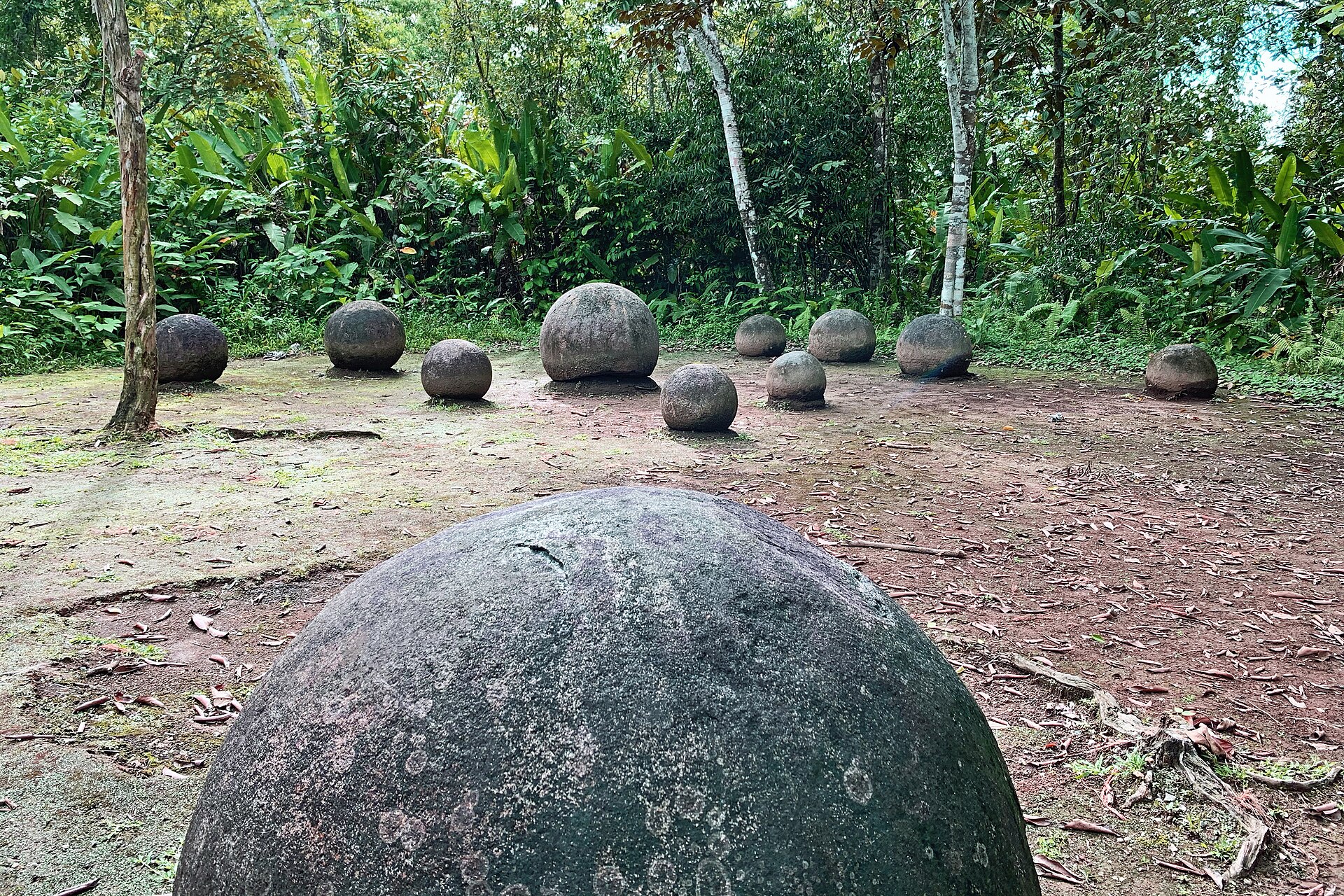
The first scientific study was published by Doris Stone in 1943, followed by Samuel Lothrop of Harvard's Peabody Museum, whose 1963 monograph documented around 186 spheres, their sizes and their arrangements. Modern understanding rests on the work of Ifigenia Quintanilla's Sierpe-Térraba project in the 1990s and, since 2002, sustained excavation by Francisco Corrales and Adrián Badilla of the National Museum of Costa Rica. At Finca 6, spheres sit in situ on alignments associated with mounds, ramps and residential areas of the Aguas Buenas (c. AD 300–800) and Chiriquí (c. AD 800–1550) periods. Because stone cannot be radiocarbon-dated directly, ages come from stratigraphy and associated pottery — which is why estimates have shifted over the decades and why displaced spheres are so hard to date at all.
As for manufacture, archaeologists reconstruct a patient, entirely human process: selecting naturally rounded boulders of gabbro or granodiorite, roughing them out by pecking and hammering with harder stones (possibly aided by alternate heating and rapid cooling to spall the surface), then grinding and polishing with sand and leather. The raw stone outcrops lie in the Cordillera Costeña, several kilometres from many find-spots, so the delta's chiefdoms also moved multi-tonne boulders across rivers and swamps. The spheres are strongly associated with high-status settlements and are generally read as markers of chiefly rank, ceremonial space or social identity; their makers left no writing, and researcher John Hoopes of the University of Kansas — the leading academic voice on the spheres — is frank that nobody knows precisely why they were made. Crucially, measurement shows they are very good but not perfect spheres, and unfinished or broken examples fit the hand-working sequence.
- Spheres found in situ at Finca 6 in direct association with dated Aguas Buenas and Chiriquí period settlements
- A plausible manufacturing sequence of pecking, grinding and sand-polishing consistent with tool marks and local technology
- Source outcrops of gabbro and granodiorite identified in the nearby Cordillera Costeña
- Measured deviations from sphericity of centimetres, not the claimed hundredths of an inch
- Continuous archaeological research by the National Museum of Costa Rica since 2002, culminating in UNESCO listing in 2014