Belief & Society · Dambulla, Matale District, Sri Lanka

Dambulla Cave Temple (Rangiri Dambulla)

A golden rock sheltering 153 Buddhas beneath two thousand square metres of painted ceiling — and burial grounds older than Buddhism beneath its shadow.

Mainstream: Temple founded 1st century BC (King Valagamba); caves occupied from prehistory, with megalithic burials nearby c. 700–400 BCAlternative: Date not seriously disputed — the debate is over how deep the site's prehistoric roots run, and whether Sri Lanka's sacred history is far older than the Buddhist chronicles allow7.86°, 80.65°

At a glance

Dambulla Cave Temple (Rangiri Dambulla)
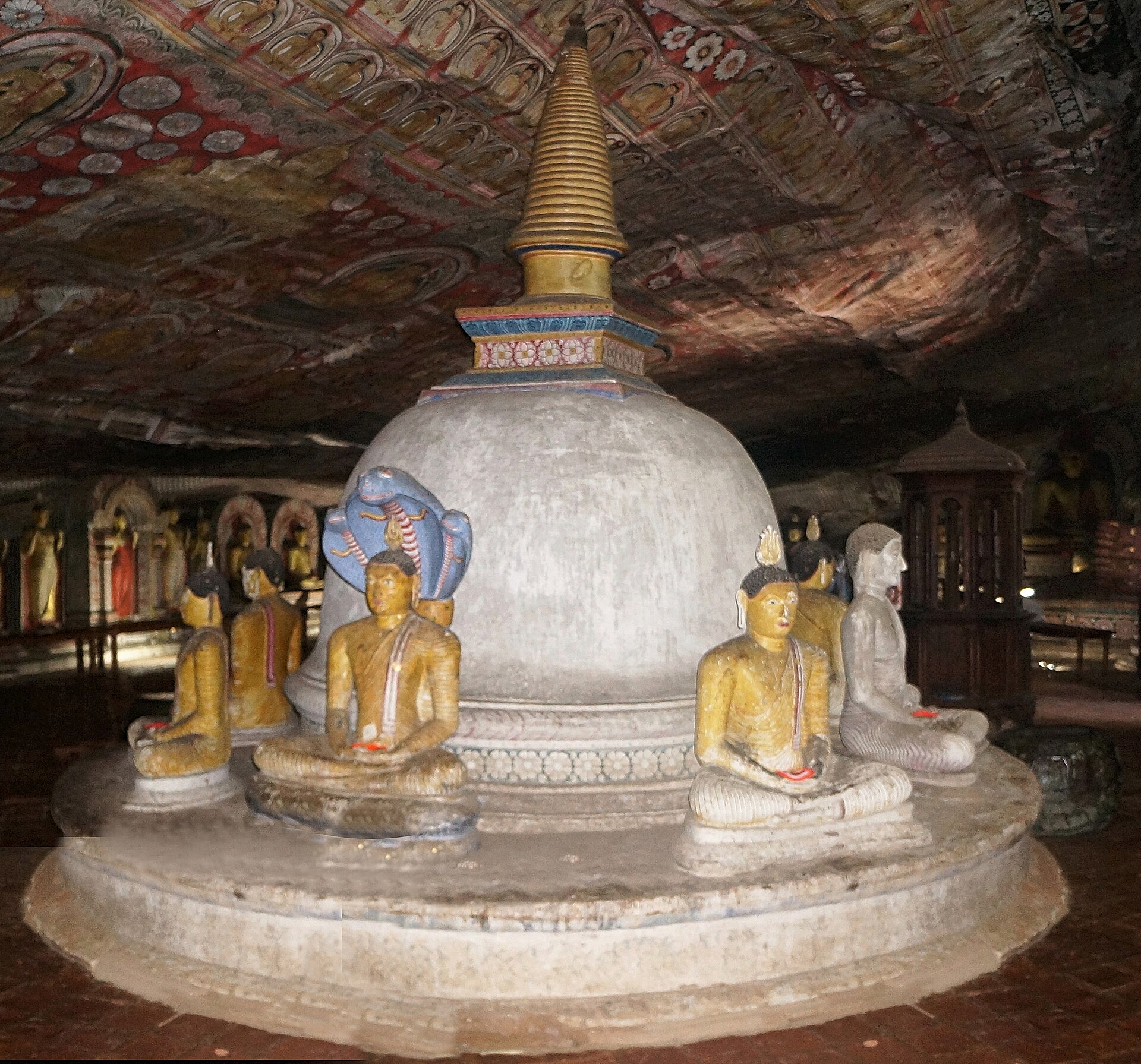
Photo: Pierre André Leclercq · CC BY-SA 4.0

Under the brow of a 160-metre granite outcrop in central Sri Lanka, five caves shelter the largest and best-preserved cave-temple complex on the island. The Rangiri Dambulla temple holds 153 statues of the Buddha, along with images of kings and Hindu gods, beneath ceilings where more than 2,000 square metres of murals flow over every bulge and hollow of the natural rock — geometric fields of seated Buddhas, narrative cycles of the Buddha's life, and scenes from Sri Lankan history repainted and refreshed for centuries. UNESCO inscribed it in 1991 as a site of continuous sacred use for over two millennia. That continuity is the site's real wonder. Tradition holds that King Valagamba of Anuradhapura sheltered in these caves for some fifteen years after being driven from his throne in the 1st century BC, and converted them into a temple in gratitude after his restoration. But people were living and dying around Dambulla long before any king hid there: excavations at Ibbankatuwa, barely three kilometres away, revealed a megalithic cist-burial cemetery dated to roughly 700–400 BC, and habitation evidence in the wider area runs deeper still — making Dambulla a rare place where prehistoric, early historic and living religious landscapes stack directly on top of one another.

See it on the globe →
The mainstream view

What archaeology says

The archaeological and epigraphic record at Dambulla is unusually coherent. Early Brahmi inscriptions carved beneath the drip-ledges of the caves — the grooves cut to shed rainwater, a signature of Sri Lanka's earliest monastic caves — record their donation to the Buddhist sangha around the 3rd to 1st centuries BC, consistent with the Valagamba tradition preserved in the chronicles. Sri Lanka's pioneering epigraphist Senarath Paranavitana catalogued such inscriptions across the island, and Dambulla fits a well-documented pattern of natural rock shelters converted to monasteries in the earliest Buddhist centuries.

The temple as visitors see it is a layered artefact of royal patronage: Nissanka Malla gilded the interiors in the 12th century (earning the name Rangiri, 'golden rock'), and the great Kandyan king Kirti Sri Rajasinha commissioned the comprehensive 18th-century repainting that gives the murals their present character. Archaeologists led by Sri Lankan teams (with German collaboration) excavated the Ibbankatuwa cemetery in the 1980s and 2010s, finding stone-lined cist graves with pottery, iron tools, carnelian and gemstone beads — evidence of an organised Early Iron Age society trading over long distances centuries before Buddhism arrived in 250 BC.

For mainstream scholars, Dambulla therefore tells an evolutionary story: indigenous megalithic communities, then early Buddhist monasticism grafted onto their landscape, then two thousand years of unbroken devotional use. Nothing about the sequence requires mystery — but its completeness is exceptional, and researchers continue to study human remains from the wider site cluster for what they reveal about the island's pre-Buddhist population.

Key evidence cited
  • Early Brahmi drip-ledge inscriptions recording donation of the caves to Buddhist monks around the 3rd–1st centuries BC
  • Chronicle tradition of King Valagamba's refuge and temple foundation, consistent with the epigraphy
  • Ibbankatuwa megalithic cist burials (c. 700–400 BC) with pottery, iron tools and imported gem beads, 3 km from the temple
  • Documented royal renovation history — Nissanka Malla's 12th-century gilding, Kirti Sri Rajasinha's 18th-century repainting
  • Over 2,000 square metres of stratified mural layers studied and conserved as a continuous artistic record
The alternative view

What the skeptics propose

Nobody seriously disputes when Dambulla became a temple; the alternative arguments are about what came before and what it implies. Within Sri Lanka a vocal popular movement — often called Ravana research, promoted by writers such as Mirando Obeysekere and amplified by sympathetic media — holds that the island hosted an advanced civilisation under King Ravana of the Ramayana thousands of years before the chronicles begin, and folds sites like Dambulla, Sigiriya and the island's cave networks into that narrative. On this reading the caves were sacred, engineered spaces of a lost Lankan golden age, merely inherited by Buddhism.

A softer alternative case leans on genuine archaeology: the Ibbankatuwa burials prove sophisticated pre-Buddhist communities in Dambulla's immediate hinterland, prehistoric tool scatters occur across the region, and some popular accounts claim habitation evidence in the Dambulla caves themselves stretching back tens of thousands of years. Advocates argue that Sri Lankan archaeology, historically framed by the Buddhist chronicles, has under-explored the island's deep prehistory — and note that sites such as Fa-Hien Lena cave elsewhere on the island have yielded some of South Asia's oldest modern-human remains, at around 38,000 to 48,000 years.

Mainstream researchers accept the deep prehistory of the island enthusiastically — it is their own discovery — but reject the Ravana framework as mythology retro-fitted onto archaeology, noting it produces no stratified evidence, no inscriptions and no dateable artefacts of the claimed civilisation. The Ibbankatuwa graves belong to a well-understood South Asian megalithic horizon, they argue, and the leap from Iron Age cemeteries to a lost high-technology kingdom is unsupported. What both camps share is a conviction that the ground beneath Dambulla still has much to say.

Key evidence cited
  • Proven pre-Buddhist occupation of the Dambulla area, showing the caves' sanctity predates the historical record
  • The Ravana-research movement's claim (Mirando Obeysekere and others) of a far older Lankan civilisation behind the island's rock sites
  • Sri Lanka's genuinely deep prehistory — cave sites elsewhere on the island with human remains up to c. 48,000 years old
  • Claims that chronicle-framed archaeology has under-investigated layers beneath and around the temple caves
  • Long-distance trade goods in Ibbankatuwa graves, read as evidence of a more connected early society than usually credited

Genuinely open questions

  1. How far back does human use of the Dambulla caves themselves extend beneath the Buddhist layers?
  2. Who exactly were the Ibbankatuwa people, and what became of their communities when Buddhism arrived?
  3. How many earlier mural generations survive beneath the 18th-century Kandyan repainting, and what do they depict?

Worth knowing

Dambulla's painters followed the rock rather than fighting it — the murals flow across every natural bulge and hollow of the cave ceilings, so in places a meditating Buddha gently swells and dips with the stone itself.