What archaeology says
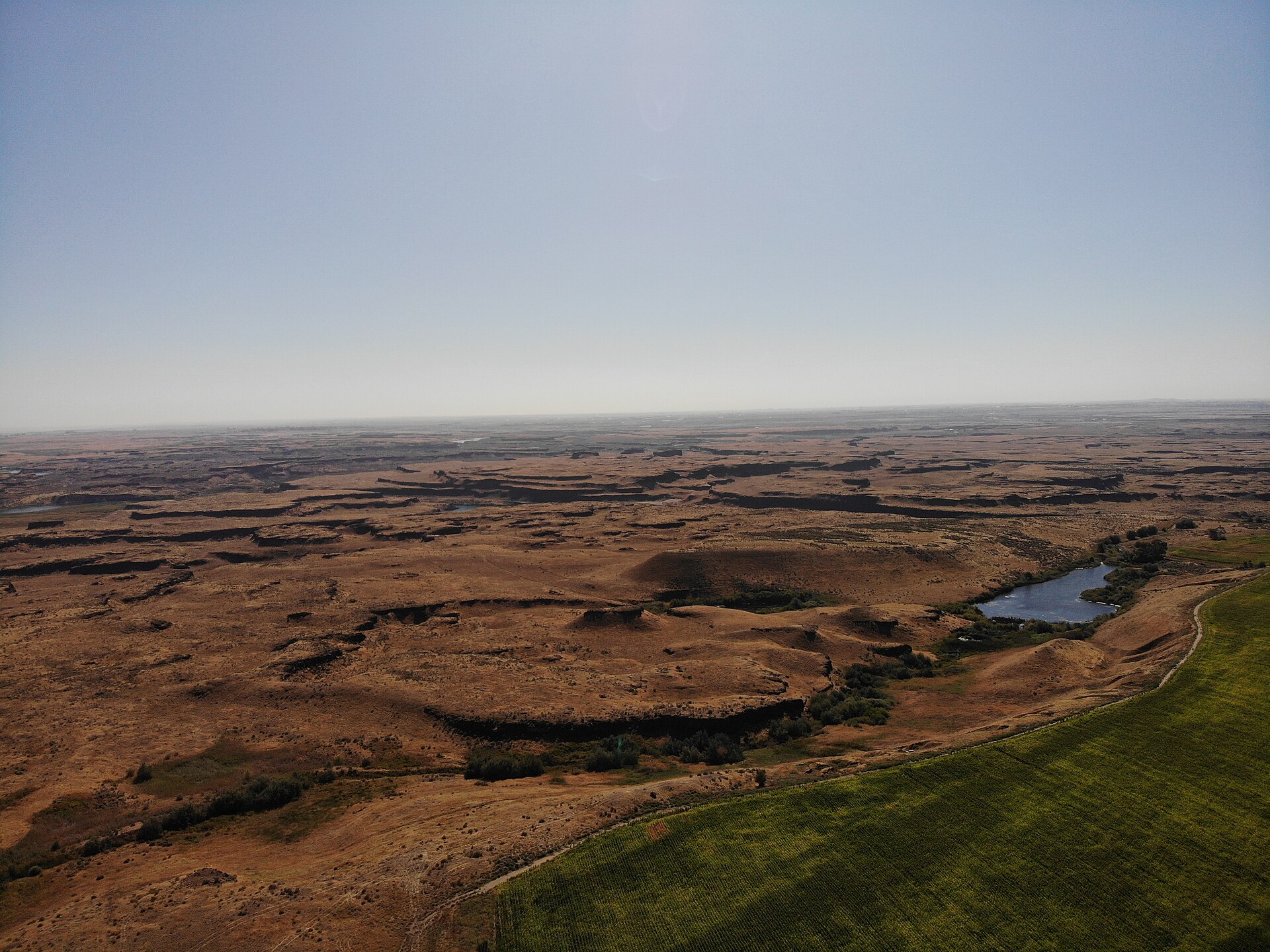
In the 1920s the University of Chicago geologist J Harlen Bretz argued that the Scablands could only have been carved by a sudden, catastrophic flood of staggering size. This collided head-on with the ruling doctrine of the day, uniformitarianism — the principle that landscapes are shaped by slow, everyday processes over immense time. Invoking a biblical-sounding deluge struck Bretz's peers as a betrayal of scientific method, and at a now-famous 1927 meeting of the Geological Society of Washington he was effectively ambushed and dismissed. His key missing piece was a water source. That was supplied by Joseph Pardee, who documented glacial Lake Missoula — a body of water held back in Montana by a lobe of the ice sheet — and its giant current ripples, showing the lake had drained catastrophically when its ice dam failed.
The modern consensus vindicates Bretz's mechanism but revises his single-flood picture. Beginning with Richard Waitt's work around 1980, geologists established that the ice dam formed and failed repeatedly, unleashing not one but roughly forty or more separate megafloods between about 18,000 and 13,000 years ago. Rhythmically layered flood deposits (rhythmites) with volcanic ash beds and buried soils record the successive events, and peak discharges are estimated at up to seventeen million cubic metres per second. Bretz lived to see his ideas accepted, receiving the Penrose Medal, geology's highest honour, in 1979 at the age of 96.
Bretz remains the discipline's cautionary tale about premature rejection, and his story is routinely cited whenever a maverick hypothesis meets institutional resistance.
- Giant current ripples and drained-lake features at glacial Lake Missoula (Pardee) supplying the floodwater
- Dry Falls and vast dry cataracts, plunge pools and scoured basalt explicable only by immense flood discharge
- Rhythmically layered flood deposits with intervening soils and ash beds recording repeated events
- Waitt's multiple-flood chronology dating roughly 40+ floods to about 18,000–13,000 years ago
- Erratic boulders and gravel bars whose scale matches modelled discharges of millions of cubic metres per second