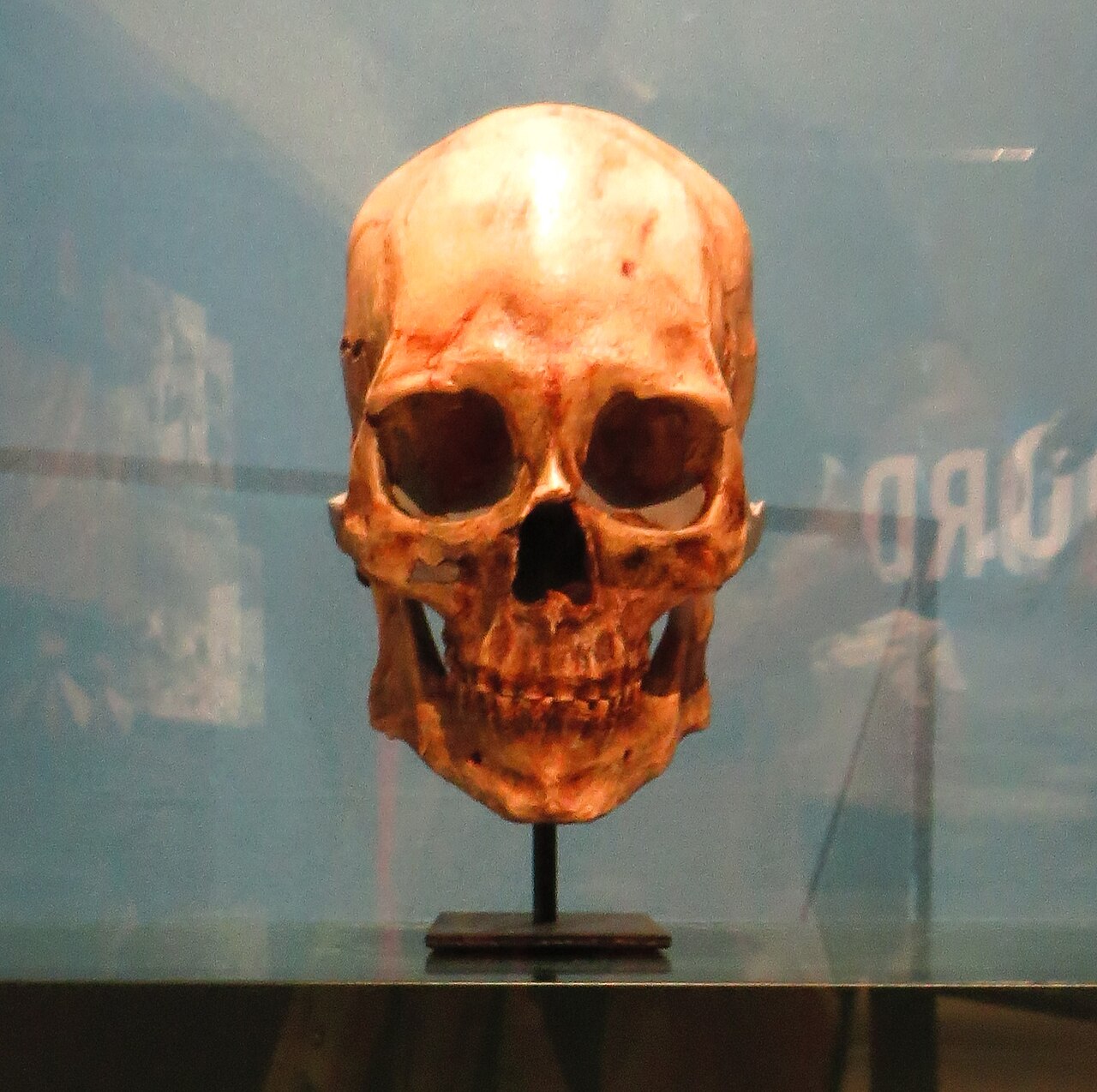
Origins of Civilisation · Bank of the Columbia River, Kennewick, Washington, USA

Kennewick Man / the Ancient One

A 9,000-year-old skeleton, a 'Caucasoid' misreading, and a twenty-year custody war.

Mainstream: c. 8,500-9,000 years oldAlternative: Once misread as 'Caucasoid' and non-Native46.21°, -119.14°

At a glance

Kennewick Man / the Ancient One
Photo: Ghedoghedo · CC BY-SA 4.0

In July 1996, two men found a human skull on the bank of the Columbia River near Kennewick. The nearly complete skeleton - about 8,500 to 9,000 years old - became the centre of a two-decade legal and cultural battle. An early anatomical description called the skull 'Caucasoid', which was widely misread as meaning the individual was European rather than Native American, feeding claims that challenged tribal origins. Ancient DNA and federal legislation ultimately resolved the case, and the Ancient One was reburied by Columbia Basin tribes in 2017.

See it on the globe →
The mainstream view

What archaeology says

The scientific and legal resolution is now settled. Genome sequencing published in 2015 by Eske Willerslev's team at the University of Copenhagen showed that the Ancient One is more closely related to modern Native Americans than to any other population, and specifically closest to Columbia Plateau tribes such as the Confederated Tribes of the Colville Reservation. Independent analysis by geneticists at the University of Chicago in 2016 confirmed the result. The DNA answered the question directly: this was a Native American ancestor.

The word "Caucasoid" in Douglas Owsley's early forensic description had been a source of enormous confusion. In mid-twentieth-century physical anthropology, cranial "Caucasoid" was a morphological category, not a statement of European descent, and the individual's skull shape simply differs from that of many later Native Americans - a reflection of how much cranial form changed over nine millennia, not evidence of European ancestry. The public and some litigants nonetheless took "Caucasoid" to mean "white", which drove a decade of contention.

Legally, the skeleton had been the subject of a lawsuit in which scientists won the right to study it against tribal claims under NAGPRA. After the DNA results, Congress acted: a provision in the 2016 Water Infrastructure Improvements for the Nation Act directed the remains to Washington State for return to the claiming tribes. On 18 February 2017 the Ancient One was reburied at an undisclosed location by more than 200 members of five Columbia Basin tribes.

Key evidence cited
  • The skeleton is radiocarbon-dated to roughly 8,500-9,000 years old.
  • 2015 genome sequencing showed closest affinity to modern Native Americans, especially Plateau tribes.
  • Independent 2016 analysis at the University of Chicago confirmed the Native American result.
  • 'Caucasoid' was an outdated morphological label, not a claim of European descent.
  • Cranial shape differences reflect nine millennia of change, not a separate ancestry.
The alternative view

What the skeptics propose

During the long dispute, the "Caucasoid" description and the skeleton's unusual cranial shape were seized upon to argue that the earliest Americans might not have been the ancestors of today's Native peoples at all - that Europeans, Ainu, Polynesians or other populations reached the Americas first and were later displaced. This "Palaeoamerican" narrative connected Kennewick to the Solutrean hypothesis and to a wider set of claims that the standard Beringian, single-origin model of American settlement was incomplete or wrong. A facial reconstruction that some said resembled the actor Patrick Stewart became an emblem of the idea.

For alternative-history writers, Kennewick was doubly attractive: it seemed to show an anomalous early skeleton and it involved a bitter fight in which the government sided, for years, with keeping the bones from the tribes, which could be framed as suppression of study or of an inconvenient origin story. The case was cited as evidence that the peopling of the Americas was more tangled than textbooks admitted.

The current standing is that these interpretations were resolved against them. The DNA is unambiguous, the "Caucasoid" reading has been retired as a misunderstanding of an outdated typological term, and the once-popular Palaeoamerican-replacement narrative has collapsed for Kennewick specifically, even as debate about the details of American settlement continues.

Key evidence cited
  • The early 'Caucasoid' description was read as evidence of non-Native, possibly European ancestry.
  • The unusual cranial shape was linked to Palaeoamerican and Solutrean replacement models.
  • A widely circulated facial reconstruction looked, to some, un-Native.
  • The long federal fight to allow study was framed as suppression of an inconvenient origin.
  • Proponents argued the earliest Americans might differ from later Native populations.

Genuinely open questions

  1. How much did cranial form change across the millennia between the Ancient One and later peoples?
  2. Why did an outdated typological term cause such lasting public misunderstanding?
  3. What does the case reveal about balancing scientific study against Indigenous rights under NAGPRA?
  4. How do rare early skeletons like this fit the genetically supported single-origin peopling model?

Worth knowing

The tribes always called him the Ancient One and insisted he was an ancestor - a position the cutting-edge genome sequencing of 2015 ultimately confirmed, so that twenty years of expensive science arrived at the answer the Columbia Plateau tribes had stated from the start.