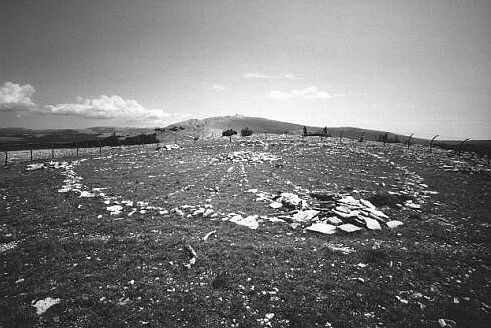
Ancient Knowledge · Medicine Mountain, Bighorn Mountains, Wyoming, USA

Bighorn Medicine Wheel

A 28-spoke stone wheel on a windswept 2,940-metre summit — sacred ground to dozens of tribes, and the site that launched North American archaeoastronomy's biggest argument.

Mainstream: c. AD 1200–1700, with construction phases and use continuing into the historic eraAlternative: Date not seriously disputed — the argument is whether the wheel was a deliberate solstice-and-star observatory (Eddy) or a ceremonial monument whose alignments are coincidental44.83°, -107.92°

At a glance

Bighorn Medicine Wheel
Photo: National Park Service · Public domain

The Bighorn Medicine Wheel is a circle of limestone rocks about 25 metres across, laid out on a treeless shoulder of Medicine Mountain in Wyoming's Bighorn range at roughly 2,940 metres above sea level. Twenty-eight uneven spokes radiate from a central stone cairn to the rim, and six smaller cairns sit on or just outside the circle, most opening in different directions. Snow closes the site for much of the year; it is fully accessible only around midsummer. Since 2011 it has been protected within the Medicine Wheel/Medicine Mountain National Historic Landmark, and visitors today walk the final 2.4 kilometres on foot past a fence hung with prayer cloths and offerings. The wheel is the best-known of well over a hundred 'medicine wheels' scattered across the northern Plains, the great majority in Alberta and Saskatchewan, some of which — like the Majorville cairn — have basal deposits thousands of years old. Crucially, the Bighorn wheel is not a ruin: it is an active ceremonial site. More than 80 tribes, including the Crow, Cheyenne, Arapaho, Shoshone and Lakota, hold historical and religious connections to Medicine Mountain, and fasting, vision quests and ceremonies continue there under a landmark 1996 management agreement between the tribes and federal agencies.

See it on the globe →
The mainstream view

What archaeology says

Archaeologists date the Bighorn wheel broadly to between AD 1200 and 1700, though precision is impossible because unmodified surface stones cannot be directly dated. A piece of wood lodged in one cairn gave a tree-ring date of about 1760, showing at least one element was in use then; artefacts from the vicinity span several centuries; and the cairns themselves may be older than the connecting spokes, with the monument growing by accretion. When the Crow arrived in the region they said the wheel was already there, and Crow tradition ties the site to the story of Burnt Face, a scarred young man who fasted on the mountain, tended an eagle's nest and was healed — a narrative charter for the vision-quest use that continued into the historic period and continues today. Ethnographers record functional parallels too: the 28 spokes match the 28 rafters of a Lakota Sun Dance lodge and the days of the lunar month, and several historic-period medicine wheels on the Plains are documented memorials to noted chiefs.

The site's scientific fame, however, comes from astronomy. In 1972 the solar astronomer John Eddy of the High Altitude Observatory surveyed the wheel and published his analysis in Science in 1974, showing that a line from cairn E through the centre marks the summer solstice sunrise, another pair the solstice sunset, and that three further cairn pairs point to the dawn rising points of Aldebaran, Rigel and Sirius — bright stars whose heliacal risings, around AD 1200–1700, flagged the approach and passing of the solstice at roughly 28-day intervals. Jack Robinson later added a proposed Fomalhaut alignment fitting an earlier window. Since the site is only easily reached in midsummer, a solstice-timing function seemed elegant, and Eddy extended the model to the Moose Mountain wheel in Saskatchewan with Alice and Thomas Kehoe.

Mainstream opinion today treats Eddy's solstice alignments as plausible but unproven, and the stellar alignments as probably illusory. Astronomer Bradley Schaefer's statistical reassessments found no significant evidence for the star alignments at Bighorn, Moose Mountain or Fort Smith, and a 1980s survey of dozens of medicine wheels showed claimed orientations often fail randomness tests: with six cairns and a centre, many sightlines exist by chance. Critics also note the cairns may predate or postdate the spokes, that some likely held offerings or central poles rather than observers' backsights, and that no Plains oral tradition describes stellar backsight observation at the site. The balanced current view is that the wheel is a ceremonial and vision-quest monument whose builders were certainly aware of the solstice — the season the mountain opens — without it being an 'observatory' in any instrumental sense.

Key evidence cited
  • Wood from a cairn tree-ring dated to c. 1760, with artefacts nearby spanning several centuries
  • Crow tradition (the Burnt Face story) and testimony that the wheel predated their arrival
  • The 28-spoke form matching Sun Dance lodge rafters and documented memorial wheels on the Plains
  • Schaefer's statistical analyses finding no significant evidence for the claimed stellar alignments
  • The wheel's continuity with a broader, millennia-deep Plains medicine-wheel and cairn tradition
The alternative view

What the skeptics propose

At Bighorn the roles are unusually reversed: the boldest claims came from inside establishment science. Eddy was one of America's most respected solar astronomers, and his 1974 Science paper — arriving on the heels of Gerald Hawkins' work at Stonehenge — effectively founded North American archaeoastronomy. The strong version of his thesis, popularised in National Geographic in 1977, presented the wheel as a purpose-built calendar: an alpine instrument where a shivering observer at dawn could fix the solstice by sun and confirm the season by the successive heliacal risings of Aldebaran, Rigel and Sirius. Proponents argue this is no stranger than accepting solstice function at Stonehenge, that the alignments' modest precision is exactly what rough boulder cairns would deliver, and that the 28 spokes suit a luni-solar counting device. Jack Robinson's Fomalhaut extension even offered a way to push the wheel's astronomical use back a century or two, and supporters note the wheel's high, view-commanding, midsummer-only location is hard to explain for ceremony alone when sheltered sites lay nearby.

Beyond the academic debate, the wheel has been drawn into wider alternative currents. New Age writers treat it as a continental 'energy vortex' and hold appropriated ceremonies there; hyper-diffusionist authors have compared it to Old World stone circles and speculated about pre-Columbian visitors, occasionally reviving the 19th-century canard that the wheel was built by a vanished non-Indian race — early settlers variously credited it to the Aztecs or lost wanderers. There is no archaeological support for any external origin: the wheel sits squarely within a documented Plains tradition of stone cairns, effigies and wheels stretching back millennia at sites like Majorville.

Tribal voices complicate both camps. For the Crow, Cheyenne, Arapaho, Shoshone, Lakota and dozens of other nations, the question 'what was it for' is partly malformed: Medicine Mountain is a place of fasting, vision and healing whose meaning is carried in living practice, not recoverable solely by sightline mathematics. Native critics have objected both to New Age appropriation and to reductionist astronomical readings, while some Indigenous scholars embrace the sky connection on their own terms — noting that Plains star knowledge was rich and practical, and that watching the solstice sun from a sacred summit needs no imported theory to explain.

Key evidence cited
  • Eddy's 1974 Science survey showing cairn lines to summer solstice sunrise and sunset
  • Proposed cairn alignments to the heliacal risings of Aldebaran, Rigel and Sirius, spaced ~28 days apart
  • Robinson's added Fomalhaut alignment extending the proposed observational scheme
  • The site's exposed midsummer-only summit location, argued to fit solstice observation
  • Parallel alignment claims by Eddy and the Kehoes at the Moose Mountain wheel in Saskatchewan

Genuinely open questions

  1. Were any of the cairn alignments intended, or are they artefacts of abundant chance sightlines?
  2. How old are the wheel's oldest elements, and were the cairns and spokes built centuries apart?
  3. Why 28 spokes — lunar days, Sun Dance lodge rafters, both, or neither?

Worth knowing

John Eddy noted that the Bighorn wheel's star-and-solstice scheme worked best between about AD 1200 and 1700 because precession slowly shifts every star's rising point — meaning that if he was right, the wheel is a calendar with a built-in expiry date.