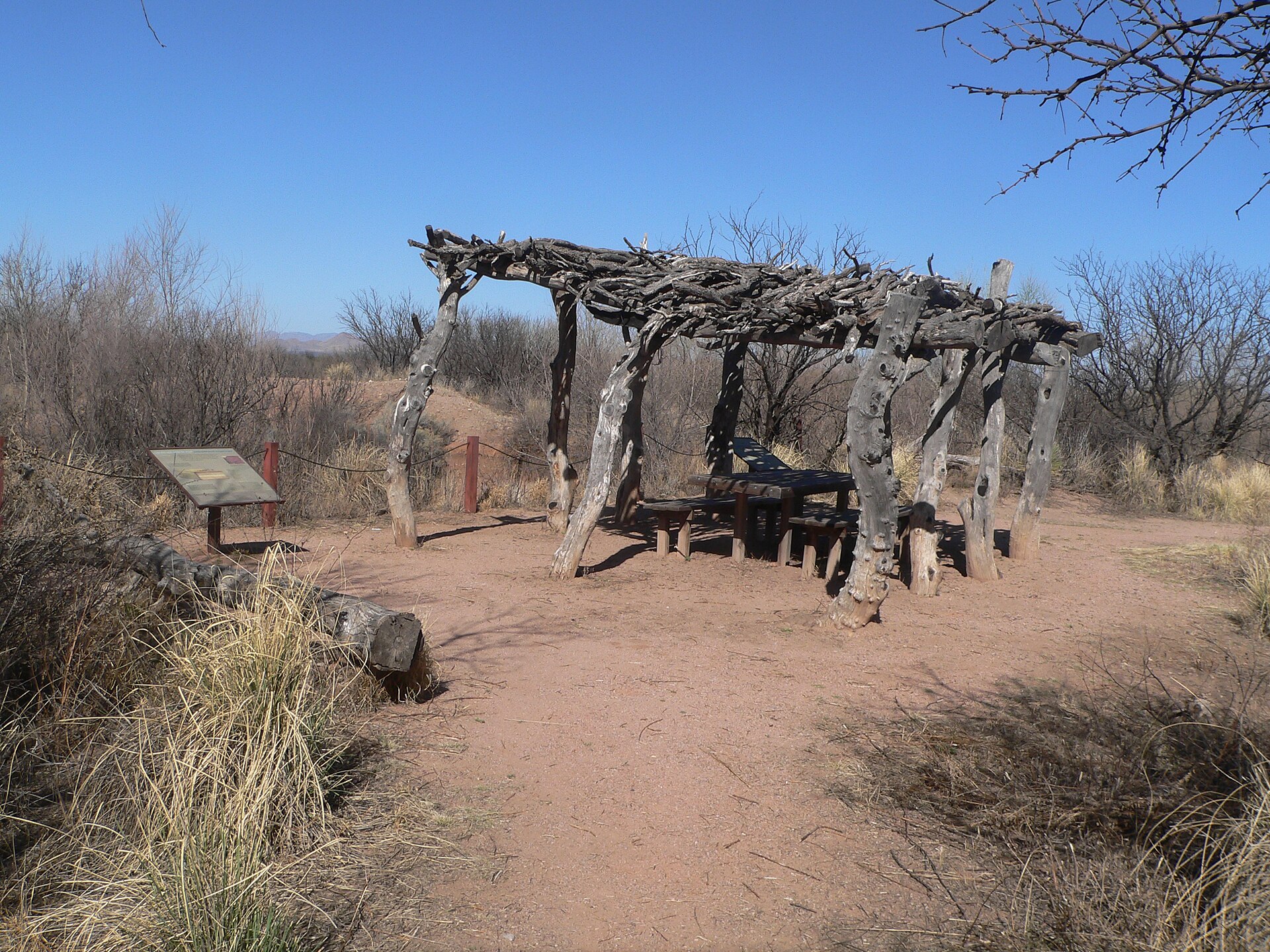
Catastrophe & Climate · San Pedro Valley near Sierra Vista, Arizona, USA

Murray Springs & the 'Black Mat', Arizona

A Clovis hunting camp sealed beneath a dark organic layer that marks the exact moment the Ice Age megafauna vanished — and the front line of the impact-hypothesis fight.

Mainstream: Clovis occupation c. 13,000 years ago; the black mat marks the Younger Dryas onset c. 12,800 years agoAlternative: Same date, but read as the fingerprint of a cosmic impact at the Younger Dryas boundary31.57°, -110.18°

At a glance

Murray Springs & the 'Black Mat', Arizona
Photo: Ammodramus · CC0 (public domain)

Murray Springs, in the San Pedro Valley of south-eastern Arizona, is one of the most important Clovis-era sites in North America: a cluster of mammoth and bison kill-and-butchery locations with Clovis spear points, tools and even a rare bone tool, all sealed beneath a distinctive dark stratum known as the 'black mat'. That thin organic layer, deposited around 12,800 years ago at the onset of the Younger Dryas, drapes over the Clovis material and the last bones of the extinct megafauna — and above it, they are simply gone. The layer has become a battleground over what killed the Ice Age giants.

See it on the globe →
The mainstream view

What archaeology says

Murray Springs was excavated principally by the geoarchaeologist C Vance Haynes, one of the most respected authorities on the peopling of the Americas, whose careful stratigraphy made the site a reference point for Clovis studies. Haynes documented the black mat — a wet, algal, organic-rich horizon — at Murray Springs and traced comparable dark layers across many sites in the American south-west. In the standard interpretation the black mat records an abrupt shift to cooler, wetter conditions at the Younger Dryas onset, raising water tables and spreading marshy, algae-rich ground. Critically, Clovis artefacts and megafaunal remains occur beneath it and never above it, making the mat a stratigraphic marker for both the end of Clovis and the extinction of the megafauna.

The consensus explanation for those extinctions combines rapid climate change with sustained human hunting pressure, without any need for an extraterrestrial trigger. Haynes himself, while acknowledging the black mat as a genuine and abrupt signal, remained cautious and ultimately sceptical of the claim that a cosmic impact caused it. The mainstream position, reinforced by comprehensive reviews such as the 2023 Earth-Science Reviews refutation led by researchers including Vance Holliday and Mark Boslough, is that the proposed impact proxies are either misidentified, non-unique, poorly dated or not reliably reproducible, and that no crater, no shocked minerals and no consistent global signature support an impact.

On this view Murray Springs is a superb record of climate-driven ecological upheaval at the close of the Ice Age — dramatic, but earthly.

Key evidence cited
  • Clovis artefacts and megafaunal bones found below the black mat and never above it
  • Haynes' detailed stratigraphy showing the mat as a wet, algal layer marking the Younger Dryas onset
  • Comparable dark organic horizons traced across many south-western sites as a climatic signal
  • 2023 Earth-Science Reviews refutation finding the impact proxies misidentified or non-unique
  • Absence of any crater, shocked minerals or reliably reproduced global impact signature
The alternative view

What the skeptics propose

Proponents of the Younger Dryas Impact Hypothesis read the very same black mat as a scorch line from the sky. Following Firestone et al. (2007), a research group centred on James Kennett, Allen West, Richard Firestone and colleagues reported a suite of impact proxies concentrated in a thin layer at the base of the black mat at Murray Springs and other sites: magnetic microspherules, high-temperature melt-glass, elevated platinum and iridium, and nanodiamonds — including forms they argue can only form under impact-level shock and heat. In their account, a comet or its fragments struck or airburst over the ice sheet around 12,800 years ago, igniting continent-wide wildfires, destabilising the climate, and wiping out the megafauna and Clovis culture in a geological instant, with the black mat settling over the devastation.

The nanodiamond claim became the sharpest point of the fight. Supporters say the diamonds have been independently replicated at multiple sites, Murray Springs among them, and that the spherule and platinum spikes recur at the boundary across continents. Advocates such as science writer James Lawrence Powell have gone further, arguing in a 2022 paper that the hypothesis has suffered 'premature rejection' — that Bretz-style institutional resistance, not the evidence, explains its marginal status.

Critics fired back hard. Teams led by researchers including Tyrone Daulton reported finding no genuine impact nanodiamonds in Younger Dryas sediments, arguing that non-diamond carbon minerals had been misidentified; others showed spherules and magnetic grains at the boundary are ordinary in origin and not unique to that horizon. The result is one of the most bitter, unresolved replication disputes in Quaternary science — with Murray Springs, and its black mat, at the very centre.

Key evidence cited
  • Reported spikes of magnetic microspherules and melt-glass at the base of the black mat
  • Claimed nanodiamonds said to require impact-level shock, replicated at Murray Springs and other sites
  • Elevated platinum and iridium anomalies tied to the Younger Dryas boundary layer
  • Coincidence of the black mat with the abrupt end of both Clovis culture and the megafauna
  • Powell's 'premature rejection' argument that resistance, not evidence, has sidelined the hypothesis

Genuinely open questions

  1. Are the nanodiamonds and spherules at the boundary genuine impact products, or misidentified ordinary materials?
  2. Why can some laboratories replicate the impact proxies while others, using similar samples, cannot?
  3. How much of the megafaunal extinction owes to climate, to human hunting, and to any additional trigger?

Worth knowing

C Vance Haynes, who did more than anyone to make the black mat famous, spent much of his later career arguing against the very impact hypothesis his own layer is now used to support — a rare case of a discoverer publicly restraining the theory built on his find.