What archaeology says
Archaeologists date the complex to the late 1st or early 2nd century AD, probably begun as the private hypogeum of a single wealthy Alexandrian family and progressively expanded into a communal necropolis managed, on the evidence of comparable Alexandrian tombs, by a funerary association; burials continued into the 4th century. The lowest of the three levels is permanently flooded by groundwater — the second was only cleared and reopened after major pumping and drainage works completed in 1995, and managing the water table remains the site's chief conservation battle, addressed by an Egyptian-American dewatering project in the 2010s.
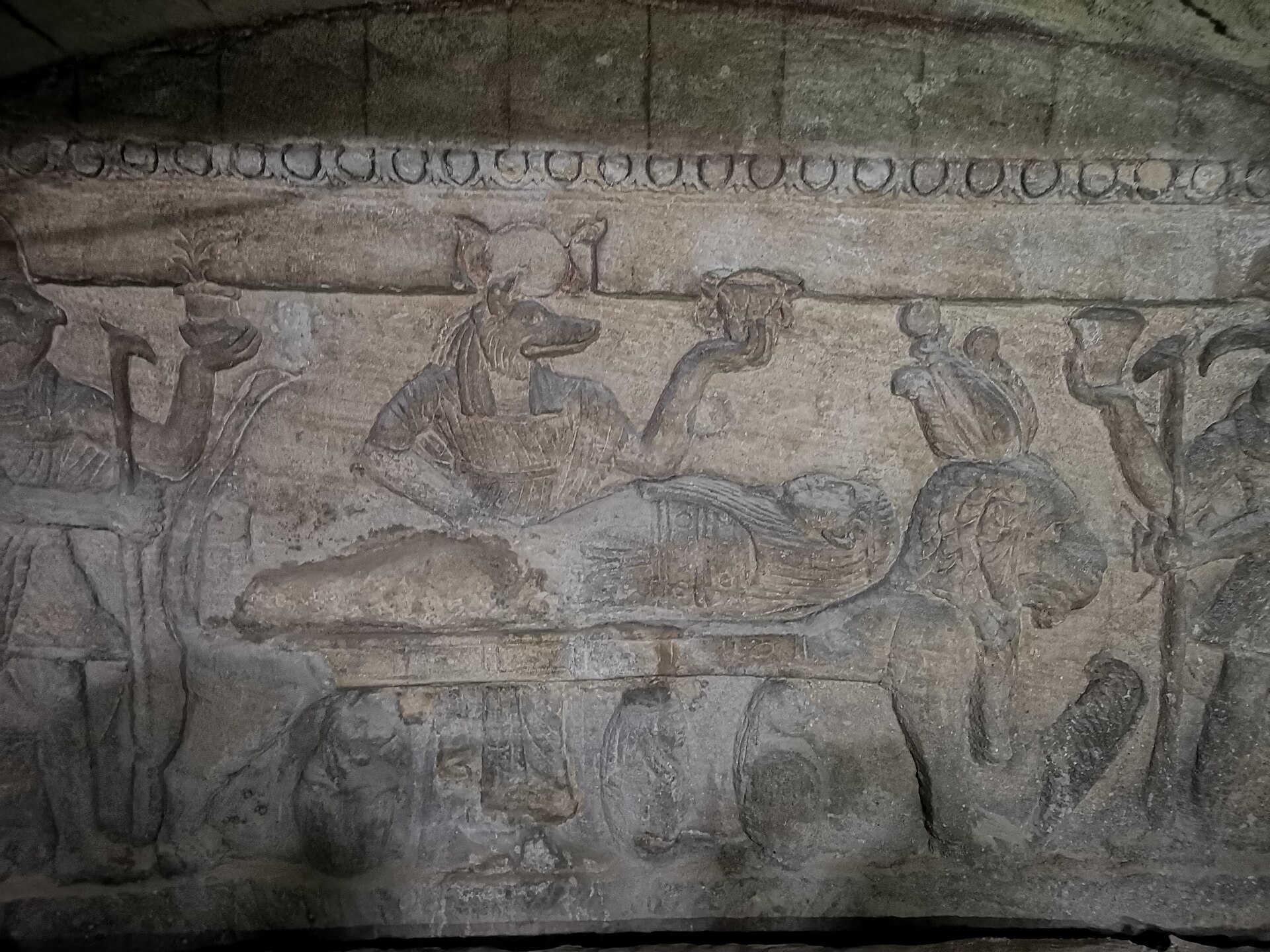
The hybrid art is read by scholars such as Marjorie Venit, whose studies of Alexandria's monumental tombs remain standard, as a deliberate visual strategy rather than confusion: Alexandria's elite were simultaneously Greek by culture, Roman by citizenship and administration, and Egyptian by land and religion, and in death they hedged their bets — Egyptian gods guaranteed resurrection, Greek and Roman forms guaranteed status. The catacombs are thus prime evidence for how multicultural identity actually worked in a Roman provincial metropolis.
The discovery is conventionally dated to 28 September 1900, when the ground gave way beneath a donkey (in some tellings, a donkey-drawn cart) on Rue Karmouz, dropping the animal into the main shaft. The German archaeologist Theodor Schreiber and the founder of Alexandria's Graeco-Roman Museum, Giuseppe Botti, had in fact been hunting for the catacombs in that district for years, and excavation followed immediately under the museum's auspices, continued by Botti's successor Evaristo Breccia.
- Artistic style, architectural form and finds dating the complex firmly to the 1st–2nd centuries AD
- Parallels with other documented Alexandrian hypogea studied by Marjorie Venit, showing a local tomb tradition
- The triclinium, rotunda and shaft system matching known Roman-era funerary practice for family and association burials
- Contemporary 1900 excavation records by Botti, Schreiber and the Graeco-Roman Museum
- Pottery heaps ('shoqafa') consistent with centuries of documented Roman funerary banqueting customs