Belief & Society · Kimberley region, Western Australia

Wandjina Rock Art

Mouthless, halo-crowned cloud spirits — a living Aboriginal tradition repeatedly mistaken for alien portraiture

Mainstream: Wandjina style c. 4,000 years ago to the present; a continuously maintained living traditionAlternative: Claimed by ancient-astronaut writers as memories of sky-beings of unknown antiquity-15.75°, 125.50°

At a glance

Wandjina Rock Art
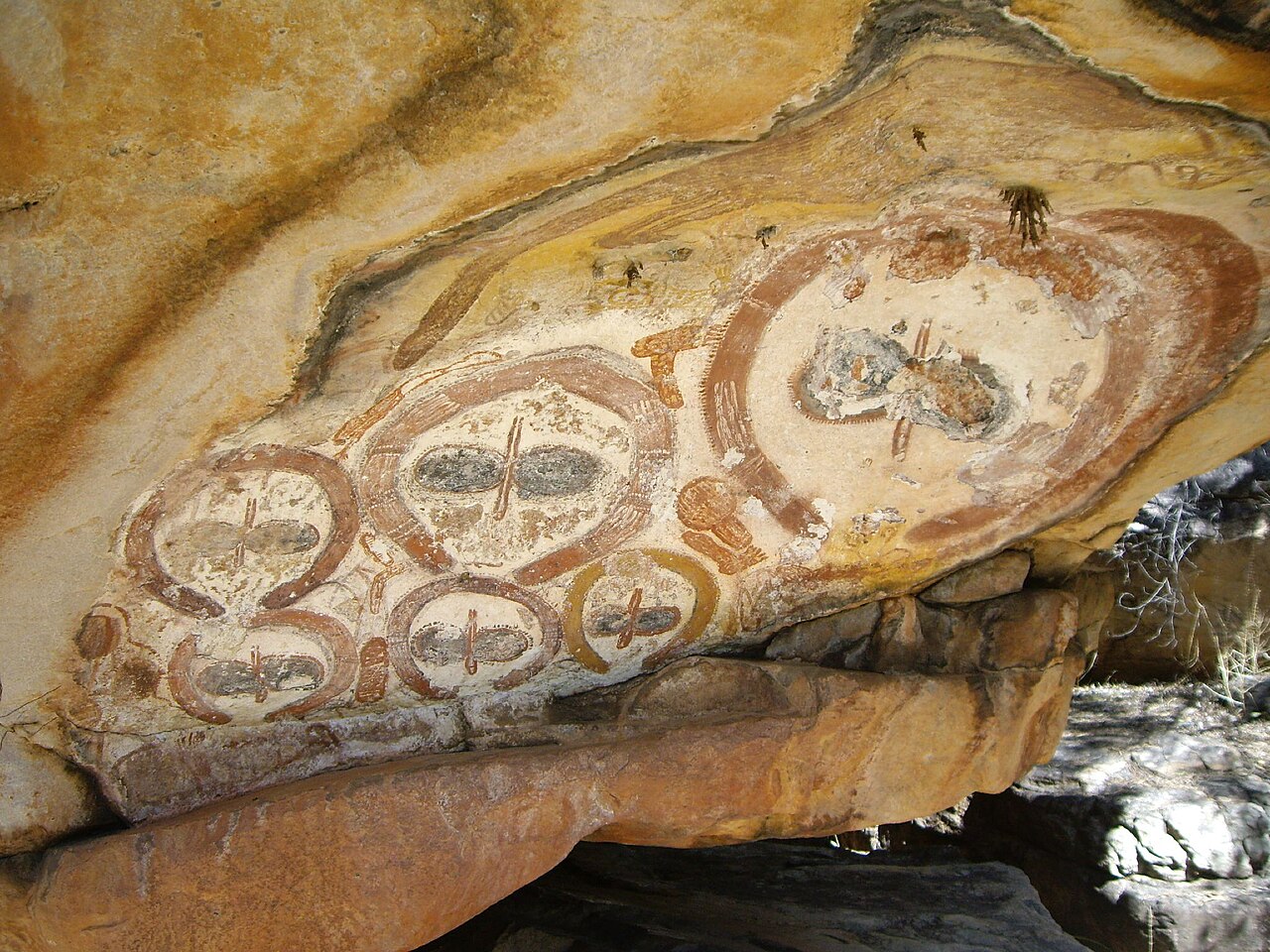
Photo: Claire Taylor · CC BY-SA 2.0

Across the sandstone shelters of the Kimberley in north-west Australia, hundreds of rock shelters carry paintings of the Wandjina: large white-faced figures with dark, staring eyes, no mouths, and radiating headdresses often likened to halos or lightning. To the Worrorra, Ngarinyin and Wunambal peoples, the Wandjina are not pictures of ancestors but the ancestral cloud and rain spirits themselves, present in the rock, controlling the monsoon and the fertility of the land. The style is at least several thousand years old and overlies the much older Gwion Gwion (Bradshaw) paintings, yet it is also contemporary: images were lawfully repainted and refreshed into the twentieth century, and Wandjina remain central to Kimberley art and law today. The figures' otherworldly faces have also made them a fixture of ancient-astronaut books since the 1960s.

See it on the globe →
The mainstream view

What archaeology says

Archaeologists and anthropologists treat the Wandjina paintings as the most recent major phase of one of the world's longest continuous rock art sequences. The style appears in the archaeological record within roughly the last four millennia, following earlier Kimberley traditions including the elegant Gwion Gwion figures, some of which are considerably older. Ethnography collected since the nineteenth century, including Ian Crawford's The Art of the Wandjina (1968), documents in detail what the images mean to their custodians: Wandjina are rain-makers who laid down the law, left their images in the shelters, and must be periodically renewed so the seasons continue.

The distinctive features that outsiders find uncanny have clear explanations within the tradition. Custodians have explained that Wandjina have no mouths because they are so powerful that speech is unnecessary, or because with mouths the rain would never cease; the radiating headdress represents clouds, lightning and feathers. When the explorer George Grey published the first European account in 1838, he speculated the paintings were too sophisticated to be Aboriginal work — a colonial assumption that modern scholarship regards as simply wrong, and which foreshadowed later alien claims.

The tradition's living nature produced a famous controversy in 1987, when a government-funded Ngarinyin project repainted Wandjina images near the Gibb River. Some rock art researchers protested that irreplaceable ancient art had been painted over by young people using modern materials; elders such as David Mowaljarlai replied that repainting is the law, that the images were never static art objects, and that ceasing renewal would itself destroy the tradition. The episode, debated in the journal Antiquity in 1988, became a landmark case in who owns and controls Indigenous heritage.

Key evidence cited
  • Unbroken ethnographic testimony from Worrorra, Ngarinyin and Wunambal custodians explains the figures' meaning, features and required renewal
  • The Wandjina style consistently overlies older Kimberley art phases such as Gwion Gwion, fixing its position as the most recent tradition
  • Documented repainting into the twentieth century shows the images are a maintained practice, not relics of a vanished people
  • Mouthlessness and halo-like headdresses are explained within the tradition (rain power, clouds and lightning) without external input
  • George Grey's 1838 doubts about Aboriginal authorship established a pattern of outsiders underestimating Aboriginal art that alien claims repeat
  • Radiocarbon and stylistic studies of Kimberley art support a long, locally evolving sequence culminating in the Wandjina phase
The alternative view

What the skeptics propose

Ancient-astronaut writers seized on the Wandjina early. Erich von Däniken and successors have presented the white faces, huge dark eyes, absent mouths and halo-like headdresses as a naive rendering of helmeted beings, with the radiating lines read as antennae or an energy field. Because Aboriginal accounts describe the Wandjina as powerful beings who came from the sky and the sea, shaped the land, and will return, proponents argue the oral tradition itself preserves a memory of visitation, and they place the Kimberley figures alongside Tassili's Round Heads and Utah's Barrier Canyon figures as a global gallery of contact imagery. The claim features regularly in the Ancient Aliens television franchise.

Traditional custodians reject this reading emphatically, and their perspective cuts against both camps in instructive ways. For Worrorra, Ngarinyin and Wunambal law, the Wandjina are not depictions of anything — human, alien or otherwise — but living presences in the rock, and speculation about spacemen is experienced as a disrespectful appropriation of sacred beings. Custodians have taken practical action on this front: unauthorised commercial and new-age uses of Wandjina imagery, including a notorious unsanctioned Wandjina sculpture erected near Perth in 2010, provoked formal protests and campaigns for Indigenous cultural intellectual property protection.

At the same time, the custodial view also resists the mainstream framing of the paintings as archaeological specimens with dates and stylistic phases. As the 1987 repainting dispute showed, treating the images primarily as ancient artefacts to be preserved unchanged conflicts with a law in which their renewal is the whole point. The Wandjina case is thus less a mystery about who painted the figures than a test of whether outside interpreters — alien theorists and archaeologists alike — will let a living tradition speak for itself.

Key evidence cited
  • The figures' white faces, oversized black eyes, missing mouths and radiating 'halos' visually suggest helmeted beings to ancient-astronaut proponents
  • Oral traditions describe the Wandjina as powerful non-human beings who came from sky and sea and will return
  • Proponents note the recurrence of mouthless, big-eyed, haloed figures in rock art on several continents
  • Some Wandjina panels show figures apparently floating or grouped like crews, a composition emphasised in ancient-aliens media
  • The precise age of the earliest Wandjina images remains under active scientific investigation, leaving room proponents exploit

Genuinely open questions

  1. Exactly when did the Wandjina style begin, and what drove the transition from the earlier Gwion Gwion tradition?
  2. How should conservation law balance scientific preservation with custodians' obligation to repaint living images?
  3. Can Indigenous cultural intellectual property law effectively prevent misappropriation of sacred imagery like the Wandjina?
  4. What relationship, if any, exists between Wandjina iconography and older Kimberley art phases' belief systems?

Worth knowing

Custodians say the Wandjina are painted without mouths because they are too powerful to need speech — and that if they had mouths, the rain would never stop falling on the Kimberley.