What archaeology says
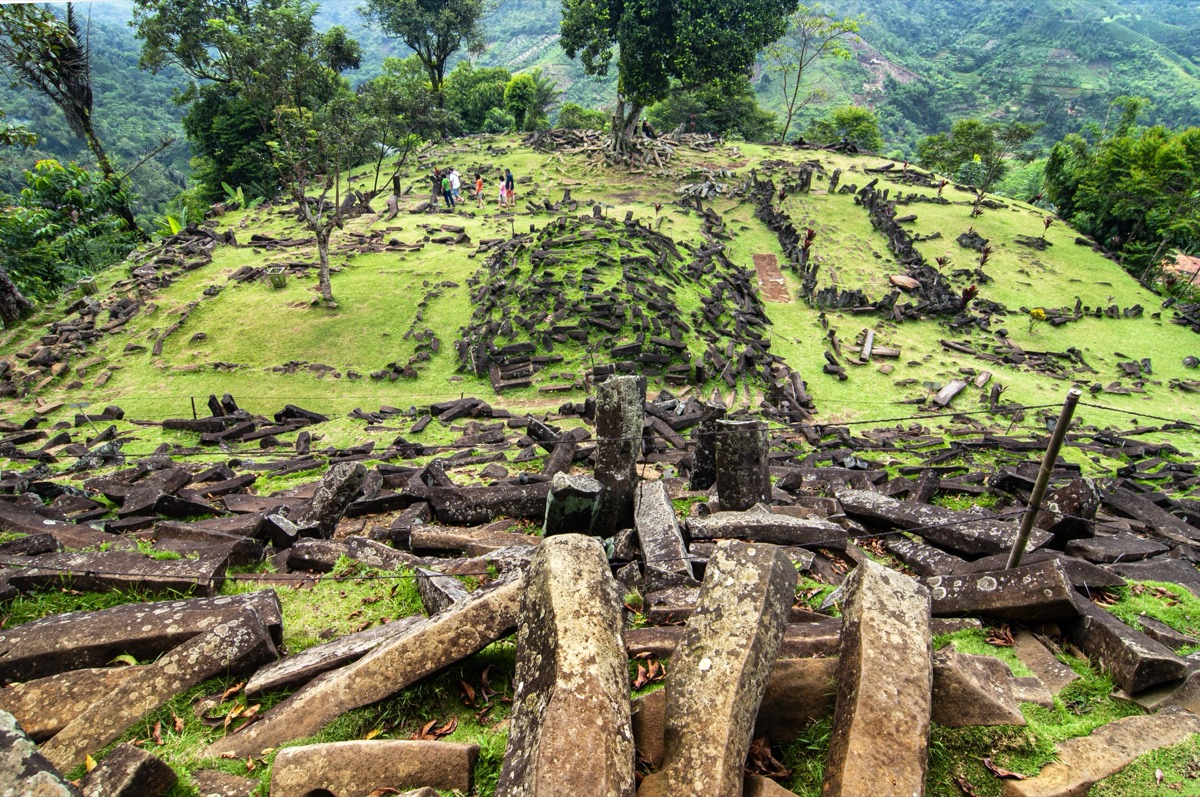
Most archaeologists regard Gunung Padang as a punden berundak — a traditional Indonesian stepped terrace sanctuary — built on top of a natural volcanic hill. The columnar basalt blocks are naturally formed (columnar jointing is a common volcanic phenomenon, as at the Giant's Causeway), quarried or gathered from the hill itself and arranged by people on the summit. Radiocarbon dates and artefacts associated with the visible terraces suggest construction broadly in the first millennium BC to mid-first millennium AD; Indonesian archaeologist Lutfi Yondri's work places the builders' activity around 117 BC–AD 45. Volcanologist Sutikno Bronto interpreted the hill as the eroded neck of an ancient volcano.
In October 2023, geologist Danny Hilman Natawidjaja and colleagues published a paper in Archaeological Prospection claiming the hill conceals multiple constructed layers, the deepest built as far back as 25,000–14,000 BC — which would make it vastly older than any known monument on Earth. After an investigation, the journal retracted the paper in March 2024: the publisher concluded the radiocarbon dates came from natural soil samples not associated with any artefacts or features that could be reliably interpreted as anthropogenic — so they date buried organic matter, not human construction. Critics such as archaeologist Flint Dibble and dating specialists noted the deeper layers yielded no tools, charcoal hearths, bones or any other trace of human activity.
For mainstream scholars, Gunung Padang is still an important site — the finest megalithic terrace complex in Indonesia — just not an Ice Age pyramid.
- Columnar basalt forms naturally; the blocks match the hill's own volcanic geology
- Artefact-associated dates place terrace construction in the last ~2,500 years
- The retracted 2023 paper's deep radiocarbon dates came from natural soil with no artefacts
- No tools, hearths, bones or occupation debris found in the claimed deep layers
- The site fits the known Indonesian punden berundak (stepped sanctuary) tradition