Ancient Engineering · Mount Lawu, Central Java, Indonesia

Candi Sukuh

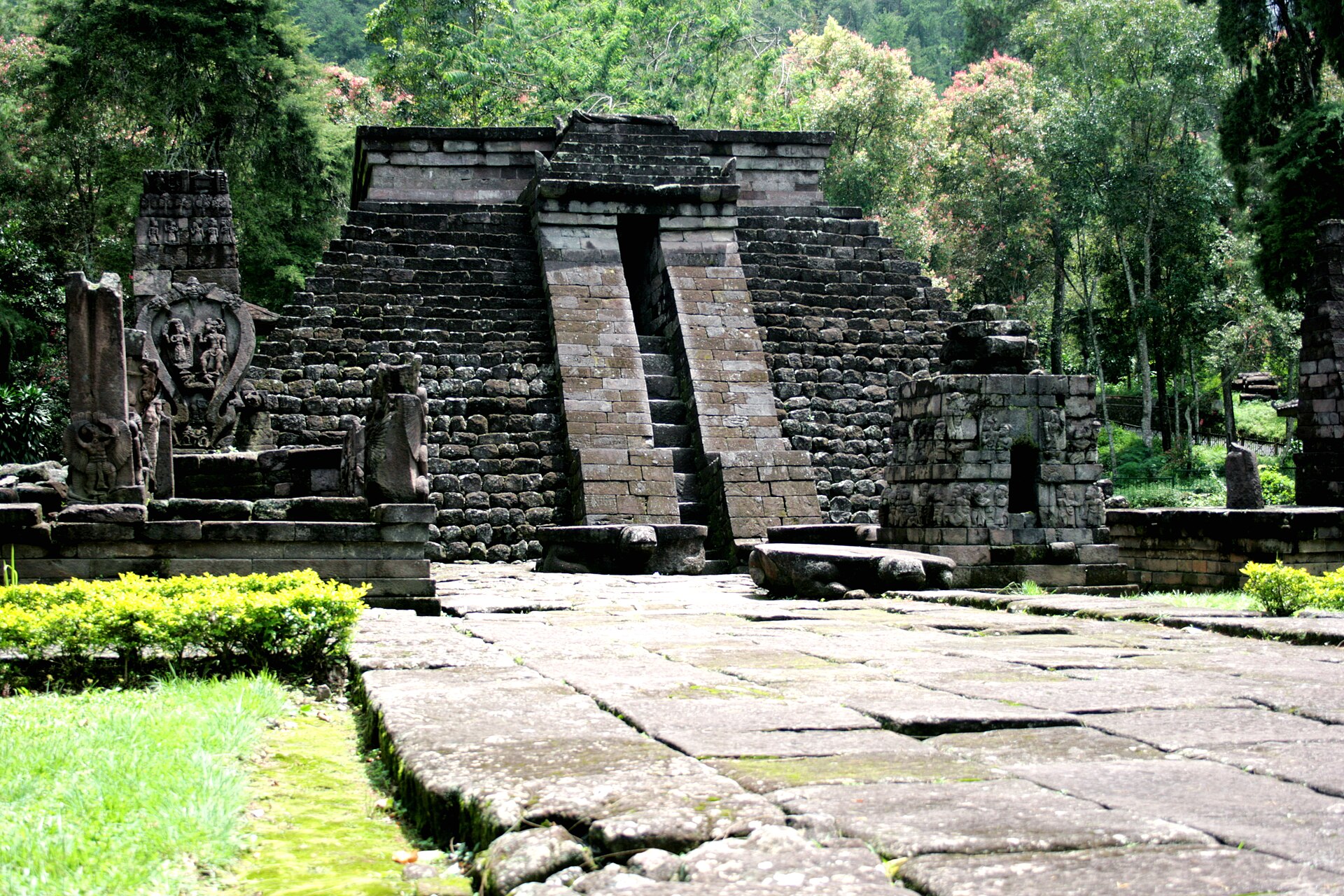
A Javanese temple that looks like it wandered in from the Yucatán — built a world away from the Maya, at the twilight of a Hindu kingdom.

Mainstream: c. AD 1437–1440s (late Majapahit period)Alternative: Date not seriously disputed — alternative writers instead ask why a 15th-century Hindu temple takes the form of a 'Maya-style' stepped pyramid-7.63°, 111.13°

At a glance

Candi Sukuh
Photo: Anton Leddin · CC BY-SA 3.0

Perched at about 910 metres on the western slopes of the volcano Gunung Lawu, Candi Sukuh is unlike any other temple in Java. Instead of the ornate towers of Prambanan or the mandala terraces of Borobudur, its main shrine is a plain truncated stepped pyramid of rough andesite that visitors routinely compare to Maya monuments such as those at Uxmal or Tikal. Around it stand life-sized turtle statues, a winged Garuda, and some of the most sexually explicit carvings in Southeast Asian art — lingam-and-yoni imagery linked to fertility and spiritual release. Built as the Hindu Majapahit kingdom waned before the advance of Islam, Sukuh is both one of Java's last classical temples and one of its strangest.

See it on the globe →
The mainstream view

What archaeology says

Archaeologists date Candi Sukuh securely to the first half of the 15th century. The dating rests on candrasengkala — Javanese chronograms in which a pictorial scene encodes a year: a carving at the western gate showing a monster devouring a man, with birds in a tree, resolves to 1359 Saka, or AD 1437, and a giant 1.82-metre lingam from the site (now in the National Museum of Indonesia in Jakarta) carries an inscribed date equivalent to 1440. Stylistically and epigraphically the complex belongs to the final flowering of Majapahit-era religion, when court Hinduism was retreating to mountain sanctuaries as Islamic sultanates rose on Java's north coast.

The temple's un-Indian appearance has a well-studied explanation. As imported Hindu-Buddhist orthodoxy weakened, Javanese builders revived the far older indigenous tradition of the punden berundak — the stepped terraced platform used for ancestor and mountain-spirit worship across Austronesian cultures for millennia. Sukuh and its neighbour Candi Cetho higher up the same volcano are seen as deliberate returns to this native form, with the pyramid representing the cosmic mountain and the whole complex oriented towards the sacred summit of Lawu. The site was reported to the West in 1815 during Thomas Stamford Raffles' administration of Java, described by the Dutch scholar Van der Vlis in 1842, and restored in stages from the late 1910s, with a major (and controversial) re-restoration completed in 2017.

The reliefs, carved in the flat wayang shadow-puppet style of East Java, narrate tales of Bhima, Garudeya and the liberation of souls, alongside a famous smithy scene in which a blacksmith forges a keris blade while an unusually posed dancing Ganesha looks on — read by scholars as evidence of the mystical status of metalworking in late Majapahit society.

Key evidence cited
  • Pictorial chronogram at the western gate encoding the year AD 1437
  • A dated inscription (equivalent to AD 1440) on the site's 1.82-metre lingam, now in Jakarta
  • Reliefs carved in the late-Majapahit wayang style found across 15th-century East Java
  • The indigenous punden berundak stepped-terrace tradition, which long predates Hindu Java
  • Historical context: mountain sanctuaries multiplied as Majapahit court Hinduism declined
The alternative view

What the skeptics propose

For alternative writers, Sukuh's pyramid is the puzzle. Diffusionist authors, most prominently David Hatcher Childress in his Lost Cities series, present the temple as evidence of ancient transpacific contact — a 'Maya temple in Java' implying that pyramid-building cultures on opposite sides of the Pacific shared a common source or maintained ocean-going links. They point out that Sukuh abandons a thousand years of refined Indo-Javanese temple architecture for a form that, superficially at least, matches Mesoamerica far better than India, and ask why a culture at its artistic peak would suddenly build 'crudely' unless it was copying or remembering something else.

Ancient-astronaut and internet-era researchers have gone further. The popular YouTube investigator Praveen Mohan has presented Sukuh's carvings — a figure seemingly enclosed in a capsule-like form, the strange squat statues, and reliefs he interprets as depicting biological processes — as possible records of advanced knowledge or 'ancient technology', and highlights local traditions that the mountain sanctuary encodes secrets of human origins. Some writers also fold Sukuh into a wider claim, energised by the Gunung Padang debate elsewhere in Indonesia, that Java preserves traces of a much older pyramid-building civilisation beneath its classical monuments.

Mainstream scholars respond that the resemblance to Maya architecture is coincidental convergence: stepped pyramids are among the simplest monumental forms, arising independently in Egypt, Mesopotamia, Mesoamerica, Polynesia and Java. The punden berundak terraces of Indonesia demonstrably predate Hindu arrival, so Sukuh's builders needed no foreign blueprint — they were reviving their own ancestral form. The chronograms, inscriptions and Majapahit historical context leave the 15th-century date effectively beyond doubt, and the 'crude' carving style is a deliberate return to indigenous wayang aesthetics rather than a loss of skill.

Key evidence cited
  • Striking visual resemblance to Mesoamerican stepped pyramids (Childress's transpacific case)
  • Abrupt abandonment of a millennium of refined Indo-Javanese temple architecture
  • Carvings interpreted by Praveen Mohan and others as encoding advanced or anomalous knowledge
  • Sukuh's orientation and terraces echoing far older megalithic mountain sanctuaries
  • Wider claims (via the Gunung Padang debate) that Java hides a much older pyramid tradition

Genuinely open questions

  1. Why did Sukuh's builders reject classical temple forms so completely — revival, sect, or something else?
  2. What ritual purpose did the explicit fertility imagery and the summit platform actually serve?
  3. How much of the original monument was altered by colonial-era and modern reconstructions?

Worth knowing

A relief at Sukuh shows the hero Bhima forging a keris dagger while Ganesha dances beside the furnace — one of the oldest depictions of Javanese blade-smithing, a craft so revered that UNESCO now lists the keris as intangible world heritage.