What archaeology says
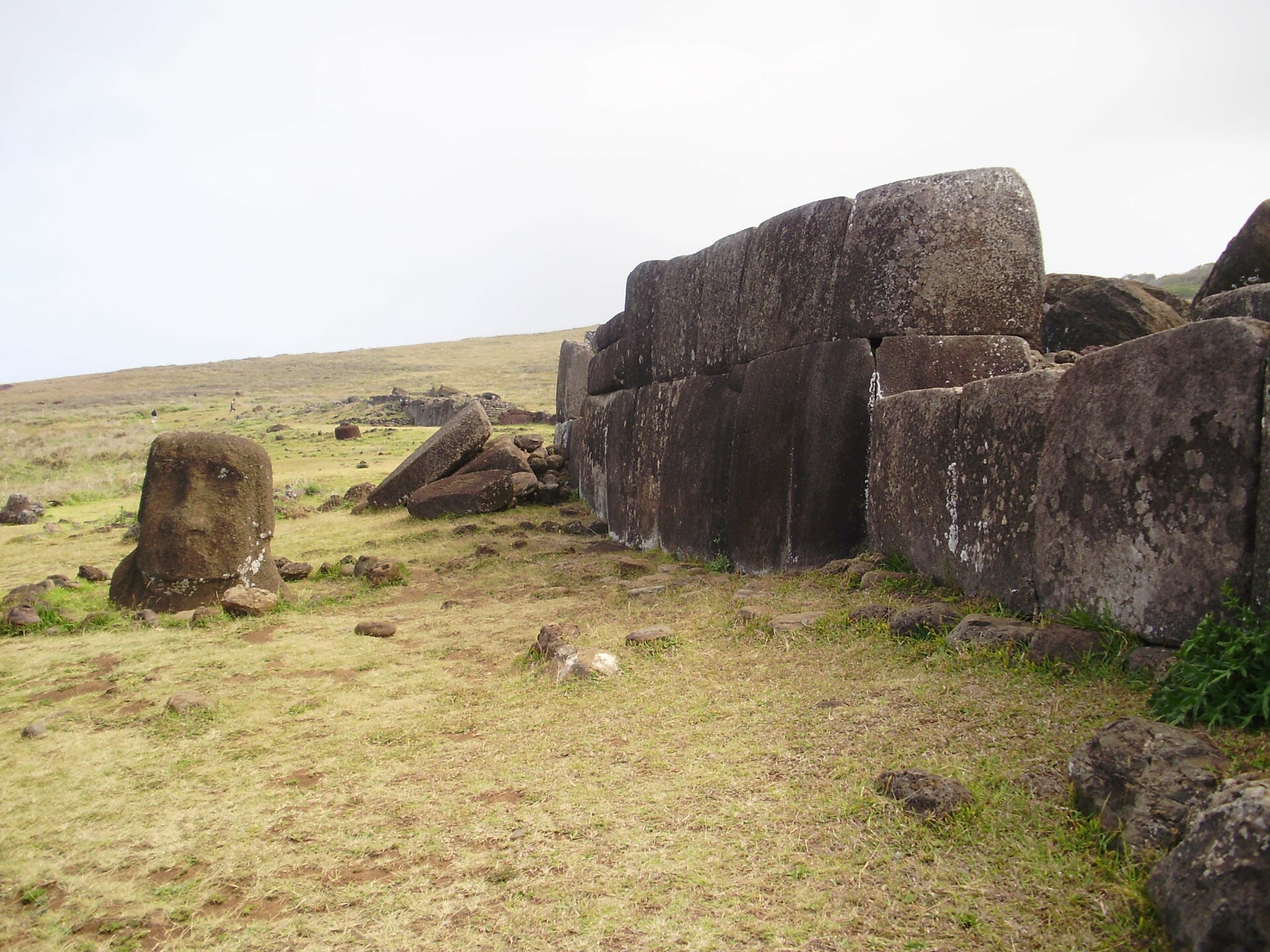
The archaeological consensus is that Rapa Nui was settled by Polynesian voyagers from the west, most likely from the Mangareva or Marquesas region, around AD 1200, and that its monumental culture — moai, ahu and the fitted stonework of Vinapu — developed locally on the island rather than being imported from the Andes. The Norwegian archaeologist Arne Skjolsvold and others who excavated Vinapu found that the celebrated fine-fitted Ahu Vinapu 1 wall is relatively late (dated to around AD 1516), while the rougher, upright-slab facing of the neighbouring Ahu Vinapu 2 is actually earlier (around AD 857). That sequence runs directly opposite to what a South American import model predicts: the 'Inca-looking' refinement is an endpoint of local evolution, not a founding template.
Scholars also stress that the resemblance to Andean masonry is superficial. The Vinapu wall is a facing veneer of dressed slabs over a rubble-and-earth core, not the solid interlocking polygonal blocks of Sacsayhuamán, and the two traditions arrive at a similar look by different means. The genetic and linguistic evidence points overwhelmingly to a Polynesian founding population. A 2024 ancient-DNA study of Rapanui individuals, together with earlier work, confirms the islanders are Polynesian in origin — while also detecting a genuine but minor Native American genetic contribution (around ten per cent), which most researchers interpret as the trace of a contact event somewhere in the eastern Pacific, not as evidence that South Americans built Vinapu.
- Radiocarbon dating placing the fine Vinapu 1 wall late (c. AD 1516), after the rougher Vinapu 2 (c. AD 857)
- The wall being a dressed-slab veneer over rubble, structurally unlike solid Andean polygonal masonry
- Overwhelmingly Polynesian genetics and language among the Rapanui
- A 2024 ancient-DNA study confirming Polynesian origin with only minor Native American admixture
- A clear local developmental sequence for ahu and stonework on the island