What archaeology says
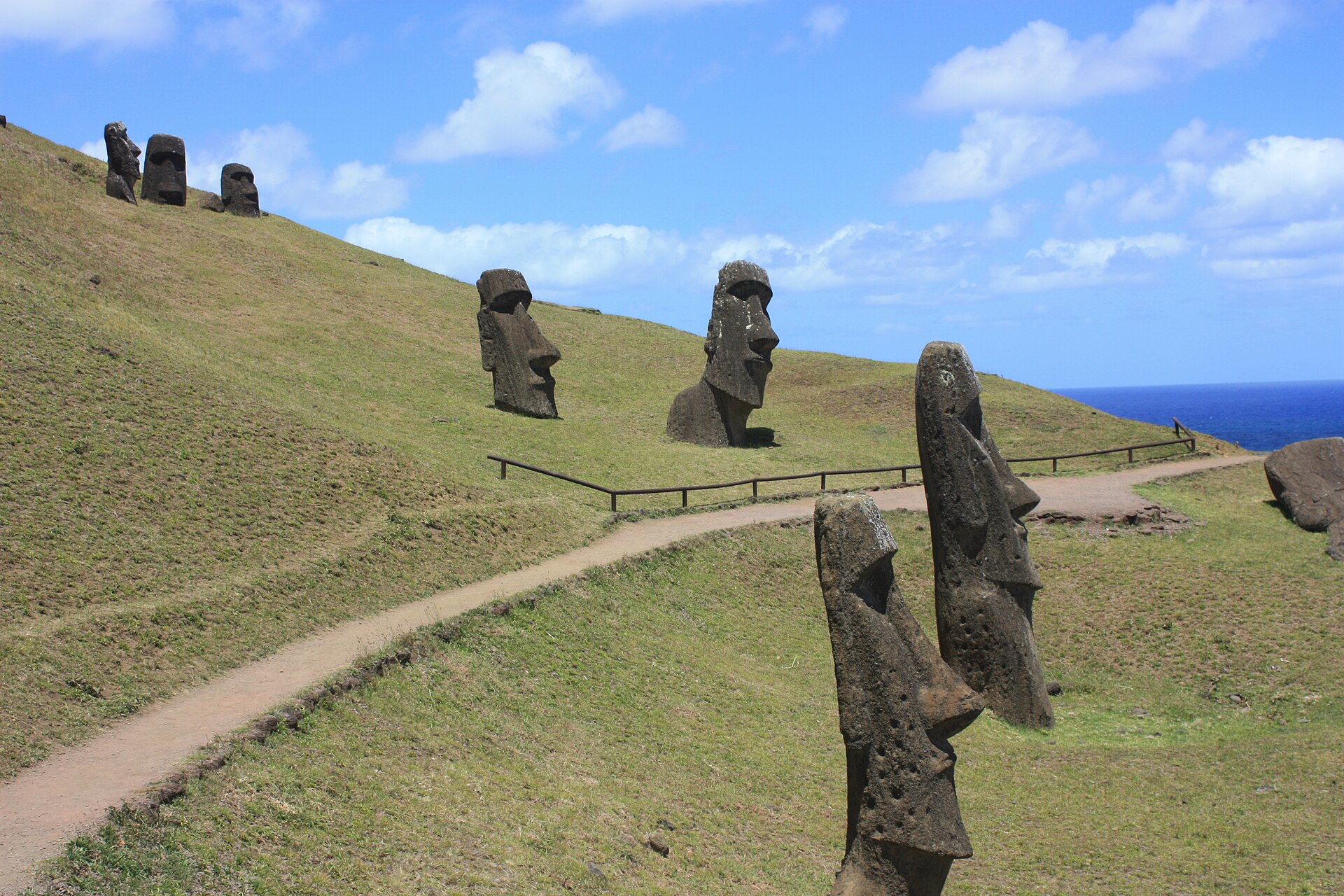
Archaeology and radiocarbon dating indicate Polynesian voyagers settled Rapa Nui around AD 1200, at the tail end of the great eastern Pacific expansion, and carved moai between roughly 1250 and 1600. The statues developed from wider Polynesian ancestor-figure traditions, and every stage of manufacture is documented in the quarry at Rano Raraku. On transport, the long-dominant image of statues hauled prone on wooden sledges (championed by Jo Anne Van Tilburg, who tested a sledge replica) has been strongly challenged by Carl Lipo and Terry Hunt's 'walking' hypothesis: moai abandoned along roads have wide D-shaped bases and a forward lean suited to being rocked upright side-to-side with ropes. In 2012 their team walked a 4.35-tonne replica 100 metres in 40 minutes with just 18 people, and a 2025 Journal of Archaeological Science study added physics modelling, 3D analysis of 962 statues and road evidence, answering critics point by point. Rapa Nui oral tradition always said the moai walked.
The 'ecocide' narrative — popularised by Jared Diamond's Collapse (2005), in which islanders felled every tree, triggered war, famine and demographic catastrophe, toppling their own statues — has fared badly. Hunt and Lipo argued in The Statues that Walked (2011) that deforestation was driven substantially by introduced Polynesian rats eating palm seeds, that there is little evidence of pre-European warfare (the obsidian 'spearpoints', mata'a, are mostly general-purpose tools), and that islanders farmed the poor soils ingeniously with rock-mulch gardens. A 2024 satellite study of those gardens suggested the island supported a modest, stable population of around 3,000–4,000 rather than a boom-and-bust of tens of thousands.
Ancient DNA delivered the strongest blow: a 2024 Nature study of 15 historical Rapanui genomes by Moreno-Mayar and colleagues found no genetic bottleneck in the 1600s — the population grew steadily from settlement until the 1860s, when Peruvian slave raids and introduced disease removed a third of the islanders. The same study confirmed about 10 per cent Native American ancestry entering the gene pool around 1250–1430, evidence of pre-European contact between Polynesia and the Americas. The real collapse, researchers conclude, was colonial, not ecological suicide.
- Radiocarbon dates placing settlement c. AD 1200 and moai carving c. 1250–1600
- 887 moai in every production stage at Rano Raraku, documenting manufacture
- The 2012 and 2025 walking-moai experiments: 18 people moved a 4.35-tonne replica 100 m in 40 minutes
- 2024 Nature ancient-DNA study showing steady population growth and no 17th-century collapse
- Rock-mulch garden surveys indicating a stable population of roughly 3,000–4,000