What archaeology says
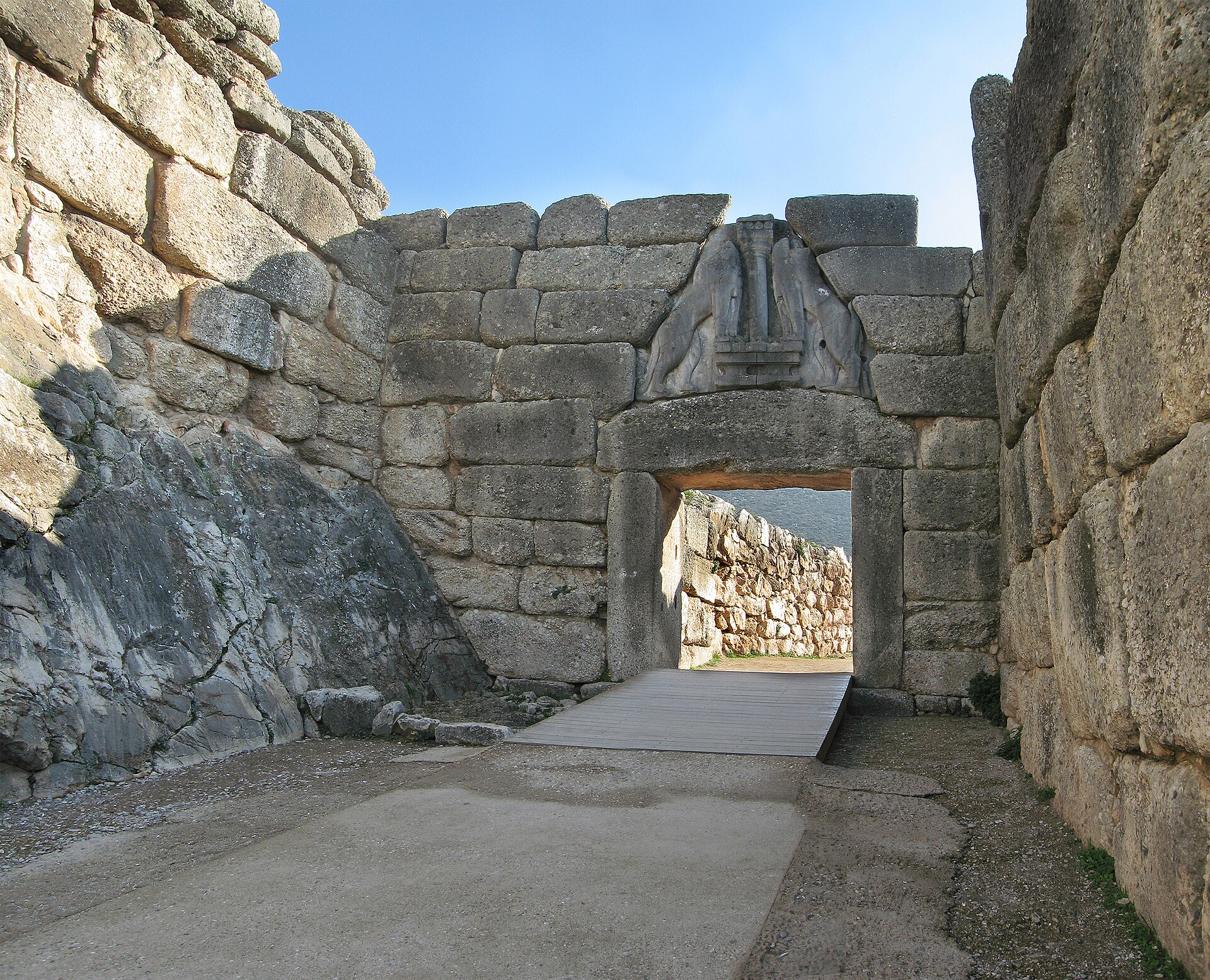
Archaeologists attribute the walls to the Mycenaeans themselves, built and repeatedly expanded during the palatial period of roughly the fourteenth and thirteenth centuries BC, with the main circuit and the Lion Gate at Mycenae dated to around 1250 BC. The construction is understood in ordinary Bronze Age terms: boulders were quarried locally, often barely dressed, and set in courses with smaller stones and clay packed into the gaps. The engineering is real but explicable. To move the heaviest blocks, work gangs are thought to have levered them onto timber sledges, hauled them over log rollers and up purpose-built earthen ramps, and lowered them into place — the same repertoire of ramps, levers, rollers and sheer organised manpower documented across the Bronze Age world.
The Lion Gate showcases the builders' sophistication. Rather than let the massive wall bear directly on the lintel and snap it, they used a corbelled 'relieving triangle' above the lintel to divert the load into the flanking jambs, filling the resulting void with a lighter carved relief slab. Tiryns displays comparable cleverness in its internal corbel-vaulted galleries. Excavation from Heinrich Schliemann in the 1870s onward, and a century and a half of subsequent study, place these citadels firmly within a well-attested Mycenaean society — with Linear B archives, palaces, workshops and trade networks — that plainly had the administrative capacity to marshal the labour such walls required.
- Walls stratified within a securely dated Mycenaean palatial context (c. 14th–13th c. BC)
- Locally quarried, only roughly dressed boulders set with clay and smaller packing stones
- The Lion Gate's engineered 'relieving triangle' diverting load off the lintel
- Documented Bronze Age methods of sledges, log rollers, levers and earthen ramps
- Linear B archives and palace remains showing the administrative capacity to organise the labour