Ancient Engineering · Cusco, Peru

Coricancha & the Streets of Cusco

The Golden Temple of the Sun, where seamless curved Inca walls carry a colonial church on their shoulders — and where every earthquake makes the case for the ancients.

Mainstream: c. 1440–1533 AD (Inca, mostly reign of Pachacuti onward)Alternative: Multi-era: proponents assign the finest curved masonry to a pre-Inca culture thousands of years older-13.52°, -71.98°

At a glance

Coricancha & the Streets of Cusco
Photo: Håkan Svensson (Xauxa) · CC BY-SA 3.0

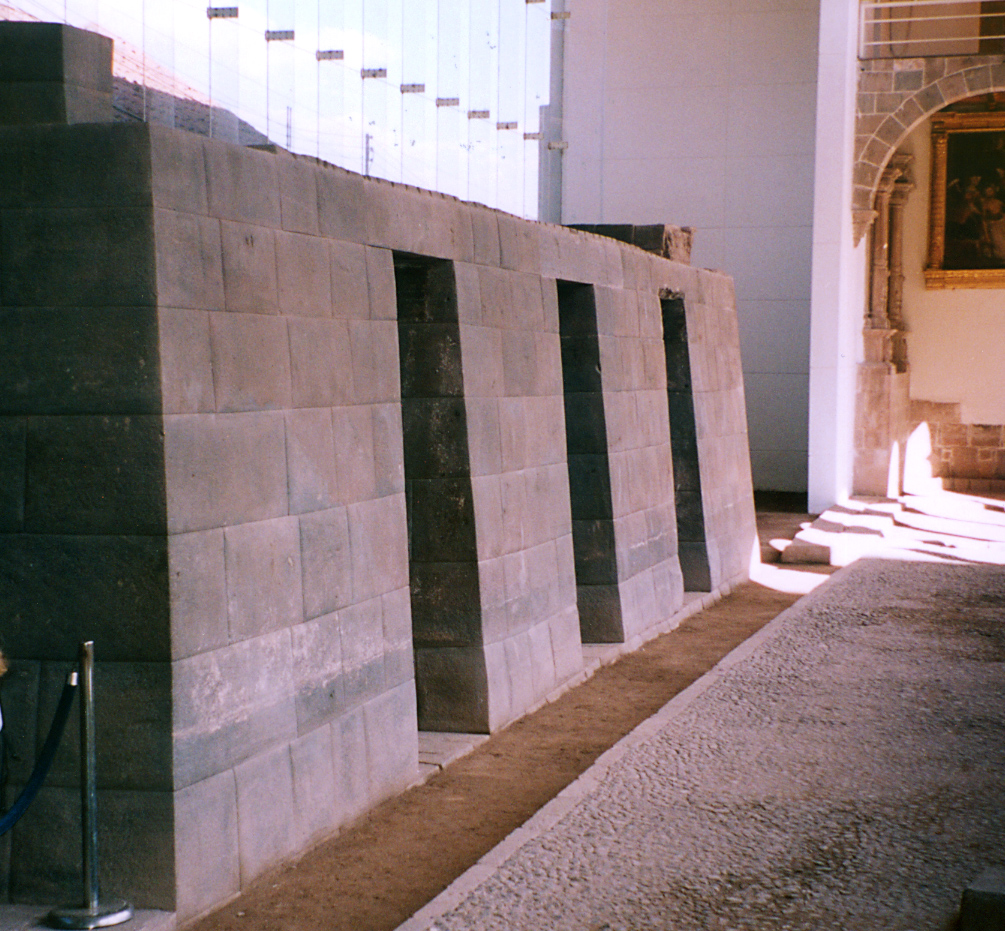
Coricancha (Qorikancha, 'the golden enclosure') was the most sacred building of the Inca Empire, the Temple of the Sun at the heart of Cusco, from which the empire's ceremonial roads radiated. Its walls once gleamed with sheets of gold, stripped by the Spanish after 1533. What remains is the masonry itself: dark andesite and diorite blocks fitted without mortar to a tolerance that leaves no gap for a knife blade, including a famous smoothly curved parabolic wall that survives beneath the Church and Convent of Santo Domingo, built directly on top of it. The surrounding streets of Cusco preserve more of the same — the twelve-angled stone of Hatun Rumiyoc among them — a citywide gallery of Inca stonecraft that is among the finest precision masonry anywhere on Earth.

See it on the globe →
The mainstream view

What archaeology says

Archaeologists and historians attribute Coricancha and Cusco's great walls to the Inca, principally from the reign of Pachacuti in the mid-fifteenth century until the Spanish conquest of 1533 — a chronology supported by Spanish eyewitness chronicles that describe the temple in use, gilded and staffed, at the moment of contact. The Inca worked hard volcanic stone with harder hammerstones, pecking and grinding faces into place, and are thought to have test-fitted blocks repeatedly, grinding down high spots until adjoining surfaces mated exactly. The slight inward lean (a three-to-five-degree batter), trapezoidal doorways and niches, and interlocking irregular joints are not decoration but seismic engineering: the walls are designed to flex and settle back rather than topple.

That design has been vindicated spectacularly. Cusco has been struck by major earthquakes, and each time the Spanish colonial masonry above has cracked or collapsed while the Inca walls beneath stood firm. The 1950 earthquake toppled much of the Santo Domingo convent and, in doing so, exposed the curved Inca enclosure it had been hiding, prompting a deliberate decision to conserve and display the original temple. Mainstream scholars emphasise that the sophistication is real and hard-won — the product of an enormous organised labour force, generations of accumulated craft, and abundant time — not evidence of a different or vanished civilisation.

Key evidence cited
  • Spanish conquest-era chronicles describing Coricancha in use as an Inca temple in 1533
  • Hammerstones and abandoned worked blocks showing the pecking-and-grinding method
  • Seismic-resistant features (batter, trapezoids, interlocking joints) matching Inca design across the empire
  • The 1950 earthquake collapsing colonial masonry while the Inca curved wall stood intact
  • A consistent citywide Inca style linking Coricancha to dated Inca sites and roads
The alternative view

What the skeptics propose

The most developed alternative account comes from the Peruvian researcher Alfredo Gamarra and his son Jesus Gamarra, who argue that the stonework of Cusco records not one culture but three successive 'worlds' or eras. In their scheme, Hanan Pacha (the oldest) produced the most astonishing megalithic work; Uran Pacha produced the classic tight-fitting polygonal and coursed walls; and Ukun Pacha is the Inca period proper, whose builders they say worked over, around and on top of the far older structures they inherited. On this reading the Inca were the last and least of three phases, and the finest masonry long predates them. The Gamarras go further, suggesting the earliest builders shaped stone when the Earth's gravity and density were somehow lower, allowing huge blocks to be worked and moved with ease — a claim mainstream geology rejects outright.

More broadly, alternative writers point to the seamless curves of the Coricancha wall, the way blocks seem to flow into one another, and the apparent 'plasticity' of the joints as signs that the stone was softened, moulded, or cut with technology beyond hammerstones. They contrast the sublime polygonal work with the visibly cruder Inca-era additions and colonial repairs above it, arguing that the quality gap is a chronological signal rather than a difference of purpose or resources. Mainstream archaeologists respond that the 'three eras' rest on stylistic intuition rather than stratigraphy or dating, that Spanish chronicles explicitly credit the Inca, and that experimental stoneworking reproduces the tight joints without any exotic method — but the visual force of the walls keeps the debate alive.

Key evidence cited
  • The Gamarras' three-era ('three worlds') classification of Cusco stonework
  • The visible quality gap between sublime polygonal walls and cruder Inca-period additions above
  • Seamless curves and 'plastic'-looking joints in the Coricancha parabolic wall
  • Interlocking megalithic joints proponents argue exceed what hammerstones can achieve
  • Reuse of finer older walls as foundations for later, rougher construction

Genuinely open questions

  1. Can the stylistic 'three eras' be tested against any independent dating, or do they rest on appearance alone?
  2. Exactly how were the tightest curved joints achieved to knife-blade tolerance with stone tools?
  3. Why is the very finest masonry so often at the base, carrying rougher work above it?

Worth knowing

When the 1950 earthquake flattened much of the colonial convent, it accidentally rediscovered the Inca temple hidden inside it — the disaster that destroyed the Spanish church is the reason we can see the Temple of the Sun today.