What archaeology says
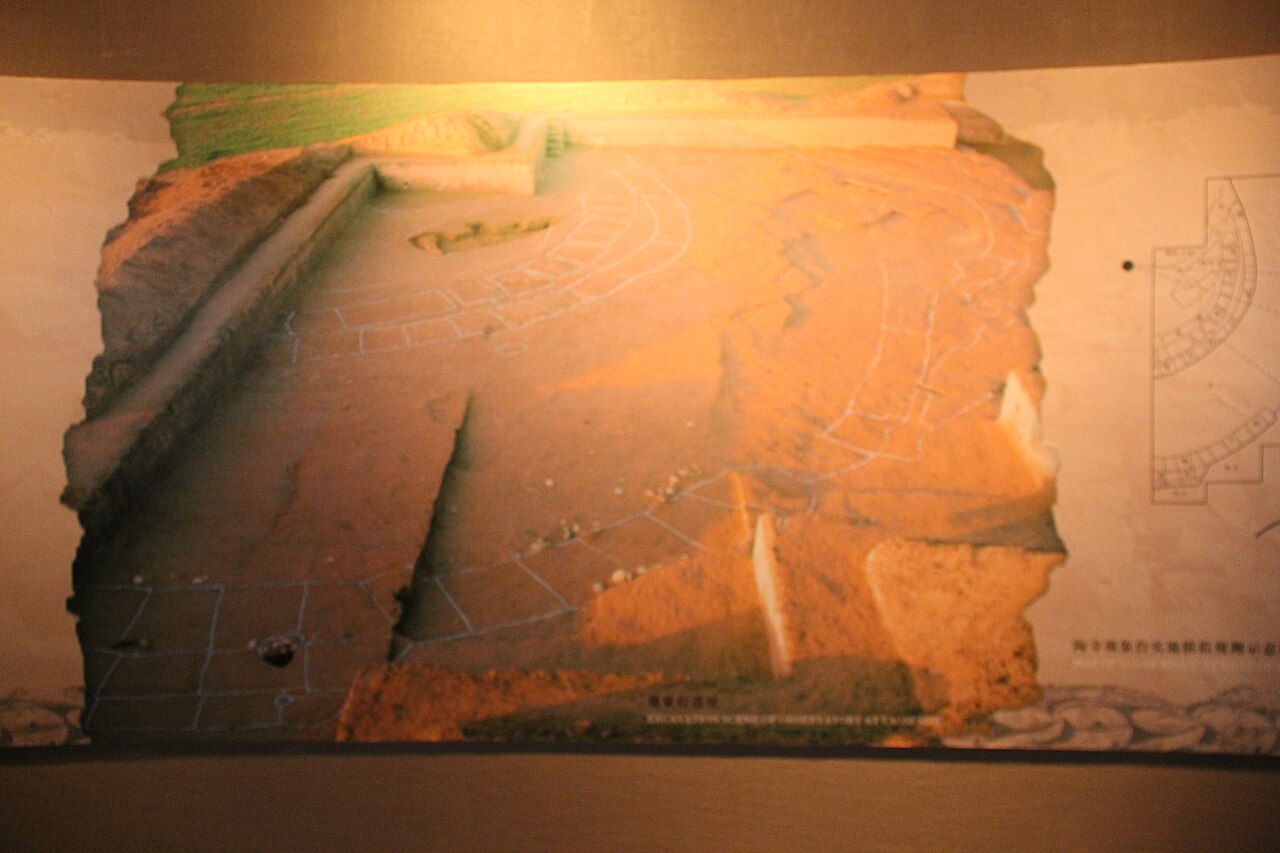
The excavated platform is a three-tiered semi-circle about 60 metres across at its widest, its outer arc originally carrying ten to thirteen rammed-earth pillars separated by slits only 15 to 20 centimetres wide. From a marked observing point at the centre, simulations and two years of on-site sunrise observations by Chinese astronomers showed that the winter solstice sun rises through the second slit and the summer solstice sun through the twelfth, with intermediate slits marking other dates — a calendar dividing the year into roughly 20 observable intervals, suited to scheduling agriculture and ritual.
Taosi itself strengthens the case: the 280-hectare city had palaces, elite tombs, craft quarters and evidence of social stratification. One elite tomb yielded a lacquered wooden rod identified by researchers as a gnomon shadow template, alongside what may be a paint-marked scale — the earliest known instruments of Chinese gnomonic astronomy. Sinologist and historian of astronomy David W. Pankenier has analysed how the platform could coordinate lunar months with the solar year, effectively operating a lunisolar calendar with intercalation.
The chronological match with the traditional dates of Emperor Yao — whom the Canon of Yao in the Book of Documents credits with commissioning astronomers Xi and He to fix the solstices and a 366-day year — is treated by most scholars as suggestive rather than probative: Taosi shows that the textual memory of state-sponsored astronomy in the Yao era has a real Longshan-period foundation, even if no inscription names its rulers.
- Radiocarbon dates place the platform's use around 2100 BC in the Taosi middle period
- Two years of direct sunrise observations from the reconstructed centre point confirmed solstice alignments through the surviving slit foundations
- The 12-slit design yields a practical division of the solar year consistent with an agricultural and ritual calendar
- A lacquered gnomon shadow rod from an elite Taosi tomb is the earliest known instrument of Chinese positional astronomy
- Taosi's palatial architecture, elite cemetery and 280-hectare walls demonstrate a state-level society capable of institutional sky-watching