Ancient Engineering · Shaanxi Province, China

Chinese Pyramids of Xi'an

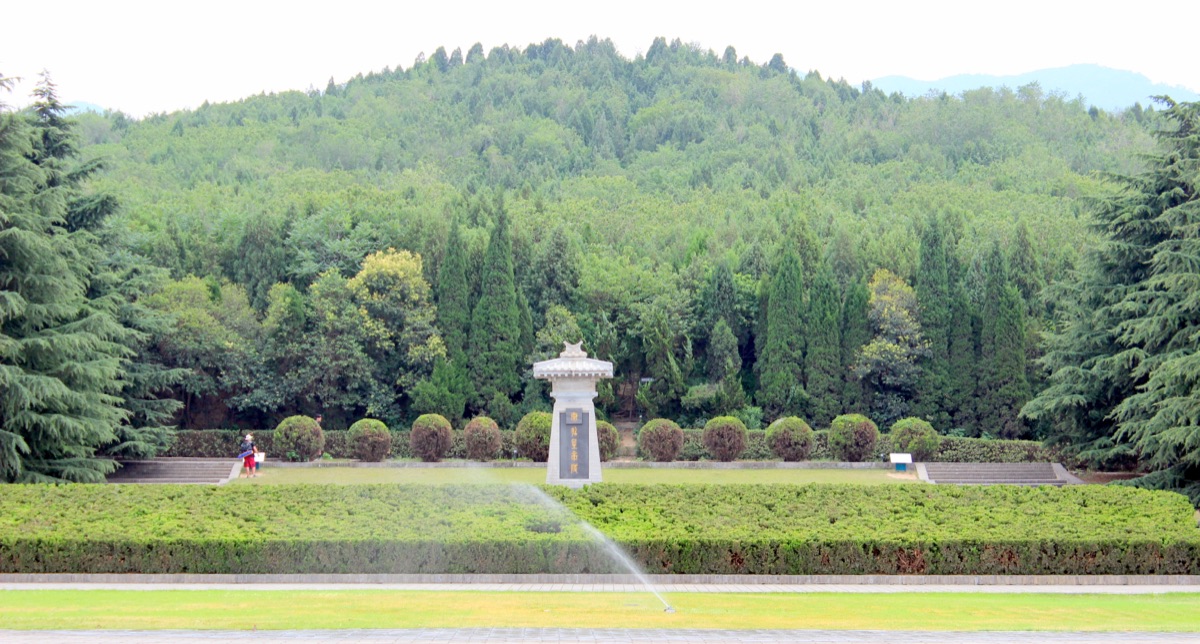
China's 'pyramids' hide in plain sight as tree-covered hills — including the never-opened tomb of the First Emperor, said to contain rivers of mercury.

Mainstream: c. 246–208 BC (Qin Shi Huang's mausoleum); other mounds to AD 900Alternative: Vast antiquity and a hidden 300-metre 'White Pyramid' proposed by Hartwig Hausdorf and earlier writers34.38°, 109.25°

At a glance

Chinese Pyramids of Xi'an
Photo: Aaron Zhu · CC BY-SA 3.0

Scattered across the Guanzhong Plain around Xi'an stand more than 40 large earthen mounds — flat-topped, four-sided rammed-earth pyramids that are the burial tumuli of Chinese emperors and elites, chiefly of the Qin, Western Han and Tang dynasties. The greatest is the Mausoleum of Qin Shi Huang, China's First Emperor (d. 210 BC), originally perhaps 100 metres or more tall and sitting at the centre of a funerary 'spirit city' of some 56 square kilometres that includes the world-famous Terracotta Army of roughly 8,000 clay soldiers, discovered by well-digging farmers in 1974. The tomb chamber itself has never been excavated.

See it on the globe →
The mainstream view

What archaeology says

Unlike most sites on this list, the Chinese pyramids are documented in detailed historical texts. The Grand Historian Sima Qian, writing about a century after Qin Shi Huang's death, describes the mausoleum's construction by hundreds of thousands of conscripts, its palace-like underground chamber, crossbow booby traps, a ceiling set with pearls as constellations, and rivers and seas of flowing mercury. Archaeology has strikingly corroborated parts of this account: soil surveys over the mound have repeatedly detected mercury concentrations far above background levels, and remote sensing indicates a large intact underground chamber and drainage system. The Terracotta Army pits, bronze chariots, stone armour workshops and mass graves of labourers anchor the complex firmly to the late 3rd century BC.

The surrounding mounds — such as Maoling, the tumulus of Han emperor Wu, and the Tang imperial tombs built into natural hills — are equally well attested in dynastic histories, with dates confirmed by excavation of satellite tombs, inscriptions and artefacts. The 'pyramid' shape is simply what monumental rammed-earth (hangtu) construction produces: layered, tamped soil rising in a truncated four-sided mound, aligned to cardinal directions according to Chinese cosmology.

Chinese archaeologists have deliberately left Qin Shi Huang's central chamber unopened — citing the mercury hazard and, above all, the lesson of past excavations where fragile organics and pigments (like the Terracotta Army's original paint) deteriorated on exposure. Restricted access reflects conservation policy, not concealment, and many mounds can be visited.

Key evidence cited
  • Sima Qian's detailed near-contemporary written account of the Qin mausoleum's construction
  • Anomalously high soil mercury over the mound, matching the 'rivers of mercury' description
  • The Terracotta Army and workshops dating the complex to the late 3rd century BC
  • Dynastic histories and excavated satellite tombs dating the Han and Tang mounds
  • Rammed-earth (hangtu) construction layers visible throughout, a well-understood Chinese technique
The alternative view

What the skeptics propose

Western fascination with 'forbidden' Chinese pyramids traces to a 1947 news story in which US pilot Maurice Sheahan reported seeing a colossal jewel-capped 'White Pyramid' near Xi'an, estimated — implausibly — at 300 metres tall, which would dwarf Giza. German author Hartwig Hausdorf popularised the tale in his 1994 book 'Die weiße Pyramide', claiming China concealed over 100 pyramids, that authorities forbade study, that trees were planted to camouflage them, and — in ancient-astronaut style — that Chinese legends of sky-descended emperors point to extraterrestrial builders in the remote past. Erich von Däniken's circle and later internet lore amplified the story, sometimes adding claims that the mounds align with Orion or match Giza's layout, or that their true age is tens of thousands of years.

Proponents cite the genuine strangeness of the sites: enormous monuments almost unknown to the Western public, the sealed and unexcavated central tomb, historical restrictions on foreign visitors, and the mercury anomaly — reading official caution as evidence of secrets. Some also point to the mounds' precise cardinal alignments and to slight, deliberate-looking deviations from true north as encoding lost geodetic knowledge.

Researchers have largely run these claims to ground: the 'White Pyramid' photograph published in 1947 is generally identified as Maoling, a documented Han tomb of ordinary (if grand) size, and no 300-metre pyramid exists on a plain that has now been comprehensively satellite-mapped by anyone with an internet connection. The dates of the mounds are fixed by texts and excavation, tree cover reflects erosion control, and alignment deviations have been explained by orientation to the rising sun or magnetic surveying methods of the period. What remains genuinely tantalising — and both sides agree — is that the First Emperor's burial chamber is still sealed, its contents known only from a 2,100-year-old description.

Key evidence cited
  • The 1947 'White Pyramid' pilot report and photograph popularised by Hausdorf
  • Decades of restricted access read as deliberate concealment
  • The still-unopened central tomb chamber of Qin Shi Huang
  • Claimed Orion-style layout correlations and precise cardinal alignments
  • Chinese legends of 'sons of heaven' descending from the sky, cited by ancient-astronaut writers

Genuinely open questions

  1. What actually survives inside Qin Shi Huang's sealed burial chamber, and will it ever be opened?
  2. How accurate is the rest of Sima Qian's account — are the crossbow traps and pearl constellations real?
  3. Why do some imperial mounds deviate slightly and consistently from true north?

Worth knowing

China's First Emperor died seeking an elixir of immortality that likely contained mercury — and his unopened tomb registers mercury levels so high that the legendary 'rivers of quicksilver' described 2,100 years ago may literally still be pooled inside.