What archaeology says
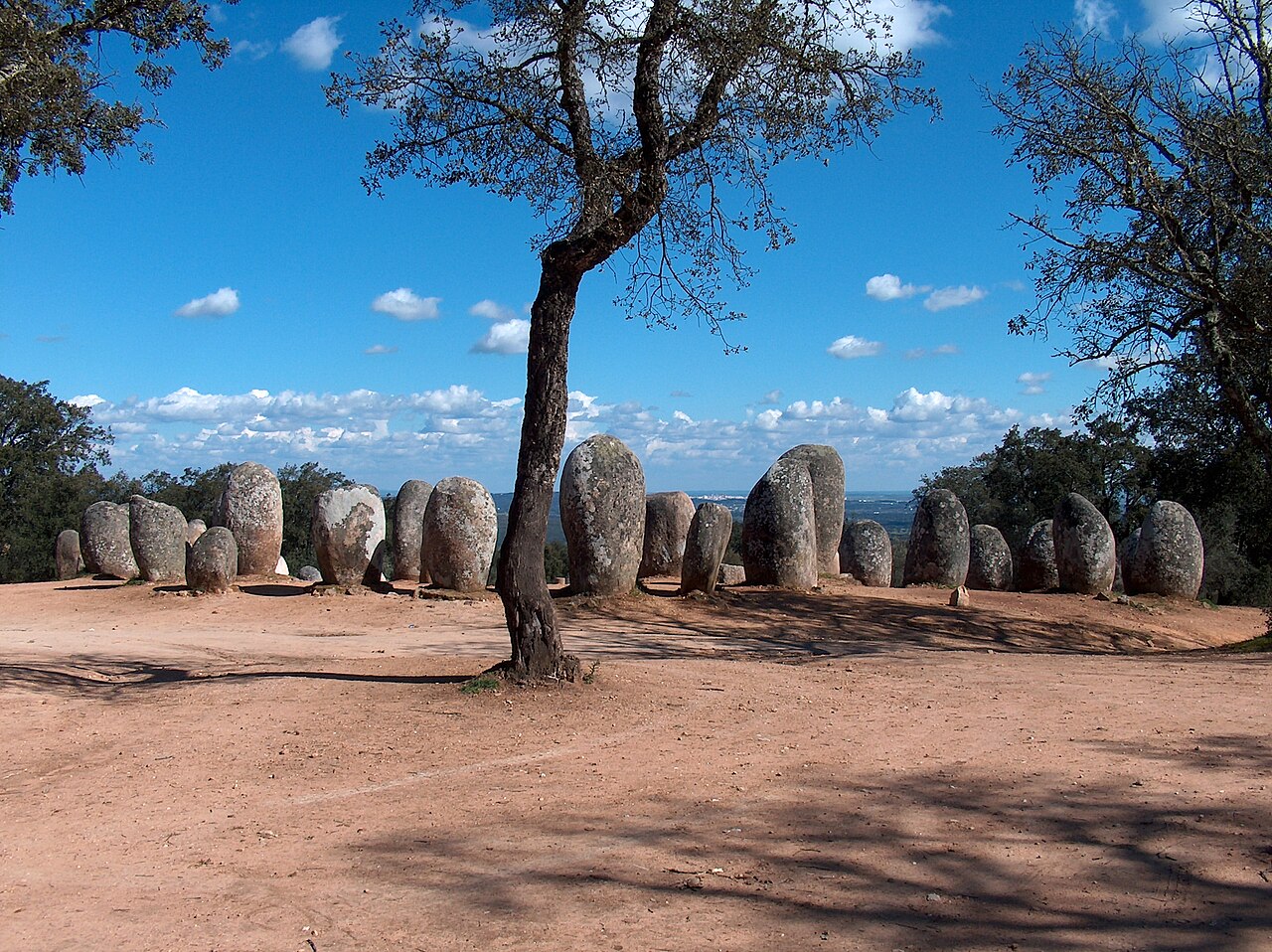
Portuguese archaeology, led by researchers such as Mario Varela Gomes, reconstructs Almendres as a long-lived sanctuary built in at least two or three major phases: an early Neolithic setting of smaller circles around 6000 BC, enlarged in the fifth millennium with larger monoliths arranged in irregular ellipses, and remodelled again into the Chalcolithic. This sequence — argued from stone typology, engravings and comparison with dated tombs nearby — makes it plausibly the oldest surviving stone circle complex in Europe, pre-dating Stonehenge's sarsen circle by more than three millennia.
The monument's axis runs roughly east-west down the slope, and studies of Alentejo megaliths show a strong regional pattern of orientation towards sunrise arcs, especially the equinoxes. A line from the cromlech to the solitary 4.5-metre Almendres menhir, about 1.4 kilometres away, points approximately to the winter solstice sunrise, and many scholars accept the complex functioned as a social and ceremonial aggregation site where the agricultural year was ritually marked.
Caution remains over precision. The stones have been re-erected after millennia of tilting and falling, absolute dates come mainly from associated material rather than the sockets themselves, and Iberian specialists warn that phase chronology at Almendres is looser than popular accounts suggest — 'c. 6000 BC' is a defensible reading of the earliest phase, not a radiocarbon certainty.
- Stone typology, engravings and regional parallels support construction phases from the sixth to the third millennium BC
- The complex is the largest in Iberia, with about 95 surviving monoliths in a coherent double-enclosure plan
- The monument's axis and the sight-line to the Almendres menhir fit equinoctial and winter solstice sunrise arcs
- Systematic studies of Alentejo megaliths show consistent regional orientation towards sunrise, indicating deliberate practice
- Decorated stones with circles, crooks and radiating motifs parallel imagery in dated passage graves nearby