What archaeology says
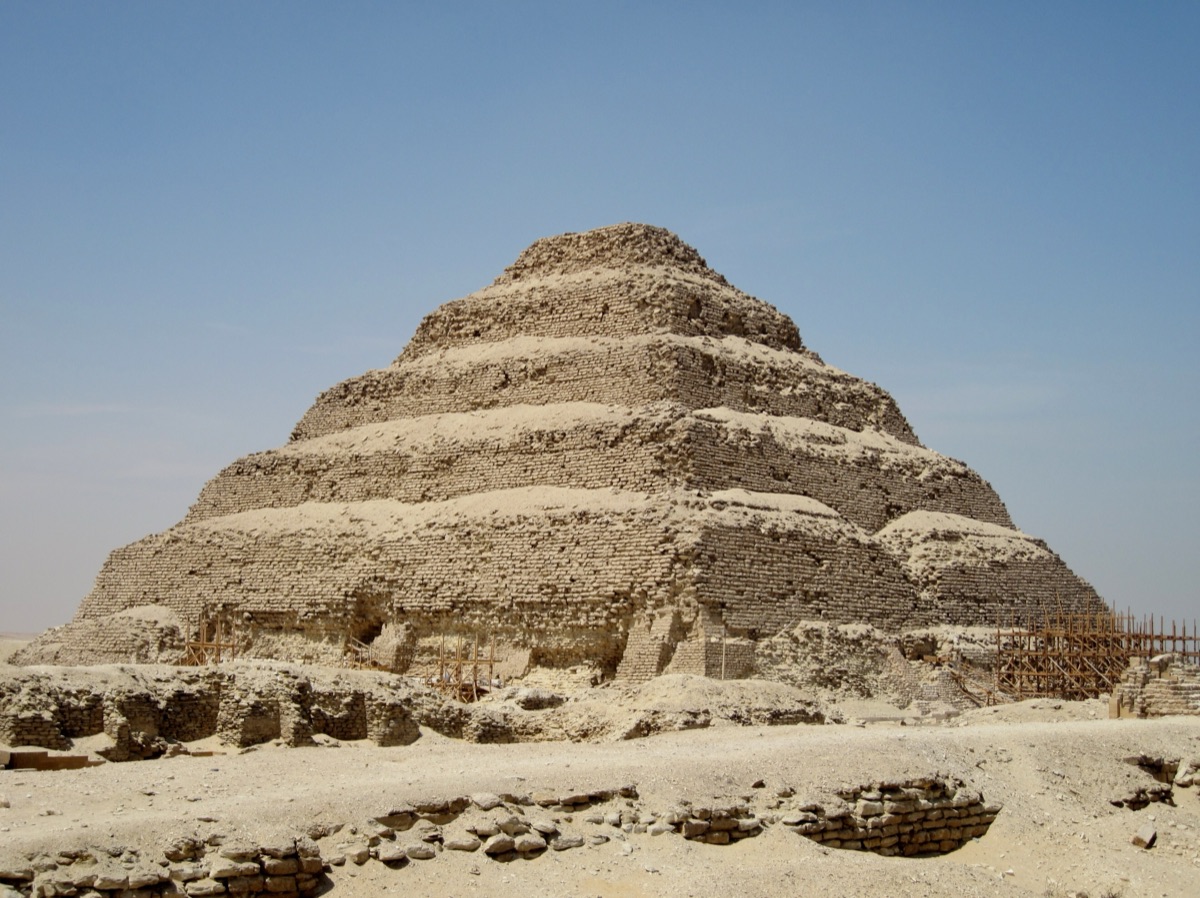
Egyptologists credit the pyramid to Pharaoh Djoser of the 3rd Dynasty and his official Imhotep, whose name and titles appear on the base of a statue of Djoser found at the site — making Imhotep history's first named architect. The building visibly records its own evolution: it began as a flat mastaba tomb and was enlarged in successive stages into a four-step and finally six-step pyramid, with the construction seams still legible in the masonry. This stepwise experimentation, followed by the failed and abandoned pyramids of Djoser's successors (such as Sekhemkhet's unfinished pyramid nearby), gives archaeologists an unusually clear developmental sequence leading toward the true pyramids at Dahshur and Giza.
Beneath the pyramid, excavators found galleries decorated with blue faience tiles imitating reed-mat shrines, and roughly 40,000 stone vessels — many inscribed with names of earlier 1st and 2nd Dynasty kings, apparently heirlooms gathered into Djoser's tomb. The complex was excavated and painstakingly restored over seven decades by Jean-Philippe Lauer, and the pyramid reopened in 2020 after a 14-year conservation project. The Serapeum's giant sarcophagi are dated by inscriptions and archaeological context mainly to the New Kingdom through Ptolemaic periods (c. 1400–100 BC), long after the pyramid age.
- Imhotep's name and titles on a statue base of Djoser from the site itself
- Visible construction phases from mastaba to six-step pyramid
- A clear evolutionary sequence to later true pyramids (Sekhemkhet, Meidum, Dahshur)
- Inscriptions dating the Serapeum sarcophagi to the New Kingdom–Ptolemaic era
- Unfinished vessels, drill cores and tool marks documenting manual stoneworking stages