Ancient Engineering · Dahshur, Egypt

Bent Pyramid & Red Pyramid of Sneferu, Dahshur

Two colossal pyramids by one king — the strange 'bent' experiment and the first true pyramid ever completed.

Mainstream: c. 2610–2590 BC (reign of Sneferu, early 4th Dynasty)Alternative: Date not seriously disputed — sceptics instead question the trial-and-error story, the absence of any royal burial, and whether the twin angles were deliberate design29.79°, 31.21°

At a glance

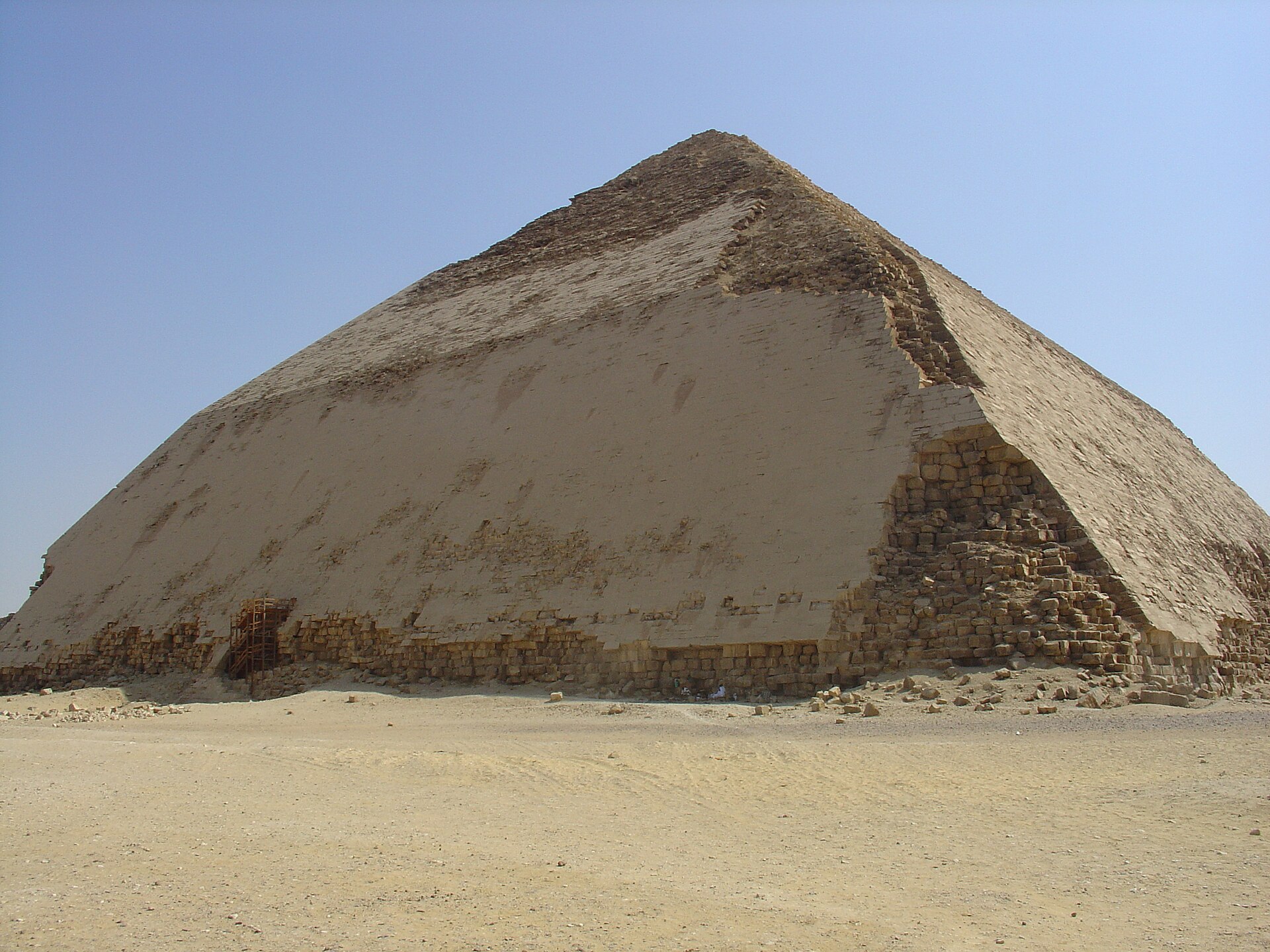
Bent Pyramid & Red Pyramid of Sneferu, Dahshur
Photo: Ivrienen · CC BY 3.0

Dahshur, on the desert edge about 40 kilometres south of Cairo, holds the two great pyramids of Sneferu, founder of the 4th Dynasty and father of Khufu. The Bent Pyramid rises at a steep 54-degree angle before abruptly changing to 43 degrees halfway up, giving it a silhouette unique among Egypt's pyramids — and it retains more of its original polished limestone casing than any other. A couple of kilometres north stands the Red Pyramid, at 105 metres the third-largest pyramid in Egypt and generally regarded as the first successfully completed true (smooth-sided) pyramid. Between them, and counting Meidum, Sneferu moved more stone than any other pharaoh in history — including his famous son.

See it on the globe →
The mainstream view

What archaeology says

Egyptologists read Dahshur as the decisive chapter in the evolution of the true pyramid. Sneferu began the Bent Pyramid at an ambitious angle on unstable desert clays; cracking and subsidence appeared in the corridors and chambers (visible today as cedar-log bracing and plaster repairs), and the builders first eased the slope of the lower section, then finished the top at a much safer 43 degrees. Rather than trust the compromised monument, Sneferu started again nearby, building the Red Pyramid at the gentler angle from the outset. Quarry marks in red ochre naming Sneferu and dated work-gang inscriptions (referring to years of his cattle-count census) were found on casing and core blocks of both pyramids, and a decree of Pepi I later exempted the towns of 'the two pyramids of Sneferu' from taxes — anchoring ownership and date about as firmly as Old Kingdom evidence allows.

The Bent Pyramid was explored by John Perring in 1839 and systematically excavated by Ahmed Fakhry in the 1950s, who uncovered its valley temple with reliefs of Sneferu; a stela bearing the king's name stood beside its satellite pyramid. It is also the only major pyramid with two separate entrances and internal systems — one from the north, one from the west — which most Egyptologists interpret as evolving design and ritual requirements during a troubled build. The Red Pyramid's corbelled chambers, roofed with eleven-plus courses of overlapping stone, solved the structural problems, and fragmentary human remains found in its upper chamber may (though this is uncertain) be Sneferu himself. The site reopened fully to visitors in 2019, and ongoing excavation of the Dahshur necropolis continues to produce Old and Middle Kingdom tombs, coffins and mummies.

Key evidence cited
  • Red-ochre quarry marks and dated work-gang inscriptions naming Sneferu on blocks of both pyramids
  • A decree of Pepi I exempting the towns of 'the two pyramids of Sneferu' from taxation
  • Visible structural distress in the Bent Pyramid — cracks, subsidence and cedar-log shoring — explaining the angle change
  • Ahmed Fakhry's 1950s excavation of the Bent Pyramid's valley temple with reliefs and a stela of Sneferu
  • A clear engineering progression from Meidum through the Bent Pyramid to the successful Red Pyramid
The alternative view

What the skeptics propose

Alternative writers see Dahshur less as a learning curve than as a puzzle the textbook story glosses over. Independent researcher John Legon has argued from survey data that the dimensions of the Bent and Red Pyramids are mathematically interlocked — sharing ratios involving the square roots of 2 and 3 — suggesting a single premeditated architectural scheme rather than panicked improvisation. Others note the Bent Pyramid's unique double entrance and double chamber system and propose the bend was deliberate symbolism (some link it to the duality of Upper and Lower Egypt) rather than a mid-build rescue. Robert Bauval extended his Orion Correlation to Dahshur, proposing that the two pyramids correspond to stars in or near the Hyades cluster as part of a grand sky-map of the Memphite necropolis laid out to reflect the heavens of a much earlier epoch.

A second strand of scepticism targets the tomb theory itself. Sneferu built or completed at least three giant pyramids — Meidum, the Bent and the Red — containing among them not one confirmed royal burial, sarcophagus or funerary inscription. Writers in the tradition of Christopher Dunn ask why a king would need three tombs and suggest the monuments served another function entirely, pointing to the extraordinary corbelled halls of the Red Pyramid as engineering out of proportion to a burial vault.

Mainstream Egyptologists respond that the structural distress inside the Bent Pyramid is physically real — cracked casing, crushed corridors and emergency timber shoring are not symbolic choices — and that the angle change and the move to the Red Pyramid follow naturally from the partial collapse at Meidum around the same time. Robbed burials, they note, are the rule rather than the exception in Old Kingdom pyramids, and the mathematical relationships Legon finds can emerge from the Egyptians' known use of simple seked (slope) ratios without any lost master plan.

Key evidence cited
  • John Legon's survey analysis suggesting the two pyramids share one premeditated geometric scheme
  • The Bent Pyramid's unique double entrances and chamber systems, argued to be deliberate dual design
  • Robert Bauval's proposed correlation of the Dahshur pyramids with stars near the Hyades
  • No confirmed royal burial, sarcophagus or funerary text in any of Sneferu's three giant pyramids
  • The scale of Sneferu's programme — more stone than Khufu — argued to exceed any funerary need

Genuinely open questions

  1. Why does the Bent Pyramid alone have two entrances and two internal chamber systems?
  2. Was Sneferu ever buried at Dahshur — and are the human remains from the Red Pyramid's upper chamber his?
  3. Why did Sneferu build (or finish) three or more pyramids when one tomb would suffice?

Worth knowing

Sneferu is history's most prolific pyramid builder: his projects at Meidum and Dahshur total roughly 3.6 million cubic metres of stone — more than his son Khufu used for the Great Pyramid itself.