Ancient Technology · Found in mastaba S3111, tomb of Sabu, Saqqara North, Egypt (1936); Egyptian Museum, Cairo

Sabu Disk

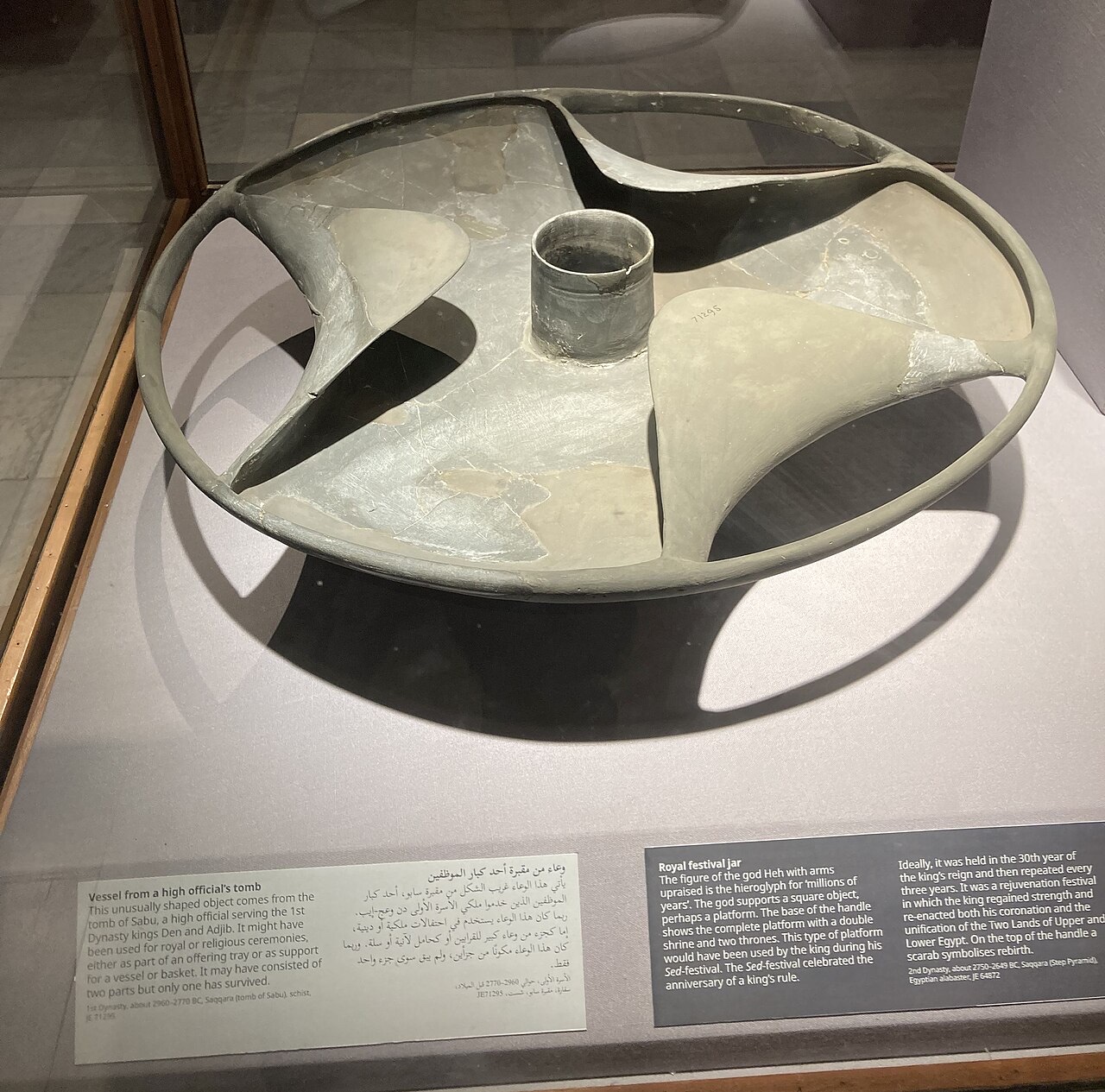
A First Dynasty stone 'wheel' with three curved lobes — lotus bowl, lamp stand, or impossible machinery?

Mainstream: c. 3100-3000 BC (First Dynasty)Alternative: Same age, claimed as a flywheel, turbine or machine component29.86°, 31.21°

At a glance

Sabu Disk
Photo: Martin1833 · CC0

Excavating the First Dynasty necropolis at Saqqara North in January 1936, the British Egyptologist Walter Bryan Emery opened mastaba S3111, the tomb of an official named Sabu, and found among hundreds of stone vessels a unique object: a disc about 61 centimetres across of metasiltstone (often called schist), worked to a thin rim that folds inward in three elegant, curved lobes around a central hub with a raised collar. Now in the Egyptian Museum in Cairo, the 'Sabu disk' has no exact parallel in Egyptian art. Its resemblance, to modern eyes, to a propeller, impeller or flywheel has made it a favourite of the lost-ancient-technology genre, while Egyptologists debate which class of ritual vessel or stand it belongs to.

See it on the globe →
The mainstream view

What archaeology says

Egyptologists place the disc firmly within the extraordinary Early Dynastic tradition of hardstone vessel carving, when craftsmen produced tens of thousands of vessels in everything from granite to rock crystal, including deliberately thin, virtuosic 'show' pieces imitating other materials. Emery himself thought it might have formed part of a stand; subsequent interpretations, discussed by specialists in early stone vessels such as Ali el-Khouli, cluster around a few options: an imitation in stone of a metal or basketry bowl, a stand for a ritual hes vase, an oil lamp component, or a stylised lotus form — the three incurved lobes reading as petals folding over the rim.

The mainstream emphasises context: the disc lay in a First Dynasty tomb among conventional grave goods, part of a funerary assemblage, not a workshop; metasiltstone is brittle and utterly unsuited to mechanical rotation under load; and the central hub matches sockets used for mounting vessels on stands elsewhere in the corpus. Its uniqueness is real but not unparalleled as a phenomenon — Early Dynastic tombs regularly yield one-off virtuoso vessels.

Scholars also note that the disc's 'aerodynamic' look is an artefact of modern pattern-matching: nothing about First Dynasty technology, which is richly documented from tools to workshops, involves rotary machines beyond the simple drill and the potter's wheel's precursors.

Key evidence cited
  • The disc was excavated in a documented First Dynasty funerary context among conventional stone vessels and grave goods
  • Early Dynastic Egypt produced tens of thousands of hardstone vessels, including unique virtuoso forms imitating other materials
  • Metasiltstone is brittle and could not survive use as a rotating mechanical component under load
  • The central hub and collar parallel mounting features on known vessel-and-stand combinations
  • The incurved lobes are consistent with lotus-petal and folded-rim motifs in early Egyptian design
  • No axles, bearings, machines or mechanical depictions exist anywhere in the vast Early Dynastic archaeological record
The alternative view

What the skeptics propose

In the alternative literature the Sabu disk is a machine part in the wrong millennium. Writers in the ancient-high-technology genre — it is a recurring exhibit on the Ancient Aliens television series and in the lost-civilisation books and websites that follow Erich von Daeniken's tradition — read the three curved lobes as impeller vanes or a propeller, the hub as a mounting for an axle, and the whole as a flywheel, pump rotor or turbine component, perhaps a stone copy of a lost metal original. Some engineers sympathetic to the genre have modelled the shape and reported that, scaled and mounted, it functions as a crude impeller, arguing the geometry is too functional to be decorative.

A related, softer claim focuses on manufacture rather than function: following the school of thought associated with engineer Christopher Dunn's work on Egyptian precision stonework, advocates argue that carving metasiltstone to a thin, symmetrical, triple-lobed form with hand tools of the fourth millennium BC strains credulity, implying lathes or advanced machining knowledge since lost.

Current status: no peer-reviewed engineering study of the disc exists; the machine reading survives on visual analogy and the object's genuine uniqueness. Even within the genre, interpretations vary wildly — flywheel, water pump, 'energy device' — which critics cite as evidence that the resemblance is in the eye of the modern beholder. The lotus-bowl and vase-stand interpretations remain unproven too, however, and the museum label's caution keeps the question honestly open.

Key evidence cited
  • The disc's three symmetrical curved lobes visually match impeller and propeller geometry to a striking degree
  • Its form has no exact parallel among the tens of thousands of known Egyptian stone vessels, leaving function genuinely unexplained
  • Genre engineers report scaled models can function as crude impellers, suggesting the shape is mechanically meaningful
  • Carving brittle metasiltstone to this thinness and symmetry with copper and stone tools is argued to imply lost techniques
  • Advocates suggest it could copy a metal original, which would not survive and so cannot be disproven
  • The mainstream itself offers multiple conflicting interpretations, showing, advocates argue, that no conventional reading fits well

Genuinely open questions

  1. What was the disc actually for — no proposed interpretation, conventional or otherwise, has evidence beyond analogy?
  2. Was it a stone copy of an object in metal, basketry or wood, and did other examples exist that have not survived?
  3. Could tool-mark analysis with modern microscopy establish exactly how it was carved?
  4. Why does it appear in the tomb of Sabu specifically — what office or cult did he hold that the vessel served?

Worth knowing

Emery's Saqqara excavation records show the disc was found crushed and was restored from fragments — the elegant 'machined' object seen today is a careful reassembly of broken First Dynasty stone.