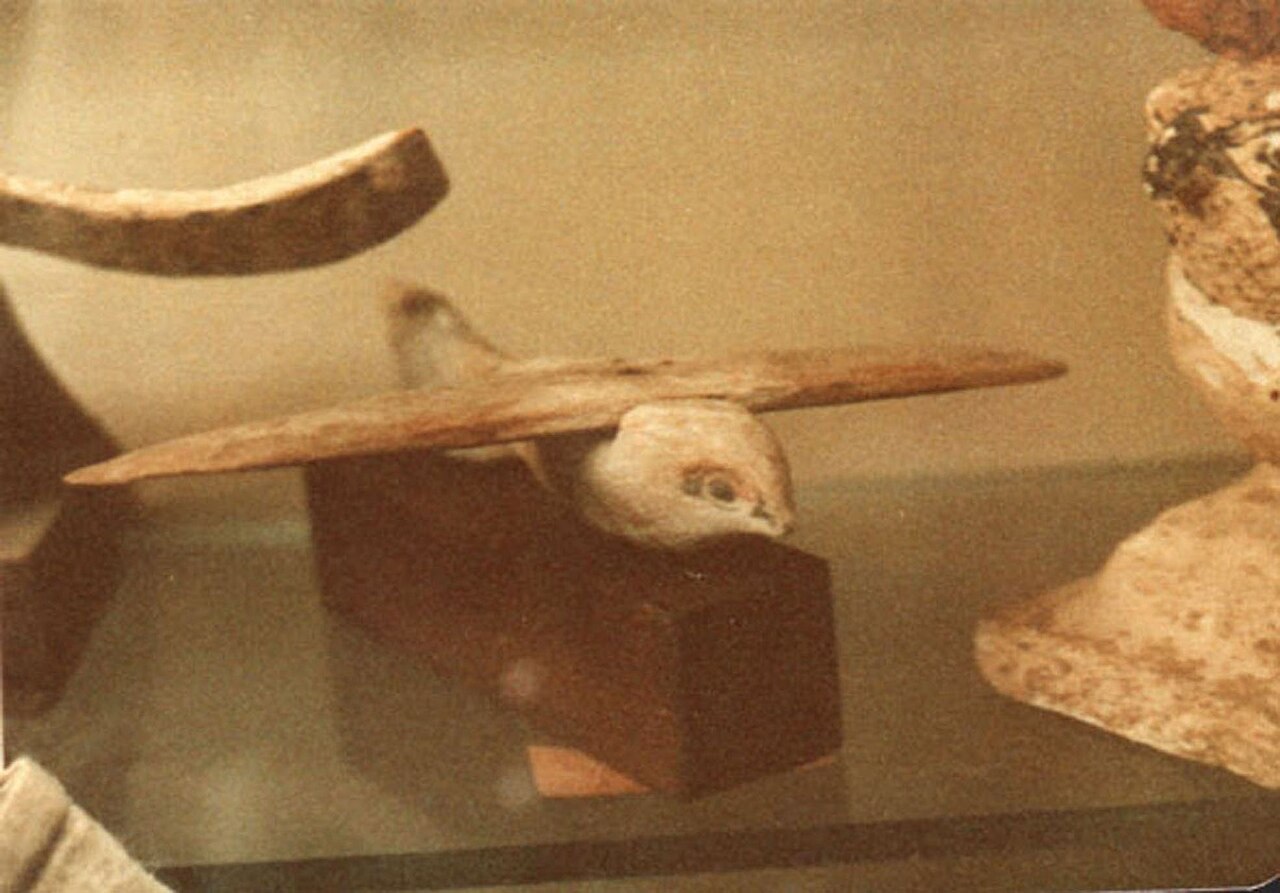
Ancient Technology · Found at Saqqara, Egypt (1898); Egyptian Museum, Cairo

Saqqara Bird

A 14-centimetre wooden bird with oddly aeroplane-like wings — toy, weathervane, or wind-tunnel ancestor?

Mainstream: c. 200 BC (late/Ptolemaic period)Alternative: Claimed as a model glider proving ancient Egyptian flight29.87°, 31.22°

At a glance

Saqqara Bird
Photo: Dawoud Khalil Messiha · Public domain

The Saqqara Bird is a sycamore-wood object about 14 centimetres long with a 18-centimetre wingspan, excavated in 1898 from the Ptolemaic-era tomb of Padiimen at Saqqara and now in the Egyptian Museum in Cairo. It has a bird's head and body, but its wings are straight and subtly dihedral, its tail is a vertical fin rather than a bird's horizontal tail fan, and it has no legs or painted feathers. In 1972 the Egyptian physician and model-flying enthusiast Khalil Messiha announced that it was a model glider — possibly evidence that the Egyptians experimented with flight — and the little bird has been circling through the ancient-mysteries literature ever since.

See it on the globe →
The mainstream view

What archaeology says

Egyptologists interpret the object as a stylised bird figurine, most likely a falcon connected with Horus imagery, and see nothing aeronautical in its context. Bird figures are ubiquitous in Egyptian art, and comparable wooden birds served as toys, ritual objects and mastheads: one common proposal is that the Saqqara Bird copies the falcon-shaped weathervanes or emblems mounted on the masts of sacred boats, which are depicted with similar upright tails. The vertical tail, the feature the glider case leans on hardest, is thus explicable within Egyptian iconography.

Aerodynamic testing has not supported the flight claim. Glider designer Martin Gregorie built an exact balsa replica in 2002 and found it useless as a glider — tail-heavy, lacking a horizontal stabiliser, and unstable in pitch; it only flew after he added a tailplane for which the original shows no attachment point or evidence. Mainstream commentators also note the absence of any Egyptian depiction, text or wreckage suggesting aviation, an enormous silence for a civilisation that documented its technology exhaustively.

The consensus position: an appealing bird carving whose slightly abstract wings say more about Ptolemaic craftsmanship than about aeronautics.

Key evidence cited
  • Bird figurines, including falcon forms with stylised wings, are common Egyptian objects with well-understood religious meaning
  • Sacred-boat mastheads and emblems in Egyptian art show falcon figures with comparable upright tails
  • Martin Gregorie's 2002 replica was aerodynamically unstable and could not glide without adding a tailplane absent from the original
  • No text, image or artefact from three millennia of Egyptian records hints at flight experiments or flying machines
  • The object comes from an ordinary Ptolemaic tomb assemblage, not a workshop or technical context
  • The 'aerofoil' wing section is within the range of ordinary decorative carving of folded bird wings
The alternative view

What the skeptics propose

Khalil Messiha, who published his case in 1972 with support from his flight-engineer brother, argued the object's features are aeronautical rather than ornithological: a fuselage-like body, straight wings with a lift-friendly cross-section and dihedral angle, a vertical fin no bird possesses, and a possible slot where a horizontal tailplane — since lost — might have fitted. He noted the Egyptians made models of their known technologies, from ships to chariots, so a model implies, at minimum, awareness of the full-size idea, and he claimed his own replicas glided.

The claim was amplified by the ancient-astronaut and lost-technology genre and tested most visibly in a 2006 documentary, in which aviation researcher Simon Sanderson built a five-times-scale replica and ran it through a wind tunnel at Liverpool University; the programme reported the shape generated four times the model's weight in lift and, with a tailplane added, flew convincingly in a flight simulator. Advocates read this as vindication: the geometry is genuinely flight-capable, remarkable for a culture supposedly ignorant of aerodynamics.

Current status: the glider reading remains a staple of Ancient Aliens-style media but has attracted no Egyptological support. Even its friendlier tests require adding the missing tailplane, and the argument now rests on whether one reads the vertical fin as lost engineering or standard falcon stylisation.

Key evidence cited
  • The vertical tail fin has no counterpart in real bird anatomy, the core anomaly Messiha identified in 1972
  • The wings show dihedral and a cambered cross-section, features that genuinely aid stable gliding
  • Messiha reported a possible mounting point for a lost horizontal tailplane, which would complete a glider layout
  • The 2006 Liverpool wind-tunnel tests reported the scaled shape produced roughly four times its weight in lift
  • Egyptians routinely modelled their real technologies — boats, chariots, granaries — so models can encode full-size counterparts
  • The figure lacks legs and painted plumage, unusual for a votive bird but consistent, advocates say, with a functional model

Genuinely open questions

  1. Was anything originally attached at the tail — a decorative element, or something structural — and could museum re-examination settle it?
  2. What was the full tomb context of Padiimen, and were similar objects found with it that never entered the literature?
  3. Why does this one figurine differ in wing and tail treatment from most Egyptian bird carvings?
  4. Would a formal, published aerodynamic study — rather than television experiments — confirm or kill the glider geometry claim?

Worth knowing

Khalil Messiha claimed the inspiration ran in the family twice over: he was a champion model-plane builder in his youth, and he said his father, also a physician, had built model aircraft in Egypt in the 1920s.