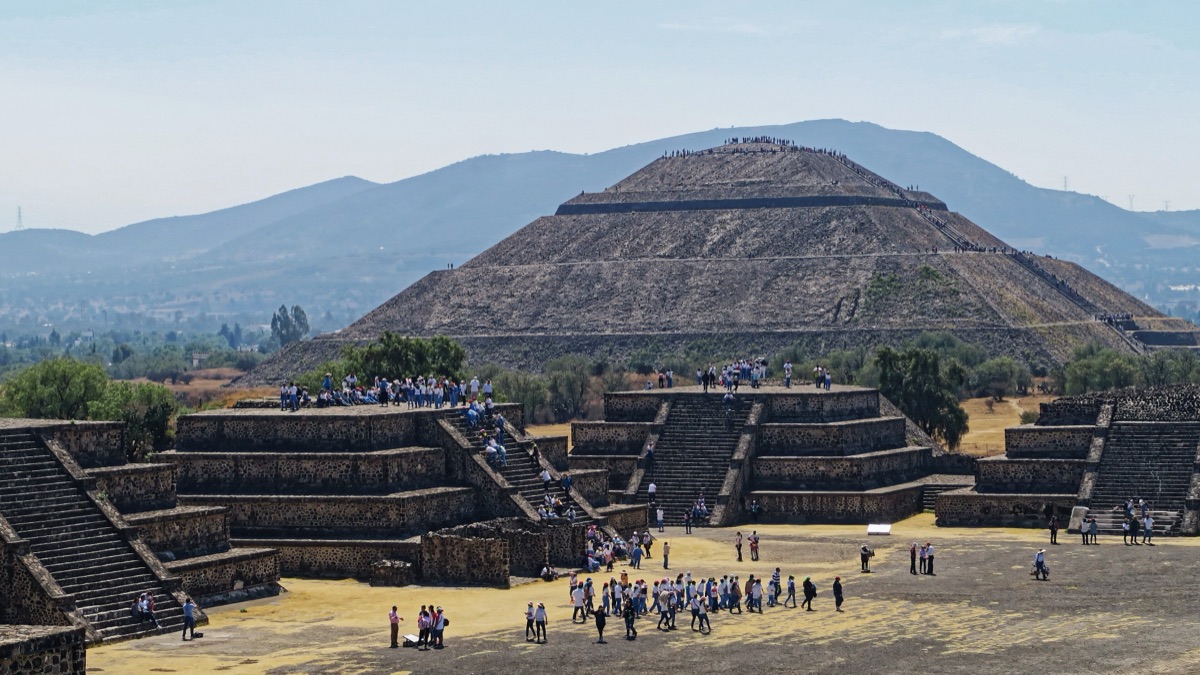
What archaeology says
Archaeologists date the city's rise to the first centuries AD through radiocarbon dating, ceramic sequences and stratigraphy: the Pyramid of the Sun was raised in essentially one massive effort of rubble, adobe and volcanic stone around AD 200, over an earlier man-made tunnel-and-chamber system. The city was a planned metropolis with apartment compounds, obsidian workshops, and neighbourhoods of foreigners from Oaxaca, the Gulf Coast and the Maya region, attested by burials, pottery and isotope studies of skeletons. Sacrificial burials with military regalia found inside the Feathered Serpent Pyramid and Pyramid of the Moon anchor construction dates and reveal a powerful, expansionist state.
Because the Teotihuacanos left no readable texts, their ethnicity and language are unknown; the name 'Teotihuacan' is Aztec, applied a millennium after the city burned and was abandoned around AD 550–650. Excavations continue to produce spectacular finds: from 2003 Sergio Gómez explored a sealed tunnel beneath the Feathered Serpent Pyramid, uncovering tens of thousands of offerings, walls dusted with pyrite to glitter like stars, and pools of liquid mercury — likely a symbolic underworld river. The city's 15.5-degree skew from cardinal orientation is understood as an astronomical/calendrical alignment tied to horizon events and sacred mountains.
- Radiocarbon dates and ceramic stratigraphy placing construction in the first centuries AD
- Dedicatory sacrificial burials inside the pyramids anchoring building phases
- Isotope studies showing a cosmopolitan population of known Mesoamerican regions
- Continuity of Mesoamerican religious iconography (Storm God, Feathered Serpent)
- The sealed Feathered Serpent tunnel's offerings dating to the city's documented era