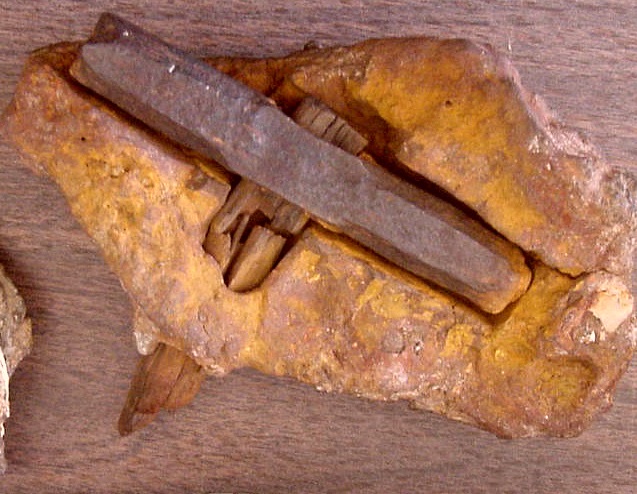
Ancient Technology · Found near London, Texas, USA; Creation Evidence Museum, Glen Rose, Texas

London Hammer

An iron hammer 'sealed in 100-million-year-old rock' — or a miner's tool wrapped in fast-forming stone

Mainstream: 19th-century American tool in a recent concretionAlternative: Claimed to predate or accompany Cretaceous rock, 100+ million years old30.68°, -99.58°

At a glance

London Hammer
Photo: S. J. Miba · CC BY-SA 4.0

In 1936, according to the standard account, Max Hahn and his family noticed a curious nodule of rock with a bit of wood protruding from it while walking near Red Creek outside London, Texas; when the nodule was cracked open years later, it revealed a small iron-headed hammer with part of its wooden handle intact. Because rocks of the area include Cretaceous strata, the object was promoted as a 'pre-Flood' or pre-human artefact. The creationist Carl Baugh acquired it in the 1980s, renamed it the London Artifact, and displays it at his Creation Evidence Museum in Glen Rose, Texas, as evidence against conventional geology.

See it on the globe →
The mainstream view

What archaeology says

Geologists see no mystery. The hammer was found loose on a ledge, not embedded in bedrock; no geologist documented it in situ, and its stratigraphic connection to the local Lower Cretaceous Hensell Sand is pure assumption. The rock around the tool is a travertine-like concretion, and dissolved calcium carbonate from ancient limestone can cement gravel, shells and stray objects around a nucleus within years to decades — modern examples abound of concretions enclosing Second World War shrapnel, bottles and even a spark plug (the 'Coso artefact'). An old iron tool dropped by a nineteenth-century miner or farmer is exactly the sort of nucleus such deposits form around.

The hammer itself is diagnostic. Glen Kuban, the researcher best known for debunking the nearby Paluxy 'man tracks', published a detailed analysis in 1997 showing the tool matches a common nineteenth-century pattern consistent with mining, smithing or general utility hammers used in the region, where mining activity is documented from the 1800s.

Mainstream commentators also note that Baugh has declined to permit independent dating or destructive testing under neutral conditions, and that the claim has never been submitted to a peer-reviewed geological journal — the argument lives entirely in creationist media.

Key evidence cited
  • The nodule was found loose, not embedded in any bedrock exposure, so it has no documented stratigraphic context
  • Travertine concretions form around objects in years to decades; modern examples enclose twentieth-century artefacts
  • Glen Kuban's 1997 analysis matches the tool to common nineteenth-century American hammer patterns
  • Mining and settlement in the London, Texas area are documented from the 1800s, supplying an obvious source for a lost tool
  • The famous Battelle metallurgical analysis has never been published or confirmed by Battelle
  • The owner has not permitted independent radiocarbon dating of the wooden handle, the single test that could decide the question
The alternative view

What the skeptics propose

Carl Baugh, founder of the Creation Evidence Museum, presents the hammer as a 'monumental pre-Flood discovery': a human tool locked inside rock he identifies as Cretaceous, which within his young-earth framework demonstrates that humans, and the Genesis Flood that he believes deposited the strata, are compatible with — and fatal to — evolutionary geology. The museum highlights reported analyses said to have been performed at Battelle Laboratories, describing the iron as unusually pure, about 96.6 per cent iron with chlorine and sulphur, allegedly without bubbles or inclusions and resistant to rust where cut, suggesting to advocates an unknown metallurgy.

Supporters add that part of the wooden handle appears coalified, which they read as evidence of great age, and that the concretion's hardness and location on a ledge derived from Cretaceous outcrop tie the tool to the ancient sediments. The hammer features regularly in creationist books, videos and museum displays as a prime 'out of place artefact'.

Current status: the Battelle testing has never been documented by the laboratory itself, the coalified-wood claim remains unverified, and Baugh has not released the object for independent radiocarbon dating of the handle — which even some creationist commentators, such as the group Answers in Genesis, regard as reason to treat the hammer cautiously; the organisation lists arguments from it among those best avoided.

Key evidence cited
  • The rock encasing the hammer is hard, dense and derived from material of the Cretaceous Hensell Sand, per the museum's account
  • Reported analyses described unusually pure iron, about 96.6 per cent, with a composition said to be atypical of historic tools
  • Advocates report a cut made in the metal in the 1930s has never rusted, suggested to indicate unusual metallurgy
  • Part of the wooden handle is described as partially coalified, argued to require substantial age
  • The hammer's stone matrix contains marine shell fragments consistent with the ancient sediments, supporters note
  • Baugh argues no modern hammer of this exact pattern has been produced as a match, keeping identification open

Genuinely open questions

  1. Would radiocarbon dating of the handle — repeatedly proposed, never permitted — end the controversy overnight?
  2. What exactly did any laboratory analysis of the iron find, and will the paperwork ever be released?
  3. Who lost the hammer, and when — can the tool pattern be matched to a specific nineteenth-century manufacturer?
  4. How quickly do concretions actually form at the Red Creek locality — a measurable, publishable test no one has run?

Worth knowing

Even the major young-earth creationist organisation Answers in Genesis lists the London Hammer among arguments creationists should not use, citing the missing documentation.