Ancient Knowledge · Newark and Heath, Ohio, USA

Newark Earthworks

The largest geometric earthworks on Earth encode the Moon's 18.6-year cycle — and for a century they doubled as a golf course.

Mainstream: c. 100 BC – AD 400 (Hopewell culture)Alternative: Date not seriously disputed — 19th-century claims instead denied Native authorship, backed by the forged 'Newark Holy Stones'40.04°, -82.43°

At a glance

Newark Earthworks
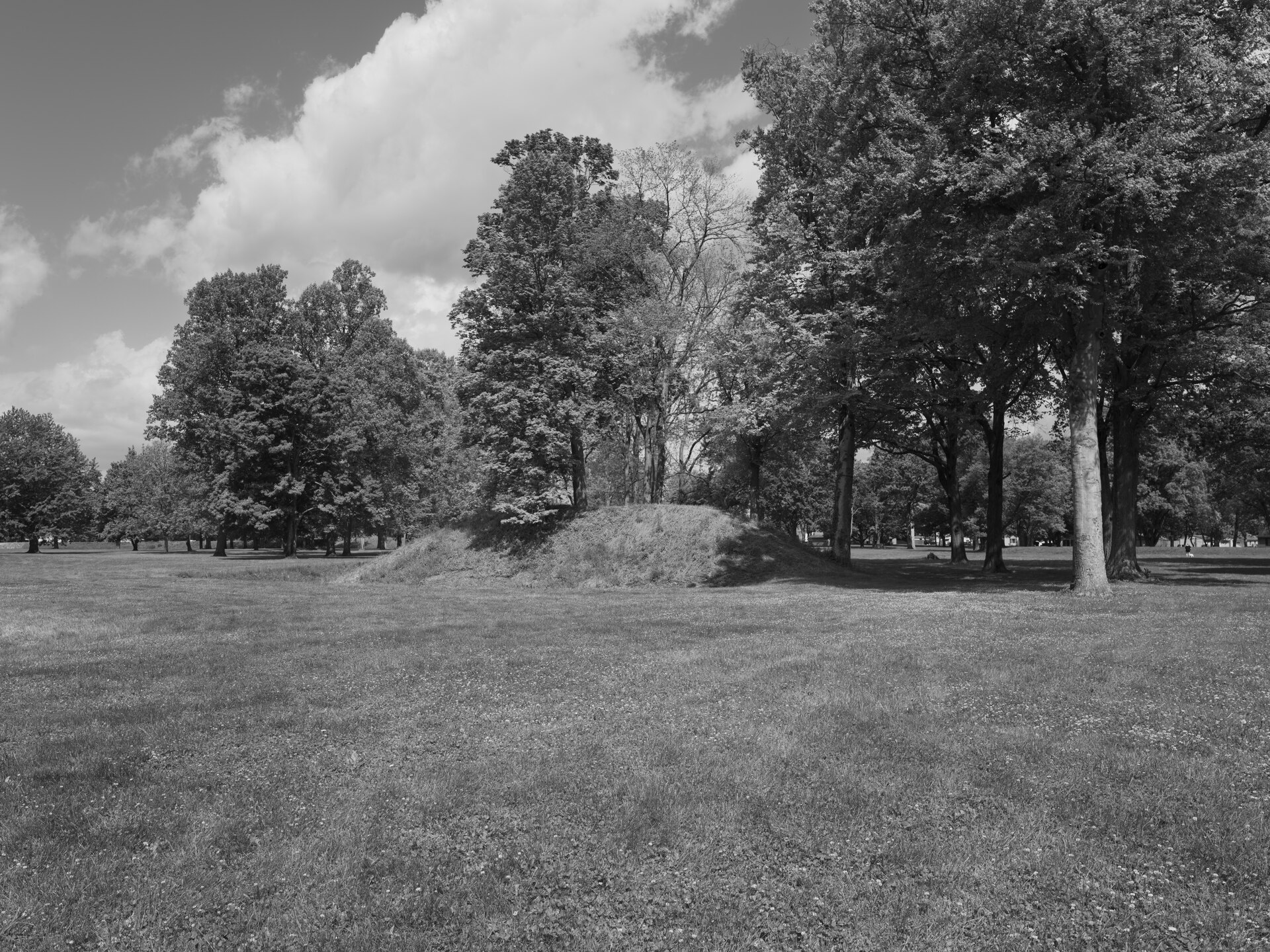
Photo: Public Lands Institute · CC0

The Newark Earthworks once sprawled across more than 12 square kilometres of central Ohio: a connected ceremonial machine of enormous circles, a square, an octagon and kilometres of parallel-walled avenues, all built of earth by the Hopewell culture around 2,000 years ago. Two major pieces survive — the Great Circle, 365 metres across with walls up to 4.8 metres high and an interior ditch, and the Octagon Earthworks, a 20-hectare octagon joined to a precise circle 321.3 metres in diameter. In 2023 they were inscribed on the UNESCO World Heritage List as part of the Hopewell Ceremonial Earthworks, and on 1 January 2025 the Moundbuilders Country Club finally vacated the Octagon after 115 years of golf played among the walls, returning full public access just as the Moon reached the very standstill the earthwork was built to observe.

See it on the globe →
The mainstream view

What archaeology says

In 1982, physicist Ray Hively and philosopher Robert Horn of Earlham College set out to debunk claims of astronomical design at Newark and instead confirmed something extraordinary: the Octagon and its attached Observatory Circle encode the Moon's 18.6-year standstill cycle. The Moon's rise and set points swing between limits that take nearly two decades to repeat, and Hively and Horn showed the earthwork's axis and walls align with the northernmost moonrise and other key lunar limits — eight alignments in all, with the main axis accurate to about half a degree. They later demonstrated that High Bank Works near Chillicothe, 100 kilometres away, is the only other circle-octagon combination known, is built on the same 321.3-metre 'Observatory Circle diameter' module, and has its axis set at exactly 90 degrees to Newark's, aligned to the same lunar cycle.

Archaeologists led by Bradley Lepper have added the 'Great Hopewell Road' hypothesis — traces of parallel walls running dead straight from Newark towards Chillicothe, possibly a 100-kilometre pilgrimage causeway linking the two lunar observatories. Artefacts show pilgrims or traders brought obsidian from Yellowstone, mica from the Carolinas and shells from the Gulf of Mexico to these enclosures, which held very little domestic refuse: they were gathering places, not towns. The geometry is equally deliberate — the circumference of the Observatory Circle equals the perimeter of the square at nearby Wright Earthworks, and the same units recur across southern Ohio.

The long fight over the Octagon's lease to the Moundbuilders Country Club ended after the Ohio Supreme Court's 2022 ruling allowed the Ohio History Connection to reclaim it by eminent domain; the club departed at the start of 2025. Through 2024 and 2025 the site hosted public moonrise observations of the first major lunar standstill since UNESCO listing — the event that comes once every 18.6 years.

Key evidence cited
  • Hively and Horn's 1982 demonstration of eight lunar standstill alignments at the Octagon, refined in later papers
  • The identical 321.3-metre Observatory Circle module and complementary lunar axis at High Bank Works, 100 km away
  • Radiocarbon dates and diagnostic Hopewell artefacts placing construction between c. 100 BC and AD 400
  • Exotic raw materials (Yellowstone obsidian, Carolina mica, Gulf shells) marking Newark as a pilgrimage centre, not a town
  • 2023 UNESCO inscription of the Hopewell Ceremonial Earthworks recognising the astronomy and geometry as Indigenous achievements
The alternative view

What the skeptics propose

Newark is ground zero for the oldest alternative-history controversy in America: the Mound Builder myth. In 1860, county surveyor David Wyrick dug up the 'Keystone', a polished stone bearing Hebrew inscriptions, and months later the 'Decalogue Stone', a carved figure of Moses wrapped in a condensed Hebrew Ten Commandments, sealed in a stone box within a mound. The Newark Holy Stones electrified a public primed to believe the earthworks were built by a Lost Tribe of Israel or some other vanished race rather than by Native Americans. Bradley Lepper and Jeff Gill have argued in detail that the stones were forged — probably by Reverend John W. McCarty and stonecutter Elijah Sutton — noting the Hebrew contains transcription errors traceable to a 19th-century printed source and that the finds conveniently entered a pre-Civil War debate about the unity of the human races. Yet the stones retain modern defenders, notably Ohio State economist J. Huston McCulloch, who argues the fraud case is circumstantial and the stones deserve re-examination; they remain on display in Coshocton.

The lost-race idea itself was demolished by Cyrus Thomas's Smithsonian mound survey of 1894, which showed continuity between the mounds and historic Native cultures. But Newark's sophistication still attracts alternative claims: Graham Hancock's America Before presents the Hopewell geometry and lunar astronomy as evidence of an inherited scientific tradition far older than the Hopewell themselves, part of a knowledge system he traces to a lost Ice Age civilisation. Nineteenth-century newspapers also reported giant skeletons from Ohio mounds — claims that persist online despite no such remains existing in any collection.

Steelmanned, the alternative case rests on a genuine puzzle: a society without writing, metal tools or cities built the largest geometric enclosures on Earth, embedded a 321.3-metre modular unit across sites 100 kilometres apart, and captured an 18.6-year lunar rhythm that requires generations of patient observation. Mainstream archaeology agrees with all of that — it simply credits the achievement to Indigenous genius rather than outside inheritance.

Key evidence cited
  • The Newark Holy Stones — Hebrew-inscribed artefacts allegedly excavated from mounds in 1860, still defended by McCulloch
  • 19th-century arguments that the works' scale and geometry exceeded the capabilities of known Native societies
  • Newspaper-era reports of giant skeletons from Ohio mounds, recycled by modern fringe writers
  • Hancock's reading of the shared geometry and lunar science as fragments of a much older inherited system
  • The genuine precision of the alignments, argued to imply a longer scientific tradition than the Hopewell period allows

Genuinely open questions

  1. Did the Great Hopewell Road really run 100 kilometres from Newark to Chillicothe, and was it a pilgrimage route?
  2. How did the Hopewell record and transmit the observations needed to capture an 18.6-year lunar cycle without writing?
  3. Who actually carved the Newark Holy Stones, and can forensic analysis of the stones finally close the case?

Worth knowing

From 1910 to 2024 the Octagon — a lunar observatory more precise than Stonehenge's solar alignments — served as the fairways of a private golf course, and archaeoastronomers had to schedule moonrise observations around tee times.