What archaeology says
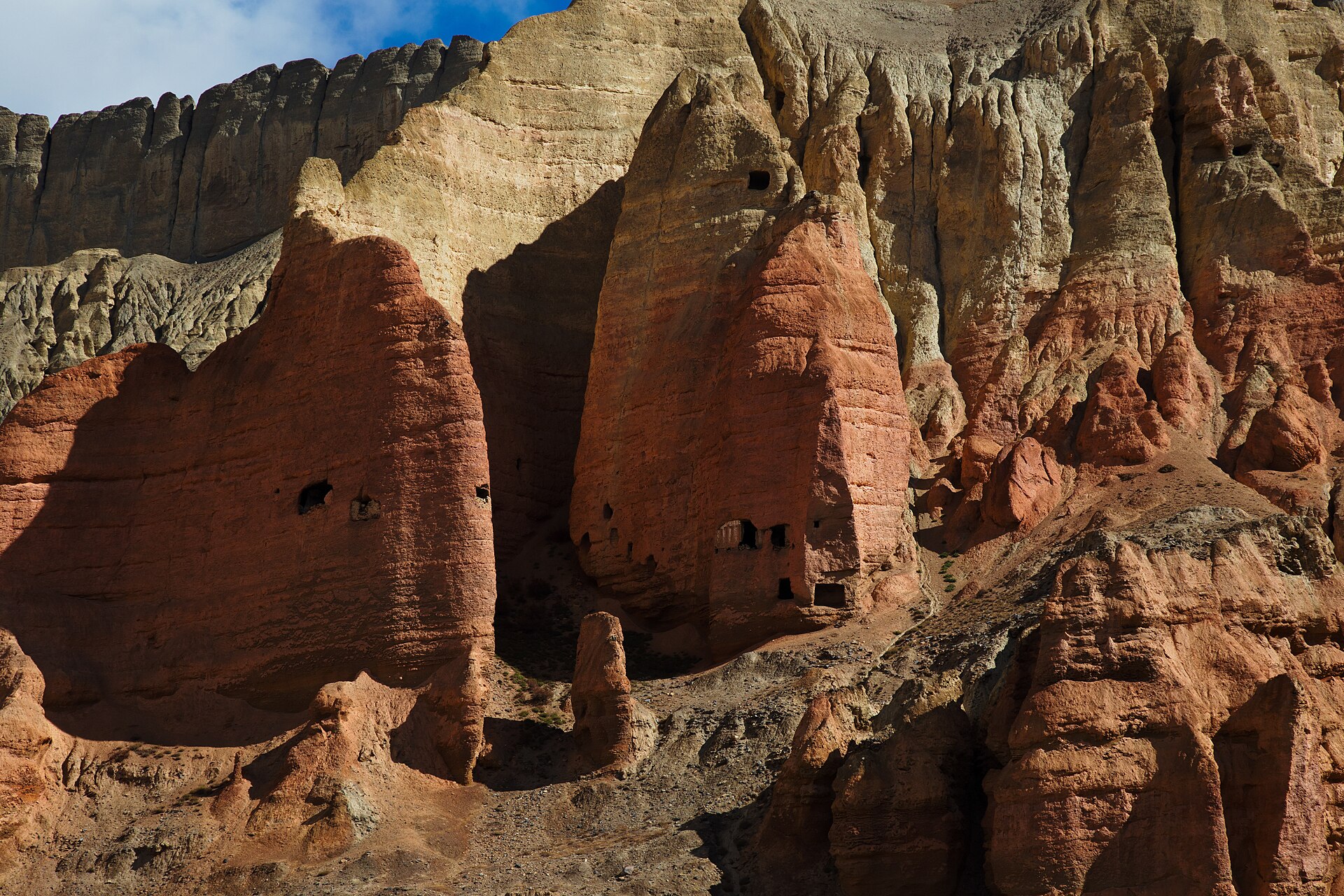
The modern picture comes largely from expeditions led by archaeologist Mark Aldenderfer (University of California, Merced) with mountaineer Pete Athans, working with Nepal's Department of Archaeology from 2008 onward, building on 1990s Nepali-German excavations of burial caves such as Mebrak 63. Aldenderfer's team distinguishes three broad phases: first, the caves served as burial chambers, from roughly 1000 BC to around AD 800; later, around the 10th century — an era of chronic warfare in the region — whole communities apparently moved into the cliffs, using cave systems as defensible homes; and by the 15th century many caves had become meditation cells, chapels and storerooms attached to Buddhist monasteries.
At Samdzong, near the Tibetan border, the team recovered remains of dozens of individuals from shaft tombs, including a spectacular 5th-century burial with a gold-and-silver funerary mask, copper vessels, glass beads from as far away as South Asia, and Chinese silk — proof that this remote gorge sat on long-distance trade networks. Cut-marks on many bones indicate defleshing, an apparent forerunner of Tibetan sky burial, studied by bioarchaeologist Jacqueline Eng. Ancient-DNA work led by Christina Warinner and colleagues (published 2016) showed the earliest sequenced inhabitants were genetically closest to Tibetan plateau populations, settling a long argument about where Mustang's first farmers came from.
On the question of how the caves were dug, mainstream archaeology is candid about the limits of its knowledge. The rock is a soft, compacted glacial-and-lacustrine conglomerate that can be worked with simple tools, and researchers suggest diggers used ropes from above, scaffolding, ladders and now-eroded access paths — noting the gorge floor and cliff faces have changed substantially over two millennia, so openings now stranded in mid-cliff were once easier to reach. But no excavation has yet found the tools, scaffolding sockets or work debris to demonstrate the method directly.
- Excavated burial caves (Mebrak, Chokhopani, Samdzong) with radiocarbon dates spanning c. 1000 BC to AD 800
- Aldenderfer's three-phase sequence — tombs, then defensive dwellings from the 10th century, then monastic use by the 1400s
- The Samdzong shaft-tomb assemblage: gold-and-silver funerary mask, Chinese silk and glass beads evidencing trade links
- Ancient-DNA studies (Warinner and colleagues, 2016) tying the earliest inhabitants to Tibetan plateau populations
- The soft, workable conglomerate geology and ongoing local use of lower caves, supporting simple-tool excavation