Belief & Society · Ancash Region, Peruvian Andes, Peru

Chavín de Huántar's Underground Galleries

A stone labyrinth built to disorient — where water roared through hidden channels, conch trumpets echoed, and initiates met a fanged god in the dark.

Mainstream: c. 1200–500 BC (main construction and ceremonial use)Alternative: Date not seriously disputed — the argument is over what the site is: alternative writers see engineering and knowledge inherited from something older than Andean archaeology allows-9.59°, -77.18°

At a glance

Chavín de Huántar's Underground Galleries
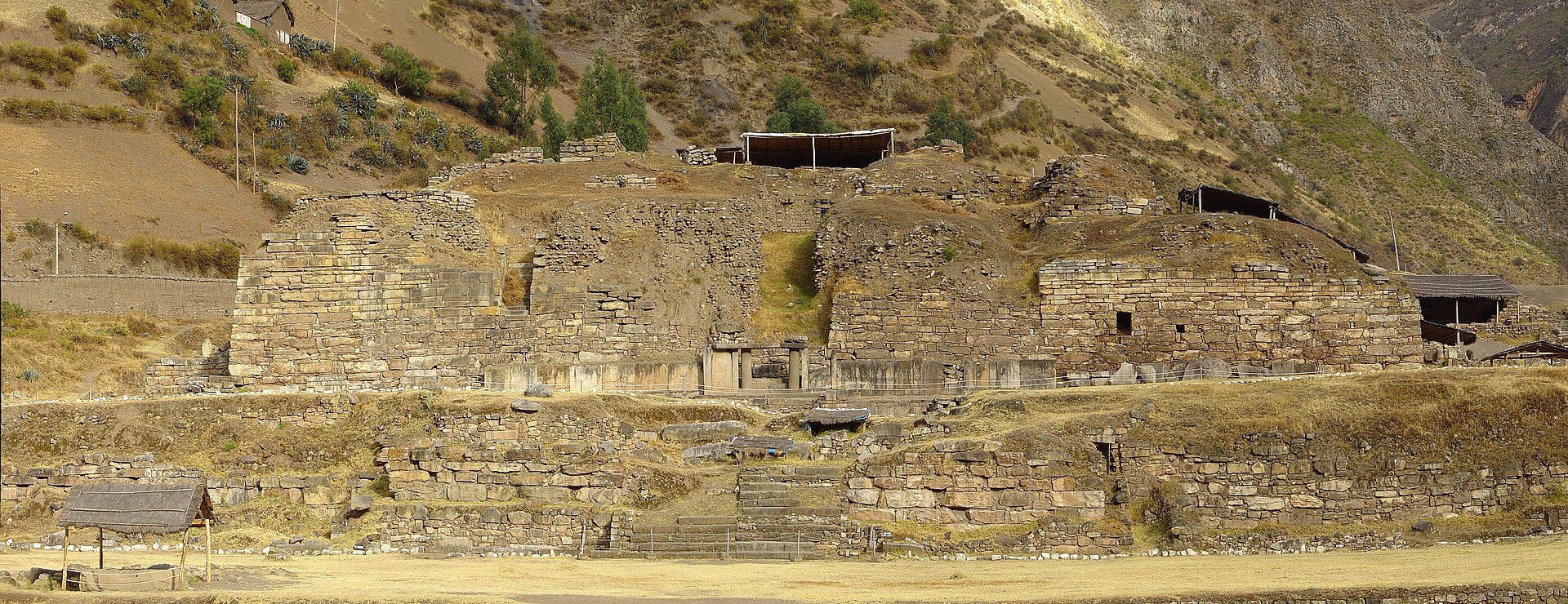
Photo: Martin St-Amant (S23678) · CC BY 3.0

At 3,180 metres in a Peruvian mountain valley, the temple complex of Chavín de Huántar conceals its real architecture underground: more than thirty-five known galleries — narrow, windowless stone passages, stairways, drains and chambers — thread through the man-made platforms like a three-dimensional maze. At the heart of the oldest labyrinth stands the Lanzón, a 4.5-metre blade of white granite carved with a fanged, snake-haired deity, still in its original position after some three thousand years. Chavín was the great pilgrimage centre of the early Andes, drawing visitors from across Peru centuries before the Incas, and it was first scientifically championed by the pioneering Peruvian archaeologist Julio C. Tello from 1919. What makes Chavín extraordinary is mounting evidence that the whole underground complex was engineered as a sensory machine. Water channels seem designed to make the temple roar; gallery acoustics transform sound in measurable, repeatable ways; and the paraphernalia of psychoactive ritual — carved heads showing hallucinogen-induced transformation, mortars, spatulas and snuff tubes — saturates the site. Archaeologists increasingly describe Chavín as an oracle deliberately built to overwhelm the senses of those admitted into the dark.

See it on the globe →
The mainstream view

What archaeology says

Half a century of excavation — by Luis Lumbreras in the 1970s and, since 1995, the long-running Stanford programme led by John Rick — dates Chavín's monumental phases to roughly 1200–500 BC and interprets it as a centre where a priestly elite manufactured religious authority. Lumbreras found dozens of Strombus-shell trumpets (pututus) in the Galería de las Caracolas, and his early experiments with water rushing through the Rocas canal suggested the temple could be made to thunder like applause. Rick's team has mapped the hydraulic network in detail, showing galleries, ducts and drains integrated with astonishing sophistication; new galleries are still being found, including chambers located by camera-carrying robots and, in 2022, the sealed 'condor gallery' with a 3,000-year-old carved stone bowl.

Stanford archaeoacoustician Miriam Kolar has put the sensory-engineering hypothesis on rigorous footing. Her measurements show the Lanzón gallery filters and projects sound so that a pututu blown inside seems to come from everywhere and nowhere; the double-ducted layout could carry a hidden speaker's voice toward the Circular Plaza; and psychoacoustic tests demonstrate the galleries strip away the echo cues humans use to orient, disorienting visitors in the dark. In 2001 an experiment reuniting replica and original pututus in the galleries confirmed their acoustic coupling with the architecture.

In May 2025 the sensory picture gained its missing chemical layer: a PNAS study led by Daniel Contreras (University of Florida) with Rick and Peruvian colleagues reported the first direct evidence of psychoactive plant use at Chavín — bone snuff tubes from small, exclusive gallery chambers bearing residues of vilca (a DMT-relative) and wild tobacco. Crucially, the chambers held only a handful of people: unlike communal drug rituals elsewhere in the Andes, Chavín's visions were rationed, staged and controlled — hallucinogens as an instrument of emerging social hierarchy, in the excavators' reading the very birth of Andean authority.

Key evidence cited
  • Radiocarbon and stratigraphic dating of construction phases to c. 1200–500 BC (Lumbreras; Rick's Stanford programme)
  • The Lanzón monolith still in situ, with a hole above its chamber suggesting oracle-style staging
  • Kolar's archaeoacoustic measurements showing the galleries measurably transform, project and disorient sound
  • Twenty engraved Strombus pututu trumpets excavated from the Galería de las Caracolas in 2001
  • The 2025 PNAS study (Contreras, Rick and colleagues) finding vilca and wild-tobacco residues in snuff tubes from exclusive gallery chambers
The alternative view

What the skeptics propose

Chavín has attracted alternative theorising since before archaeology professionalised. Its own excavator Julio Tello battled the diffusionist Max Uhle, who saw Andean civilisation as imported; modern alternative writers invert the debate. Graham Hancock and others note that Chavín's iconography — fanged deities, staff gods, serpent motifs — appears already mature at the site's founding, and argue it inherits a much older, lost tradition; Hancock's broader case in his Peru chapters ties Andean megalithic and subterranean works to survivors of an Ice Age cataclysm. The galleries themselves feature in popular lore about vast tunnel networks beneath the Andes, supposedly linking Chavín, Cusco and Lake Titicaca — claims descending from colonial-era legends and boosted by writers in the von Däniken tradition, who read the Lanzón's composite deity as something other than imagination.

A more engineering-flavoured strand asks how a society without writing, metals harder than gold alloys, or (as far as evidence shows) large-scale coercion designed a multi-storey hydraulic-acoustic complex that still functions after three millennia — precision ducting, load-bearing galleries beneath massive platforms, and stone-cut channels modelled to control both water and sound. For these writers, Chavín's sensory technology implies accumulated scientific knowledge with no visible developmental runway.

Mainstream archaeology's answer is that the runway exists and is getting longer: Andean monumental tradition reaches back through Sechín and Caral to before 2600 BC, giving Chavín over a millennium of prior architectural experiment to draw on, and Rick's excavations show the site itself was built, rebuilt and refined in many stages — trial and error frozen in stone, not a single miraculous design. The acoustics and hydraulics, researchers argue, are the point rather than the anomaly: a priesthood that discovered, empirically and incrementally, how to weaponise darkness, sound, water and vilca to convince pilgrims they had met a god. On one thing all sides agree — it worked.

Key evidence cited
  • Chavín's iconography appearing fully formed, read by Hancock and others as inheritance from a lost older tradition
  • The sophistication of integrated hydraulic and acoustic engineering with no surviving record of its development
  • Colonial-era and modern legends of vast tunnel systems beneath the Andes connecting major sacred sites
  • The Lanzón's composite fanged deity, interpreted by von Däniken-tradition writers as more than mythology
  • Precision stone ducting and galleries that still channel water and sound after three thousand years

Genuinely open questions

  1. How many galleries remain sealed and unexplored beneath the platforms — and what do they contain?
  2. Were the water channels genuinely designed for sound, for drainage, for ritual, or deliberately for all three?
  3. How did Chavín's priesthood accumulate its acoustic and pharmacological knowledge, and why did the oracle's power collapse around 500 BC?

Worth knowing

When a pututu conch trumpet is blown inside the Lanzón gallery, the architecture so scrambles the sound cues that listeners cannot tell where it comes from — the fanged god's chamber effectively has a built-in surround-sound system, three thousand years early.