Belief & Society · Paola, Malta

Ħal Saflieni Hypogeum

A three-level temple carved underground in total darkness — with an Oracle Room that hums at 110 hertz.

Mainstream: c. 4000–2500 BC (in use across the Żebbuġ to Tarxien phases)Alternative: Date not seriously disputed — the arguments are over engineered acoustics, 'elongated skulls' and a persistent urban legend of vanished schoolchildren in hidden tunnels35.87°, 14.51°

At a glance

Ħal Saflieni Hypogeum
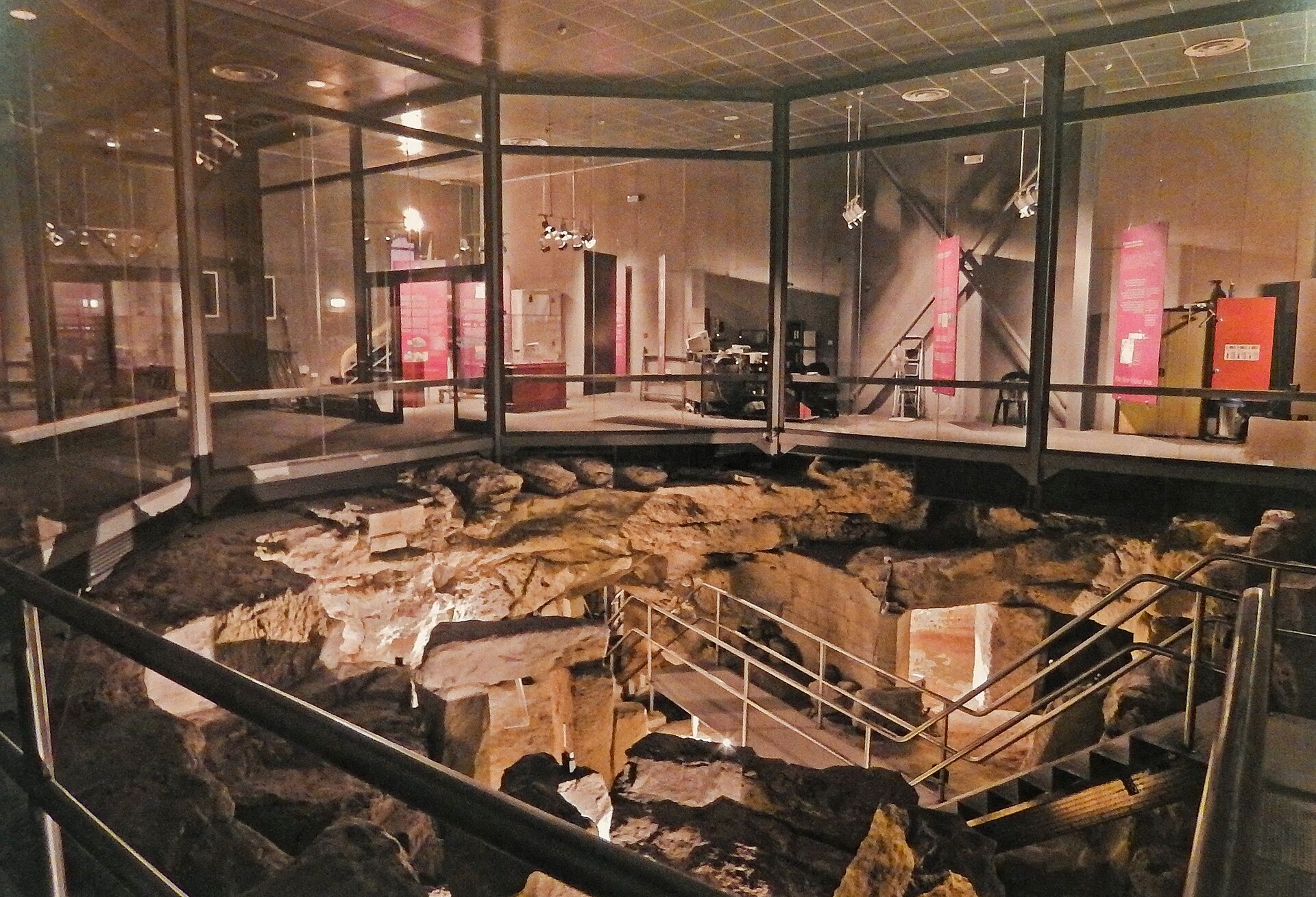
Photo: xiquinhosilva · CC BY 2.0

Beneath a quiet street in Paola lies the Ħal Saflieni Hypogeum, the world's only known prehistoric underground temple-cemetery: three levels of chambers, halls and burial niches hewn out of living globigerina limestone with stone, flint and antler tools, descending more than ten metres. Its middle level reproduces in negative the architecture of Malta's above-ground temples — carved trilithon doorways, corbelled ceilings — and its walls carry red-ochre spirals and honeycomb patterns. Discovered by accident in 1902 during house construction, it yielded the remains of thousands of individuals and the famous 'Sleeping Lady' figurine. Today entry is limited to about 80 visitors a day inside a strict microclimate.

See it on the globe →
The mainstream view

What archaeology says

After the 1902 discovery was initially concealed by the builders, the site was investigated first by Fr Manuel Magri and then, from 1907, systematically excavated by Sir Themistocles Zammit, who published his findings and estimated the remains of some 7,000 individuals (the figure of 33,000 sometimes quoted is a later inflation). Pottery seriation and comparison with Malta's dated temples place the Hypogeum's use from the Żebbuġ phase around 4000 BC to the Tarxien phase ending about 2500 BC — the lowest level probably the earliest. It functioned as a collective burial place and sanctuary: bodies were interred with red ochre, beads, amulets and figurines, and the upper levels seem to have hosted ritual, with a rock-cut 'Holy of Holies' and the 'Snake Pit' possibly used for offerings. The Sleeping Lady, a modelled clay figure of a woman asleep on a couch, is the masterpiece of the assemblage and now rests in Malta's National Museum of Archaeology.

The site's acoustics have attracted serious study. The 'Oracle Room' contains a carved niche whose low-voice resonance booms through the complex; measurements associate strong resonance behaviour around 110 Hz, comparable to values reported in other ancient chambers. A 2008 study by UCLA neuroscientist Ian Cook found that listening at 110 Hz shifted volunteers' EEG activity — relative deactivation in language-linked left temporal regions and a shift towards right-frontal patterns associated with emotional processing — and archaeoacoustics conferences held in Malta in 2014 (organised by Linda Eneix's OTS Foundation, with researchers such as Paolo Debertolis) explored whether temple builders exploited such effects. Mainstream caution remains: resonance is an inherent property of hard-walled rock chambers, and there is no way to prove the builders tuned it deliberately, though the Oracle niche's placement is suggestive.

Conservation, not mystery, dominates current work: Heritage Malta rebuilt the visitor system around microclimate control after studies showed breath and light were destroying the ochre paintings, and the site reopened in 2017 after a major environmental upgrade.

Key evidence cited
  • Zammit's systematic excavation reports (from 1907) documenting stratified burials of roughly 7,000 individuals
  • Pottery sequences tying the Hypogeum's use to Malta's dated Żebbuġ–Tarxien phases (c. 4000–2500 BC)
  • Architectural mimicry of above-ground temples, carved with stone, flint and antler tools left in the record
  • Anthropological re-examinations finding the skulls within normal human variation with known pathologies
  • Complete absence of contemporary documentation for the schoolchildren story despite Malta's small, literate society
The alternative view

What the skeptics propose

Three claims dominate the alternative literature, and they deserve careful separation. First, the skulls. Zammit described some crania from the Hypogeum as markedly 'long-headed' (dolichocephalic), and in the 1990s–2000s Maltese and Italian writers — notably Anton Mifsud and Adriano Forgione of HERA magazine — publicised a subset of unusual skulls, one lacking the usual cranial sutures, as evidence of a distinct priestly lineage or even a separate 'serpent priest' race, noting that the skulls were no longer on public display. Sceptical anthropologists who have examined the collection report natural variation, artificial cradle-boarding effects and pathology (such as craniosynostosis), no more extreme than in many ancient populations; the skulls' removal from display was routine curation, and several were re-examined and photographed for researchers. No peer-reviewed study supports a non-human or exotic population.

Second, the acoustics-as-technology claim: popular accounts upgrade the 110 Hz findings into assertions that the Hypogeum was a machine for altering consciousness, engineered with acoustic knowledge beyond the Neolithic. The measured phenomena are real; the leap to deliberate precision engineering is where mainstream researchers step off, pointing out that similar resonances arise unbidden in any small rock chamber.

Third, the vanished schoolchildren — a story that must be treated as legend. An American magazine article of August 1940 mentioned, in passing, a tale that some 30 schoolchildren and their teachers had disappeared in an underground extension of the Hypogeum when their guide-rope was severed; later retellings, especially a lurid account attributed to a British embassy worker 'Miss Lois Jessup' published in fringe UFO literature (and repeated in Riley Crabb's Borderland Sciences writings), added humanoid creatures in deep tunnels beneath the lowest level. No Maltese newspaper report, school record or family account of any such disappearance has ever been found, and Heritage Malta formally lists the story among debunked myths — possibly a cautionary tale born of Malta's genuinely labyrinthine wartime tunnels and catacombs. What the legend gets right is only this: Malta truly is honeycombed with unexplored underground spaces, and the Hypogeum itself was found by accident. Writers such as Hancock also fold the Hypogeum into the wider case for a much older Malta, but its dating is anchored by pottery and stratigraphy to the temple period.

Key evidence cited
  • Zammit's own descriptions of unusual 'long-headed' crania among the burials
  • Mifsud's and Forgione's reports on anomalous skulls, including one with fused sutures, removed from display
  • Measured ~110 Hz resonance in the Oracle Room and EEG studies showing effects on brain activity at that frequency
  • The 1940 magazine reference and Jessup account cited as testimony for hidden lower tunnels
  • Malta's genuinely vast and partly unmapped underground of catacombs, cart ruts and wartime tunnels

Genuinely open questions

  1. Did the builders deliberately shape the Oracle Room's resonance, or is the 110 Hz effect a happy accident of geometry?
  2. How were three storeys of precise, temple-mimicking architecture carved in darkness with stone and antler tools?
  3. Do further chambers or connected hypogea remain undiscovered beneath Paola, as ground anomalies occasionally hint?

Worth knowing

To protect its 5,000-year-old ochre paintings, the Hypogeum admits only about 80 visitors a day in climate-controlled groups — tickets routinely sell out weeks ahead, making a Neolithic tomb one of the hardest bookings in the Mediterranean.