What archaeology says
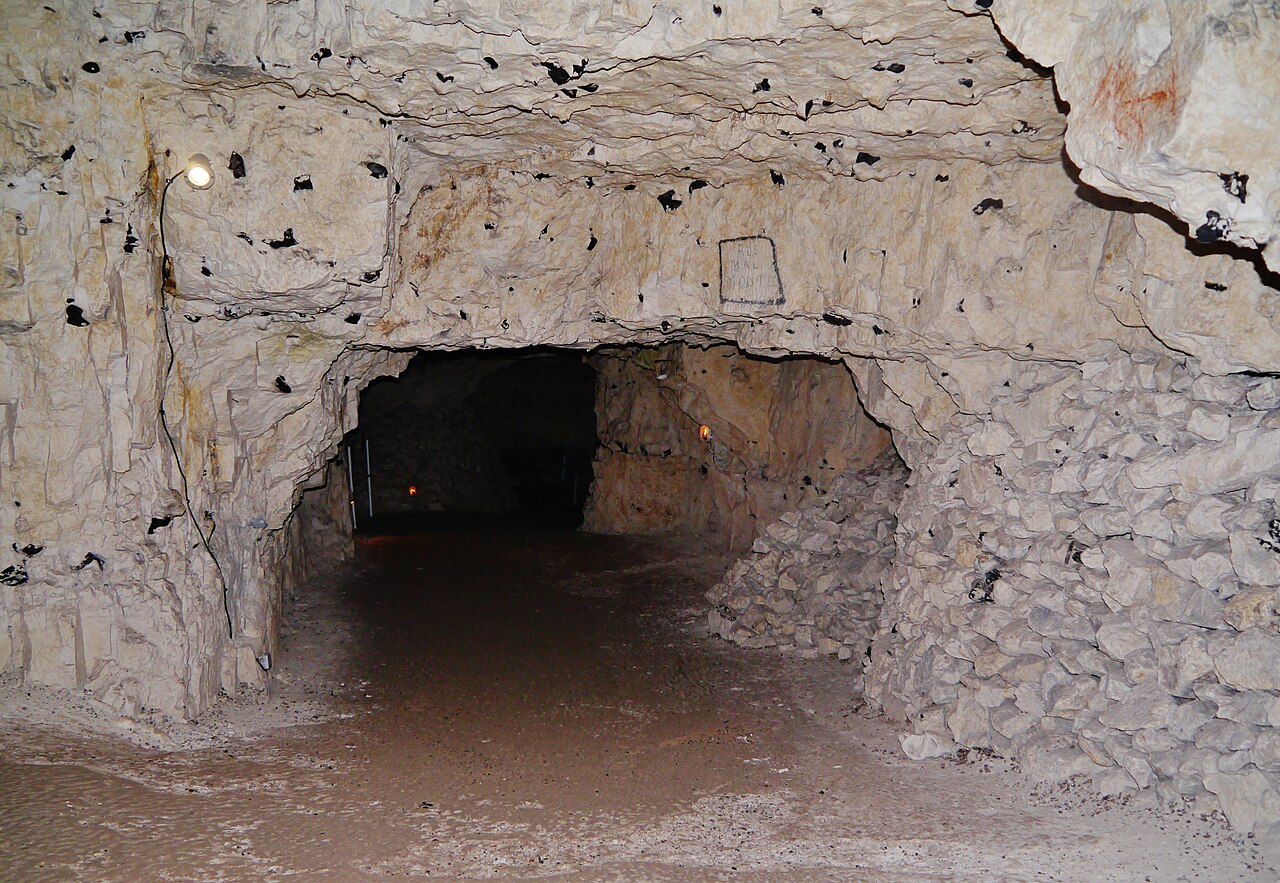
Archaeology and archives indicate that Naours began as underground chalk quarries in the Middle Ages, which villagers progressively enlarged into an organised refuge. The muches tradition — the word derives from Picard dialect for to hide — is documented across the Somme, and Naours is its grandest expression: capacity estimates run to 2,000–3,000 people plus their livestock. Use intensified during the wars of religion and the Thirty Years' War in the 16th and 17th centuries, when passing armies made surface life lethal; the complex was designed for long stays, with wells, ventilation, stabling, storage and three chapels.
After fading from memory in the quieter 18th and 19th centuries, the tunnels were rediscovered and cleared from 1887 by Abbé Ernest Danicourt, the parish priest, who spent years exploring and publicising them. During the First World War the site, lying behind the lines near Vignacourt, became an improbable tourist attraction for resting troops. Research led from 2014 by INRAP archaeologist Gilles Prilaux, originally studying the site's older history, unexpectedly catalogued nearly 3,000 items of soldiers' graffiti — the largest known concentration of First World War inscriptions on the Western Front, the majority Australian. In the Second World War the Germans requisitioned the complex, using it for headquarters and storage.
Historians note that, unlike many legendary tunnel systems, Naours is exhaustively mapped and its phases are legible in tool marks, documents and finds: a vernacular civil-defence masterpiece rather than a mystery.
- Around 300 rooms and 3 km of galleries, fully surveyed, about 33 metres below the plateau
- Documented muches refuge tradition across the Somme in the 16th–17th centuries
- Chimney flues routed through surface cottages demonstrate purpose-built concealment for civilian refuge
- Rediscovery and clearance from 1887 by Abbé Ernest Danicourt is historically recorded
- INRAP study led by Gilles Prilaux (2014 onwards) catalogued nearly 3,000 WWI inscriptions, mostly Australian
- German military use in WWII is documented, completing an unbroken modern history