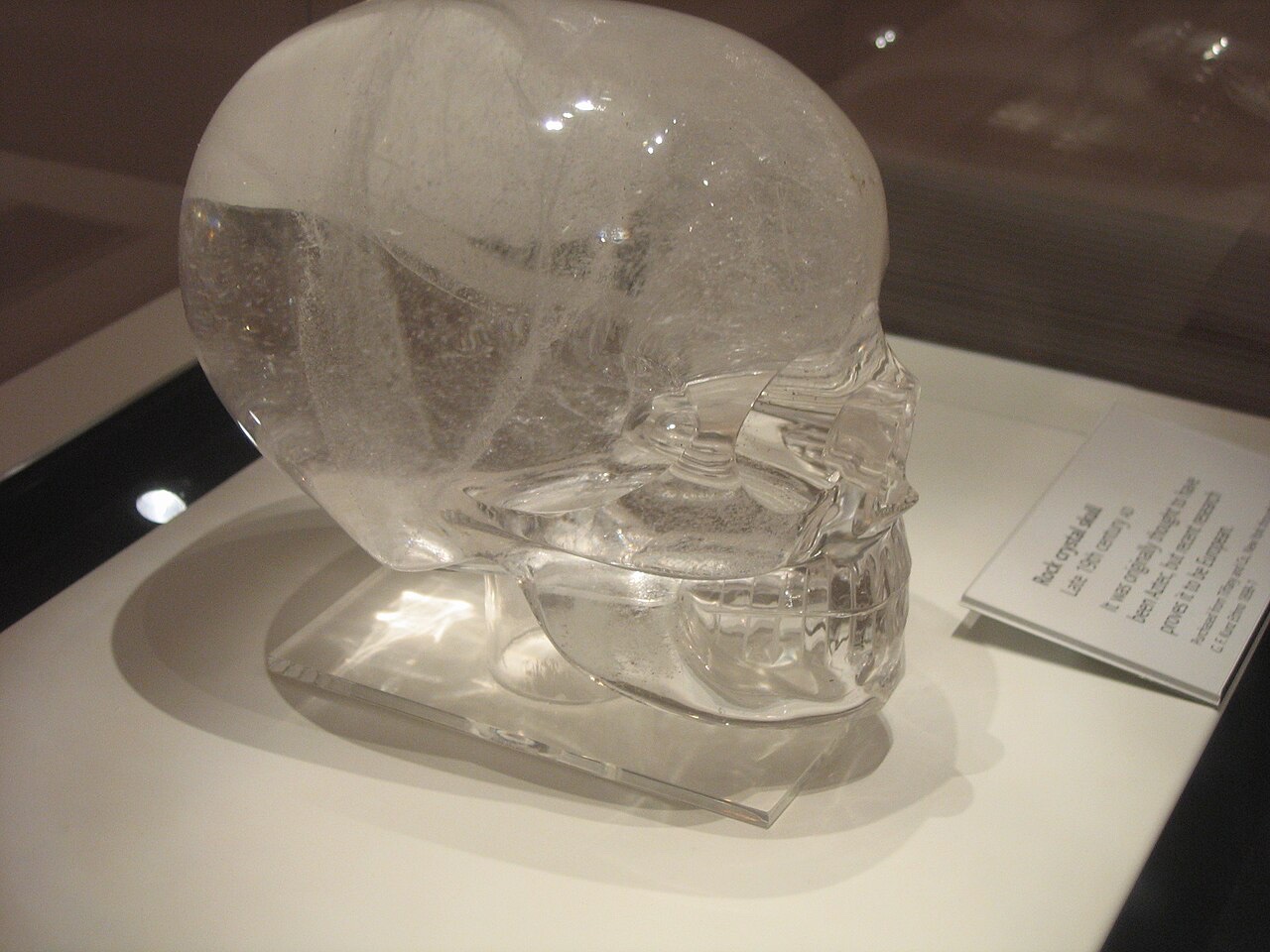
Ancient Technology · Claimed found at Lubaantun, Belize; privately held (Bill Homann, USA)

Mitchell-Hedges Crystal Skull

The 'Skull of Doom' — a flawless quartz skull with a discovery story that keeps changing

Mainstream: Carved in the 20th century, surfacing by 1933-1943Alternative: 3,600 years old or more, per the Mitchell-Hedges family16.28°, -88.96°

At a glance

Mitchell-Hedges Crystal Skull
Photo: Wikimedia Commons · CC BY-SA 2.0

The Mitchell-Hedges skull is a life-sized human skull carved from a single block of clear quartz, with a detachable lower jaw — the finest of the famous crystal skulls. Anna Mitchell-Hedges, adopted daughter of the British adventurer and author F. A. 'Mike' Mitchell-Hedges, said she found it in 1924, on her seventeenth birthday, beneath a collapsed altar at the Maya city of Lubaantun in British Honduras (now Belize). She exhibited it for decades as a 3,600-year-old Maya relic with uncanny powers. Documents tell a different story: the skull was auctioned at Sotheby's in London in 1943, where Mitchell-Hedges bought it from the art dealer Sydney Burney for 400 pounds, and no excavation record from Lubaantun mentions it.

See it on the globe →
The mainstream view

What archaeology says

Mainstream researchers regard the skull as a modern object with a manufactured legend. The documentary trail is damning: Sydney Burney possessed the skull by 1933, it was offered at Sotheby's in 1943, and Mitchell-Hedges' own newsletter references buying it; none of the many people on the 1920s Lubaantun expeditions — including the site's actual excavator Thomas Gann and later Norman Hammond — ever recorded a crystal skull, and Anna herself is not securely documented as having been at Lubaantun at all.

The physical evidence agrees. In 2008, Smithsonian anthropologist Jane MacLaren Walsh, the leading specialist on crystal skulls, examined the skull with scanning electron microscopy of surface moulds and found tell-tale traces of high-speed rotary tools and hard modern abrasives — technology unavailable to the ancient Maya. Her work paralleled the British Museum and Musee du quai Branly analyses that exposed their own crystal skulls as nineteenth-century products, many traceable to the French antiquities dealer Eugene Boban, who sold 'Aztec' skulls likely cut in German lapidary workshops using Brazilian quartz.

For scholars, the entire crystal-skull genre is a chapter in the history of the antiquities market, not of Mesoamerica: no crystal skull has ever been recovered from a documented excavation anywhere.

Key evidence cited
  • Jane MacLaren Walsh's 2008 scanning-electron-microscope analysis found marks of high-speed rotary tools and modern abrasives
  • Documents show the skull with London dealer Sydney Burney by 1933 and its purchase by Mitchell-Hedges at Sotheby's in 1943
  • No expedition record, photograph or publication from the 1920s Lubaantun excavations mentions any crystal skull
  • F. A. Mitchell-Hedges never mentioned the skull in his writings before the mid-1940s, despite being a prolific self-publicist
  • Parallel analyses exposed the British Museum and Paris crystal skulls as nineteenth-century fakes tied to dealer Eugene Boban
  • No crystal skull has ever been found in a controlled excavation in the Maya area or anywhere else in Mesoamerica
The alternative view

What the skeptics propose

The alternative account is essentially the Mitchell-Hedges family narrative and the mythology that grew around it. Anna Mitchell-Hedges maintained until her death in 2007 that she spotted the skull glinting beneath a ruined altar at Lubaantun in 1924, that the jaw was found nearby weeks later, and that the 1943 Sotheby's sale was merely her father redeeming an object he had left with Burney as security for a loan. F. A. Mitchell-Hedges wrote in his 1954 memoir Danger My Ally that the 'Skull of Doom' was at least 3,600 years old and used by Maya priests to will death upon enemies.

Around this core accreted grander claims: art restorer Frank Dorland, who studied the skull in the 1960s and arranged an informal examination at Hewlett-Packard's crystal labs, reported it was carved against the quartz's natural axis and claimed it could not have been made with modern methods without shattering — assertions that fed books linking the skulls to Atlantis, telepathic archives and a prophecy that reuniting thirteen skulls will awaken humanity, a legend popularised by writers such as Chris Morton and Ceri Louise Thomas in The Mystery of the Crystal Skulls (1997).

The skull's current keeper, Bill Homann, continues to exhibit it as an object of spiritual power. The 2008 Indiana Jones film briefly made the genre world-famous again, but no scientific body accepts a pre-modern date, and the Hewlett-Packard 'findings' were never a formal study.

Key evidence cited
  • Anna Mitchell-Hedges consistently testified for eight decades that she found the skull at Lubaantun in 1924
  • The family explained the Sotheby's sale as redemption of a loan security, not an original purchase
  • Frank Dorland reported the skull was carved with little regard for the crystal's natural axis, which he argued defied conventional lapidary practice
  • Informal examination at Hewlett-Packard's Santa Clara crystal facility in 1970 confirmed the skull and jaw came from a single quartz block
  • Supporters note the skull's optical properties — channelling light to the eye sockets — suggest sophisticated deliberate design
  • Some Lubaantun expedition photographs show Anna at the site as a teenager, her defenders claim, though the identification is disputed

Genuinely open questions

  1. Who actually carved the Mitchell-Hedges skull, and in which workshop — Europe, the Americas — and when in the early twentieth century?
  2. Where did Sydney Burney obtain it before 1933, a link no researcher has yet traced?
  3. Was Anna Mitchell-Hedges ever at Lubaantun, and did she come to believe her own story?
  4. Why was this skull carved with a detachable jaw and near-flawless finish that exceed every other known crystal skull?

Worth knowing

F. A. Mitchell-Hedges dubbed it the 'Skull of Doom' and claimed several people who mocked it died soon after — an excellent way, sceptics note, to raise the price of lecture tickets.