What archaeology says
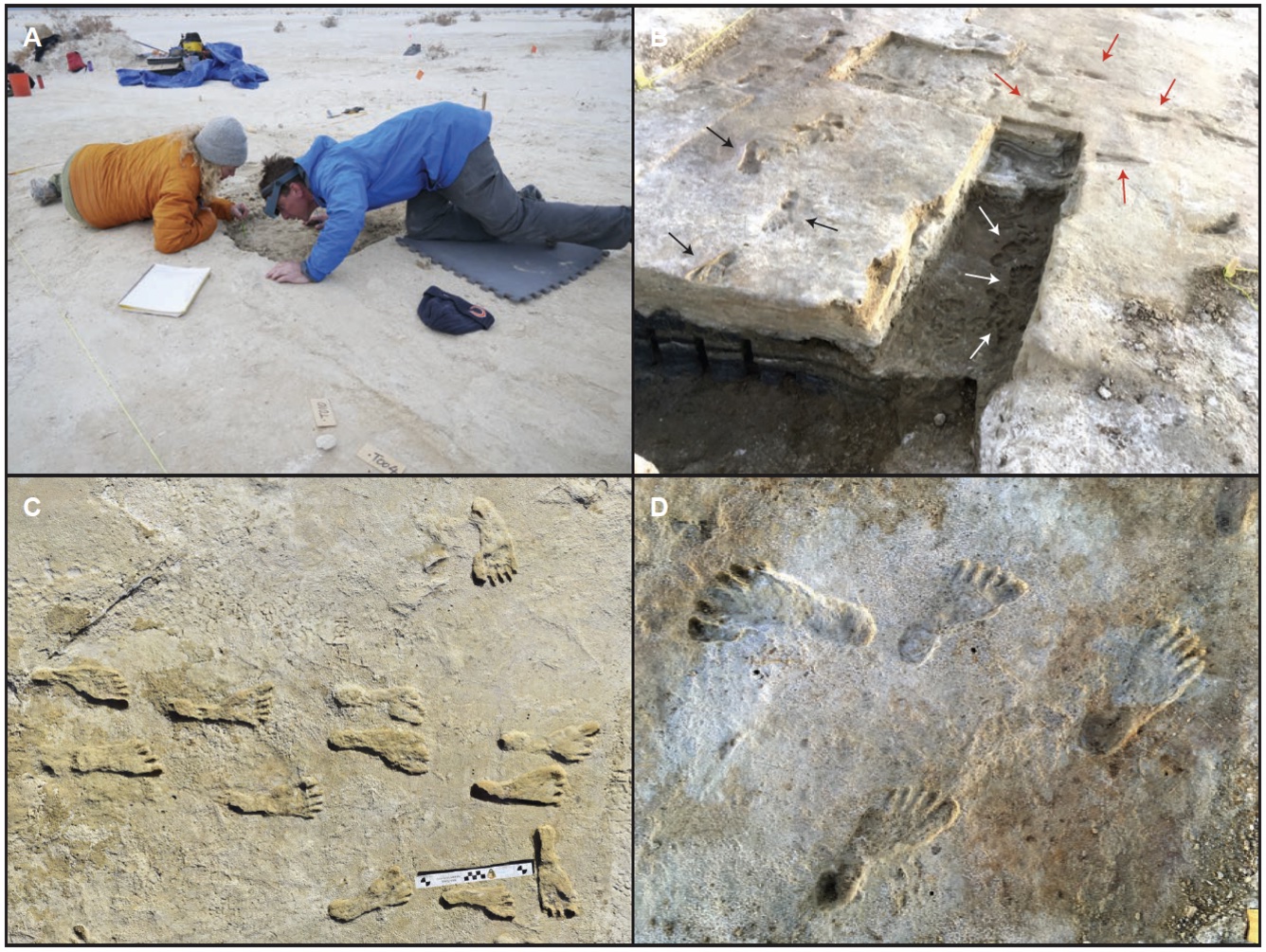
The footprints were first dated in a 2021 Science paper led by Matthew Bennett and colleagues, working with US Geological Survey and National Park Service scientists including David Bustos, Kathleen Springer and Jeffrey Pigati. Radiocarbon dating of seeds of the aquatic plant Ruppia cirrhosa found in the same layers returned ages of roughly 23,000 to 21,000 years — placing people in the Americas at the height of the Last Glacial Maximum, when the standard model held the ice-free corridor and coastal routes were largely closed and Clovis-first thinking had already been eroded but no site was so old and so securely in the continental interior.
Because the original dates rested on aquatic seeds — vulnerable to a 'hard-water' reservoir effect, whereby plants take up ancient dissolved carbon and read too old — the team returned with independent methods. A 2023 Science paper reported radiocarbon dates on terrestrial conifer pollen from the same horizons, plus optically stimulated luminescence (OSL) ages on quartz grains within the footprint-bearing sediments; both corroborated the original chronology. A further study in 2025, dating the mud itself at two independent laboratories, again supported an age older than about 21,000 years, giving three different materials, three methods and multiple labs in agreement — some 55 consistent radiocarbon dates in all.
Most researchers now treat the roughly 22,000-year age as robust, and White Sands as strong evidence that humans were present in the Americas well before the Last Glacial Maximum peak.
- Ruppia seed radiocarbon dates of c. 23,000–21,000 years from the footprint layers (2021 Science)
- Independent 2023 confirmation from terrestrial pollen radiocarbon and OSL on quartz grains
- 2025 dating of the enclosing mud at two independent labs supporting an age over 21,000 years
- Around 55 consistent radiocarbon dates across three materials, three methods and multiple labs
- Footprints found alongside extinct megafauna tracks, consistent with a full Ice Age setting