Lost Worlds · Traditional location: mid-Indian Ocean, between Madagascar and India (as mapped by 19th-century biogeographers)

Lemuria

The lost continent that began as respectable Victorian science, died at the hands of plate tectonics, and was reincarnated as an occult motherland.

Mainstream: 1864 (Philip Sclater proposes Lemuria as a scientific land-bridge hypothesis)Alternative: Millions of years ago (Theosophy's continent of the 'Third Root Race')-20.00°, 70.00°

At a glance

Lemuria
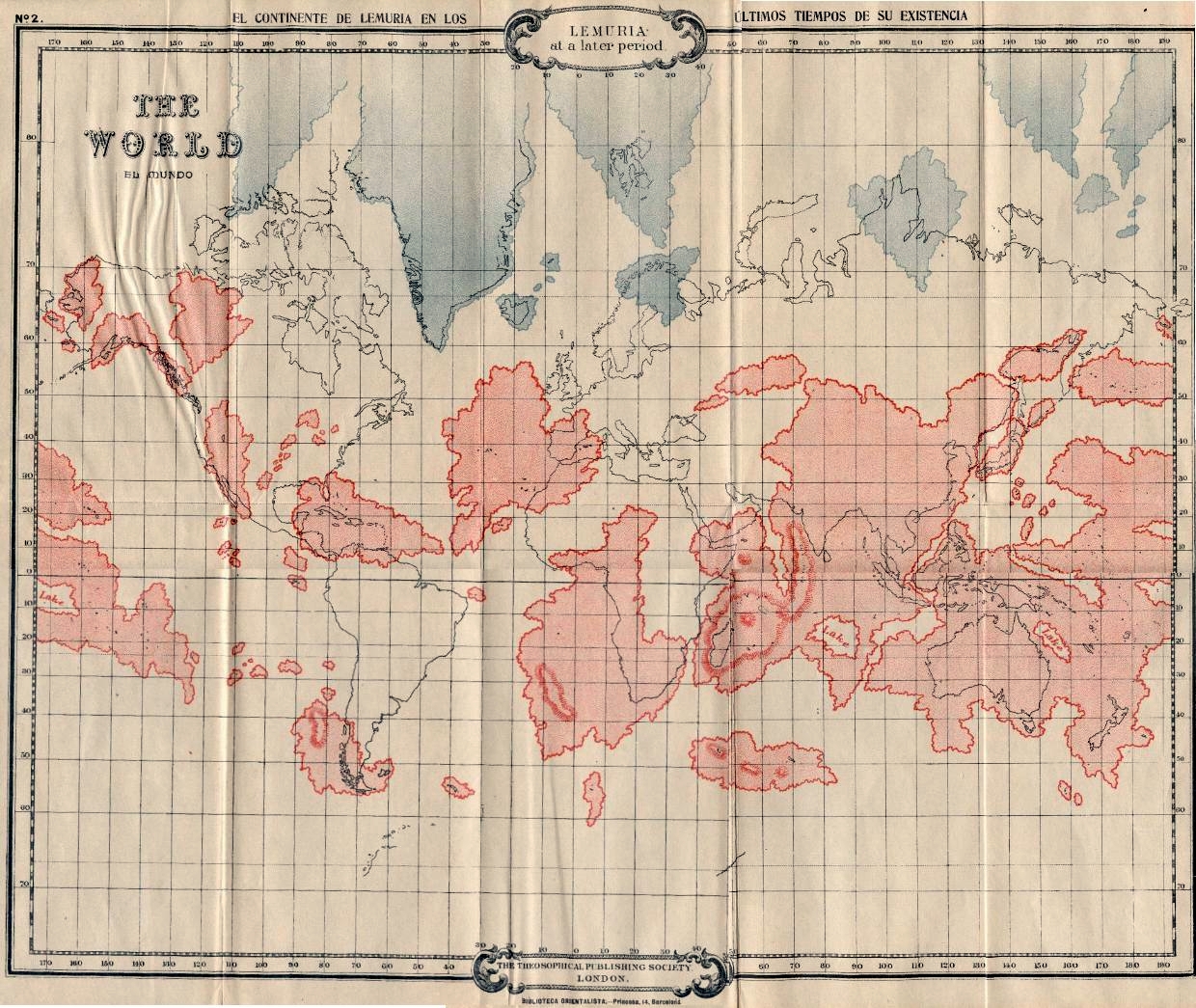
Photo: William Scott-Elliot (1904) · Public domain

Lemuria is unique among lost lands in having a precise scientific birthday. In 1864 the zoologist Philip Sclater, puzzled that lemurs and related fossils occurred in Madagascar and India but not in Africa or the Middle East, proposed a sunken Indian Ocean landmass to connect them — and named it, with impeccable logic, Lemuria. For a few decades it was mainstream biogeography, endorsed in some form by figures like Ernst Haeckel, who suggested it might even be the cradle of humanity. Continental drift and plate tectonics eventually dissolved the problem it was invented to solve. But by then the name had escaped the laboratory: Helena Blavatsky's Theosophy made Lemuria the home of a primordial root race, later writers relocated it to the Pacific and under Mount Shasta, and Tamil revivalists fused it with their own drowned-land tradition of Kumari Kandam. In a final twist, geologists really have found drowned continental fragments beneath the Indian Ocean — just tens of millions of years too old for anyone to have lived on them.

See it on the globe →
The mainstream view

What archaeology says

Historians of science treat Lemuria as a textbook case of a reasonable hypothesis overtaken by better theory. In the 1860s the fixed-continent consensus left biologists genuinely stuck: closely related animals and fossils sat on opposite shores of oceans, and sunken land bridges were the least-bad explanation available. Sclater's Lemuria was one of many such proposed bridges, and it did real explanatory work — the Madagascar–India faunal connection is genuine. The resolution came from continental drift: Madagascar and India were once joined, not by a vanished bridge, but as neighbouring pieces of the supercontinent Gondwana, which broke apart between roughly 160 and 88 million years ago, with India then sailing north to collide with Asia. Once plate tectonics was accepted in the 1960s, Lemuria became scientifically superfluous — the connection was real, the sunken continent was not, and oceanic crust in any case cannot host a foundered continent of that kind.

The delicious epilogue is Mauritia. Between 2013 and 2017, studies led by Trond Torsvik and Lewis Ashwal reported Precambrian zircon crystals — some over two billion years old, one lot nearly three billion — in young volcanic sands and rocks on Mauritius, an island whose basalts are no older than about nine million years. The favoured explanation is that Mauritius sits atop a drowned sliver of ancient continental crust, dubbed Mauritia, stretched and sunk when India and Madagascar separated. So a fragment of 'Lemuria' exists after all: a genuine microcontinent beneath the Indian Ocean, vindicating Sclater's geographical instinct while demolishing every inhabited-lost-world version — Mauritia foundered more than 80 million years before hominins existed.

Key evidence cited
  • The Madagascar–India faunal link that motivated Lemuria is fully explained by the breakup of Gondwana and plate tectonics
  • Ocean-floor mapping shows no sunken continent-scale landmass in the Indian Ocean at any humanly relevant date
  • Precambrian zircons on Mauritius (Torsvik 2013; Ashwal 2017) indicate the real drowned fragment, Mauritia, foundered over 80 million years ago
  • Lemuria's occult content traces to Blavatsky's unverifiable 'Book of Dzyan', not to any archaeological or textual discovery
  • The idea's complete paper trail — from Sclater's 1864 article onward — documents its invention and mutation step by step
The alternative view

What the skeptics propose

Lemuria's second life began with Helena Blavatsky, co-founder of the Theosophical Society, whose 1888 opus The Secret Doctrine placed the continent (sprawling from the Indian Ocean into the Pacific) at the heart of an occult prehistory. Her Lemurians were the 'Third Root Race' — colossal, egg-laying, psychically gifted beings whose continent perished by fire, succeeded by Atlantis and its Fourth Root Race. Blavatsky claimed the story from the 'Book of Dzyan', an alleged ancient Tibetan text unknown to scholarship. Theosophist W. Scott-Elliot elaborated the geography with maps in The Story of Atlantis and the Lost Lemuria (1904), and in 1894 Frederick Spencer Oliver's channelled novel A Dweller on Two Planets seeded the enduring legend of Lemurian survivors dwelling inside Mount Shasta in California — a tradition amplified by Rosicrucian writer Wishar Cervé in 1931 and still thriving in the town of Mount Shasta's crystal shops today.

The tradition's most consequential graft was in South India, where colonial-era and later Tamil writers identified Lemuria with Kumari Kandam, the drowned southern land of Tamil literary tradition, giving the occult continent a nationalist and linguistic afterlife covered in its own entry on this site. Modern proponents occasionally cite the Mauritia discoveries as vindication — headlines announcing a 'lost continent found under the Indian Ocean' circulate regularly — and sceptics reply that this gets the lesson exactly backwards: the real drowned fragments are lifeless Precambrian crust that sank in the age of dinosaurs, not the home of any root race. There are no Lemurian artefacts, texts or ruins; every detailed claim about its civilisation traces to Blavatsky's channelled sources or their literary descendants. Lemuria thus stands as the clearest case study in how an obsolete scientific hypothesis can be preserved, transformed and emotionally supercharged by esoteric tradition long after science has moved on.

Key evidence cited
  • Blavatsky's Secret Doctrine and its claimed access to the ancient 'Book of Dzyan' describing the Third Root Race
  • Scott-Elliot's Theosophical maps of Lemuria, presented as derived from clairvoyant investigation
  • The Mount Shasta tradition of surviving Lemurians, from Oliver's 1894 channelled novel through Cervé and modern sightings
  • Tamil tradition of a drowned southern motherland (Kumari Kandam), read by proponents as independent memory of Lemuria
  • Real submerged continental fragments (Mauritia, the Kerguelen Plateau, Zealandia elsewhere) cited as proof that continents can drown

Genuinely open questions

  1. How extensive is the Mauritia fragment, and what else lies unrecognised beneath the Indian Ocean's volcanic cover?
  2. Why did Lemuria, of all the discarded land-bridge hypotheses, become the one resurrected by esoteric tradition?
  3. Does any element of South Asian drowned-land tradition preserve genuine memory of post-glacial coastal flooding?

Worth knowing

Lemuria is named after lemurs — and the name was so catchy it outlived the science by 160 years and counting. Meanwhile the real buried microcontinent under Mauritius was identified partly from tiny zircon crystals found in beach sand.