Myth & Memory · Palk Strait, between Rameswaram (India) and Mannar (Sri Lanka)

Adam's Bridge / Rama Setu

A 48-kilometre chain of shoals between two nations — a natural tombolo to geologists, the causeway of Rama to a living epic tradition, and a genuine political-scientific flashpoint.

Mainstream: Sand/shoal chain over a limestone/coral base; various studies suggest exposure of parts within the last ~7,000–18,000 years, some coral dated to recent centuriesAlternative: c. 1,750,000 years ago (a widely circulated but unsupported figure) or the Treta Yuga of Ramayana tradition9.12°, 79.52°

At a glance

Adam's Bridge / Rama Setu
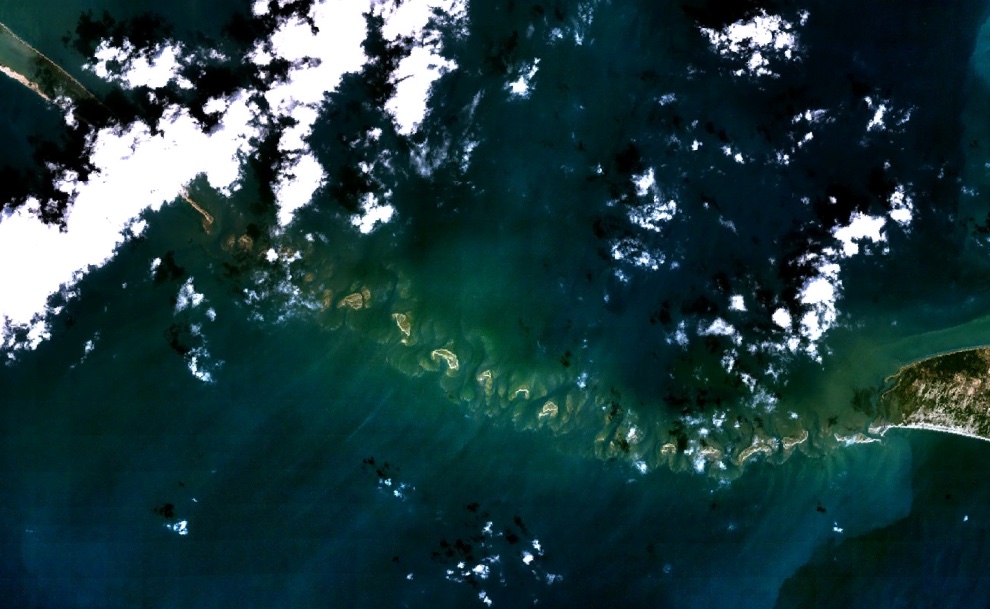
Photo: NASA / Landsat 7 (via World Wind) · Public domain

Adam's Bridge, known in India as Rama Setu, is a roughly 48-kilometre chain of limestone shoals, sandbanks and reefs stretching across the shallow Palk Strait between Rameswaram Island off India and Mannar Island off Sri Lanka. In the Hindu epic Ramayana it is the bridge built by Rama's army of vanaras to reach Lanka and rescue Sita; in Islamic tradition it is linked to Adam. For geologists it is a natural coastal formation. The bridge became a national controversy in the 2000s when the Sethusamudram shipping-canal project proposed dredging through it, colliding with the belief that it is a sacred, human-made structure — and producing one of modern India's sharpest clashes between science, faith and politics.

See it on the globe →
The mainstream view

What archaeology says

Geologists interpret Adam's Bridge as a natural feature: a chain of shoals and sandbars developed on a ridge of older limestone and coral, of a type known as a tombolo or barrier-and-shoal system, built and reshaped by longshore currents, wave action and sediment transport in the very shallow strait. The Geological Survey of India's investigations, together with satellite imagery from NASA and ISRO and high-resolution bathymetric modelling using ICESat-2 data, show a linear ridge of shoals broken by narrow channels — consistent with natural sedimentary and reef processes rather than deliberate construction.

Dating is layered and often misreported. Studies suggest the wider Rameswaram–Mannar region was intermittently exposed as sea levels fell during the last glacial period, with landmass emergence estimated across a broad window of roughly 7,000 to 18,000 years ago, while coral dating on parts of the structure has returned surprisingly recent ages, on the order of a few centuries. The much-quoted figure of '1.75 million years' derives from a misattributed television claim, not from a peer-reviewed study, and geologists reject it.

The mainstream position is therefore that the bridge is a real, striking, walkable-in-places natural formation whose components have different ages, and that the shoals sitting just below or at the water surface reflect ordinary marine geology in an extremely shallow sea — not the ruins of an engineered causeway.

Key evidence cited
  • Satellite imagery (NASA Landsat, ISRO/NASA ICESat-2) showing a natural linear shoal-and-channel ridge
  • Geological Survey of India work interpreting the chain as a tombolo/barrier system on a limestone base
  • High-resolution bathymetric modelling consistent with sediment transport and reef processes
  • Coral and sediment dating giving mixed, sometimes recent (few-century) ages for parts of the structure
  • The '1.75-million-year' figure traced to a misattributed TV claim, not any peer-reviewed study
The alternative view

What the skeptics propose

The traditional and alternative view holds that Rama Setu is the causeway described in the Ramayana, built by Rama's army, and thus either genuinely human-made or of profound sacred significance regardless of geology. Millions of devotees regard the structure as sacred and its stones as literally placed by the epic's builders; some proponents cite the chain's remarkable linearity, its near-surface continuity across nearly 50 kilometres, and floating-stone folklore as signs of design rather than accident.

The controversy became acutely political. When the UPA government advanced the Sethusamudram Shipping Canal Project from 2005, dredging a channel across the shoals to shorten shipping routes, Hindu petitioners argued this would destroy a sacred monument. In 2007 the Archaeological Survey of India filed an affidavit in the Supreme Court stating there was no scientific or historical evidence for the existence of Rama or for the bridge as a man-made structure; the ensuing outrage forced the government to withdraw the affidavit, and the court stayed dredging through the Setu. Later governments explored alternative canal alignments to avoid the structure entirely.

The scientifically weak part of the alternative case is the claim of deliberate human construction: no engineering, tooling or built-fabric evidence has been produced, and 'floating stones' are explained as pumice or vesicular volcanic rock. But the episode is a genuine case study in how heritage, faith and national identity can collide with earth science — and in how a state scientific body's blunt affidavit became politically untenable. The strongest version of the traditional view treats the Setu less as an archaeological claim than as a cultural and religious reality that policy cannot simply dredge away.

Key evidence cited
  • The Ramayana's account of a causeway built by Rama's army to reach Lanka
  • The chain's striking linearity and near-continuous, near-surface span of ~48 km
  • Floating-stone folklore cited as evidence of a special, non-natural material
  • The 2007 ASI affidavit affair, showing official science struggled to close the question publicly
  • The living devotional status of the Setu for millions, treated as heritage regardless of geology

Genuinely open questions

  1. What is the full age structure of the shoals, given that coral and land-emergence dates diverge widely?
  2. Can the strait's geology be surveyed thoroughly without dredging that would itself destroy the feature?
  3. How should a secular state weigh earth science against living sacred-heritage claims over one landform?

Worth knowing

In 2007 India's own Archaeological Survey told the Supreme Court there was no evidence Rama Setu was man-made or that Rama existed — and the political backlash was so fierce that the government withdrew the affidavit within days.